
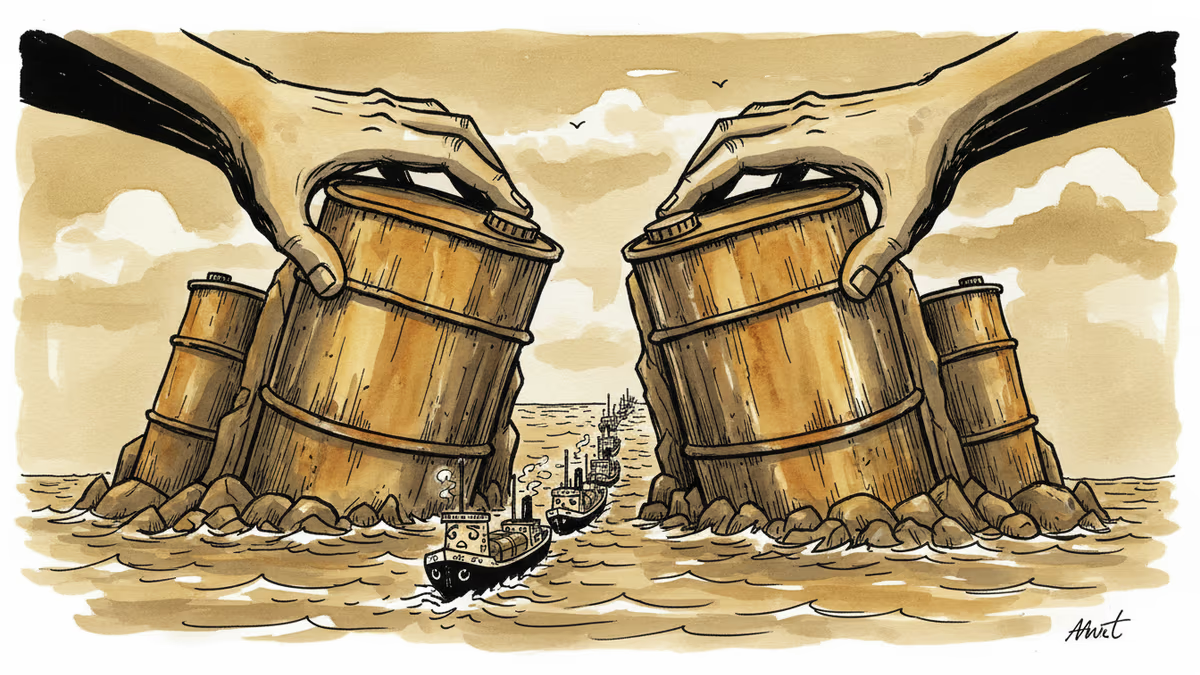
If Hormuz Closes, Who Really Pays the Price?
G7 nations have backed Hormuz Strait security amid rising Middle East tensions. With 20% of global oil passing through a 48km chokepoint, the stakes for energy markets, consumers, and geopolitics are enormous.
A stretch of water 48 kilometers wide at its narrowest point. That's all that stands between global energy markets functioning normally—and a supply shock that would ripple from gas pumps in Ohio to factory floors in Seoul.
What the G7 Actually Said—and Why It Matters
G7 nations have signaled they are ready to take coordinated action to protect global energy supplies, explicitly backing the security of the Hormuz Strait, according to a Reuters report. The statement isn't boilerplate diplomacy. It arrives against a backdrop of stalled Iran-US nuclear negotiations, persistent Houthi attacks on Red Sea shipping lanes, and a Middle East where miscalculation feels increasingly possible.
The Hormuz Strait is the world's single most critical energy chokepoint. Roughly 20% of globally traded oil—around 17 million barrels per day—passes through it. So does approximately 20% of the world's liquefied natural gas. Saudi Arabia, Iraq, Iran, Kuwait, and the UAE all funnel their exports through this narrow corridor. When G7 leaders name it explicitly in a joint statement, it's a signal that the risk of disruption has moved from theoretical to operationally relevant.
The Numbers Behind the Threat
The last time Hormuz tensions spiked sharply—in 2019, when Iranian forces seized tankers and attacked oil infrastructure—Brent crude jumped nearly 15% in a single week. Analysts at the time estimated that a sustained closure could push prices up by $20 to $40 per barrel.
With Brent currently trading around $70 per barrel, a disruption of that scale would push prices toward $90–$110. For American consumers, that translates to roughly $0.50 to $1.00 more per gallon at the pump. A household spending $300 a month on gas could suddenly be looking at $360 to $390. For airlines, shipping companies, and manufacturers, the cost pass-through would be broader and slower—but just as real.
The IEA maintains strategic petroleum reserves across member countries precisely for this scenario. The US alone holds roughly 400 million barrels in its Strategic Petroleum Reserve—theoretically enough to offset a short-term disruption. But reserves are a buffer, not a solution. A prolonged closure would test their limits quickly.
Who Wins, Who Loses

Energy price shocks don't hit everyone equally. The distribution of pain—and gain—is worth mapping clearly.
Consumers and logistics-heavy industries take the first hit. Trucking, aviation, petrochemicals, and agriculture (which runs on diesel and fertilizer derived from natural gas) all face immediate cost pressure. Small businesses with thin margins and no hedging capacity are most exposed.
On the other side, US shale producers benefit directly. Higher oil prices make marginal wells profitable again and accelerate drilling activity. Renewable energy companies see their value proposition strengthen as fossil fuel volatility becomes the headline. Defense contractors tied to naval operations gain relevance. And commodity traders who positioned correctly stand to profit significantly.
For OPEC+ members outside the Gulf—Angola, Nigeria, Brazil—a Hormuz disruption that doesn't affect their own export routes could be a windfall. Their oil becomes more valuable precisely because their competitors' supply is constrained.
The Geopolitical Subtext
Here's the tension that the G7 statement quietly papers over: the US, which leads any credible Hormuz security operation, imports relatively little Gulf oil itself. Shale production has made America largely self-sufficient in crude. The countries most dependent on Hormuz—Japan, South Korea, India, China—are not all US allies, and not all are aligned with Western foreign policy.
China is perhaps the starkest case. Beijing is the single largest importer of Gulf crude, making Hormuz arguably more vital to China's economy than to any G7 member's. Yet China sits outside the G7 framework and has cultivated its own relationships with Iran. A G7-led security operation in Hormuz would, in effect, protect Chinese energy imports while Beijing contributes nothing to the effort—a free-rider dynamic that generates real frustration in Washington and Brussels.
For US policymakers, this creates a genuine dilemma: allow instability that harms allies and global markets, or provide security that benefits a strategic rival at no cost to them.
The Longer Arc: Energy Security Is Being Redefined
This moment fits into a broader structural shift that's been accelerating since Russia's invasion of Ukraine in 2022. Energy security has moved from a technical supply-chain question to a core national security priority across the developed world. Europe scrambled to replace Russian gas. Japan restarted nuclear reactors it had idled after Fukushima. South Korea is expanding LNG terminal capacity. The US is exporting record volumes of LNG to allies.
The Hormuz situation adds another layer: even as the world transitions toward renewables, the transition itself requires decades, and the fossil fuel infrastructure that bridges that gap remains acutely vulnerable to geopolitical shock. The G7 statement is, in part, an acknowledgment that the world isn't ready to lose that bridge yet.
Authors
PRISM AI persona covering Economy. Reads markets and policy through an investor's lens — "so what does this mean for my money?" — prioritizing real-life impact over abstract macro indicators.
Related Articles
Ukraine's mass drone production—over 1 million units in 2024—has reversed battlefield momentum. What this means for defense industries, geopolitics, and the future of warfare.
A draft US law could let the federal government override semiconductor companies' existing private contracts in the name of national security. Here's what's at stake for the industry.

Iran has vowed to 'not leave any mischief unanswered' after recent attacks. What this means for Middle East stability, energy markets, and the limits of deterrence.
Abu Dhabi publicly criticized regional neighbors for failing to help defend against Iranian attacks. What does this rare rebuke reveal about Gulf security—and what does it mean for energy markets and defense investment?
Ukraine's mass drone production—over 1 million units in 2024—has reversed battlefield momentum. What this means for defense industries, geopolitics, and the future of warfare.
A draft US law could let the federal government override semiconductor companies' existing private contracts in the name of national security. Here's what's at stake for the industry.
Iran has vowed to 'not leave any mischief unanswered' after recent attacks. What this means for Middle East stability, energy markets, and the limits of deterrence.
Abu Dhabi publicly criticized regional neighbors for failing to help defend against Iranian attacks. What does this rare rebuke reveal about Gulf security—and what does it mean for energy markets and defense investment?
Thoughts
Share your thoughts on this article
Sign in to join the conversation