
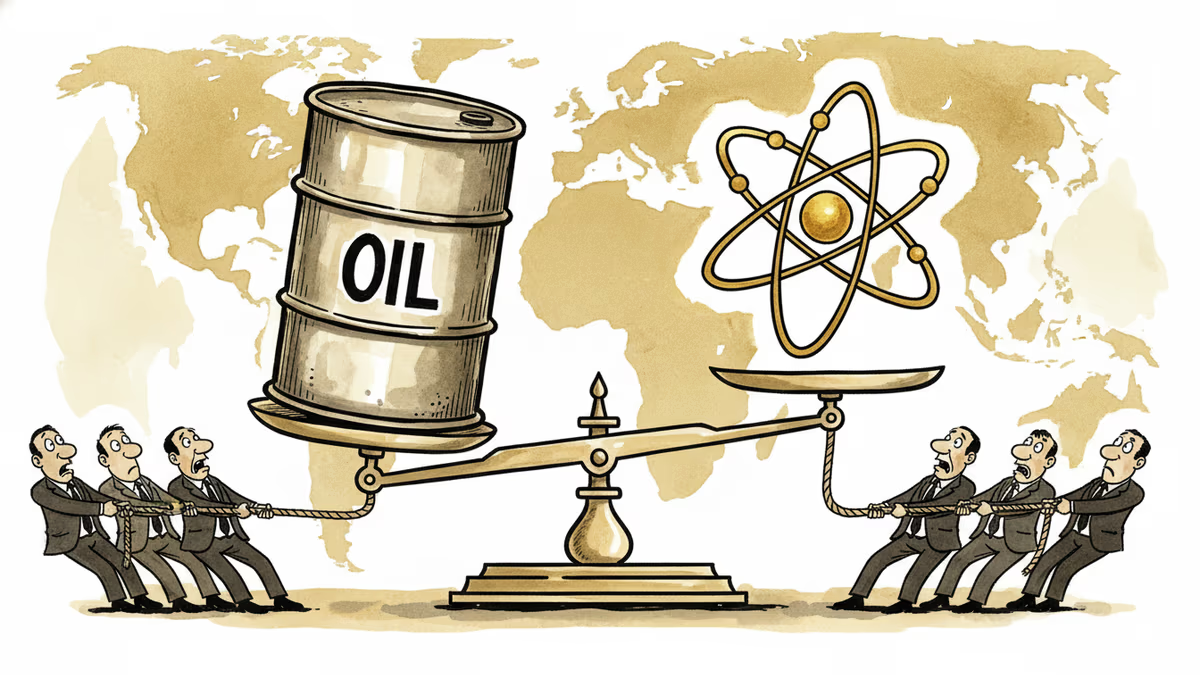
Iran Nuclear Deal Nears: Who Wins When Oil Gets Cheaper?
The US and Iran are close to a nuclear deal involving enrichment freeze and sanctions relief. Here's what it means for oil prices, energy markets, and your investments.
If Iranian oil floods back into global markets, the barrel price could drop by $10 or more. That's good news for airlines and consumers — and a serious headache for Riyadh and Houston.
What's on the Table
Axios reported that the United States and Iran are approaching a framework agreement that would pause Tehran's nuclear enrichment activities in exchange for significant relief from US sanctions. The contours of the deal echo the 2015 Joint Comprehensive Plan of Action (JCPOA) negotiated under the Obama administration — a landmark agreement that collapsed in 2018 when the first Trump administration withdrew unilaterally.
Since that withdrawal, Iran has steadily walked back its own commitments. Its uranium enrichment level now stands at roughly 60% purity — far beyond the 3.67% ceiling set by the original deal, though still short of the 90% threshold required for weapons-grade material. The gap between those numbers is where diplomats have been living for the better part of a decade.
What makes the current moment notable is the source of the overture. The second Trump administration, which entered office on a platform of maximum pressure against Tehran, is now the one sitting across the negotiating table. The shift reflects the severity of Iran's economic distress: sanctions have squeezed oil export revenues, foreign currency reserves are critically depleted, and domestic inflation is running above 40%.
What It Means for Oil Markets
Iran currently has the capacity to produce roughly 3 million barrels per day. Analysts estimate that sanctions relief could unlock an additional 1 to 1.5 million barrels per day of supply relatively quickly — a meaningful addition to a market that is already navigating OPEC+'s own production increases.

Brent crude has been trading in the mid-$60s per barrel in recent weeks. A confirmed deal could push prices lower, with energy analysts penciling in a short-term decline of $5 to $15 per barrel depending on the pace of Iranian re-entry. For context, every $10 drop in oil prices translates to roughly $100 billion in annual savings for oil-importing economies globally.
For consumers, the most visible effect would be at the gas pump. In the US, where retail gasoline prices track crude with a lag of roughly two to four weeks, a sustained oil price decline of that magnitude could shave 20 to 40 cents off the per-gallon price. For a household driving an average of 15,000 miles per year, that's a real, if modest, saving.
Winners, Losers, and the Fine Print
The clearest winners from cheaper oil are energy-intensive industries. Airlines, for which jet fuel typically accounts for 20 to 30% of operating costs, would see meaningful margin relief. Shipping, petrochemicals, and manufacturing all benefit from lower input costs. Emerging market economies that import oil — across South and Southeast Asia, sub-Saharan Africa, and Latin America — would get some breathing room on trade balances and inflation.
The losers are equally identifiable. Saudi Arabia and the broader OPEC+ bloc have been managing output carefully to defend prices. An Iranian supply surge disrupts that calculus and puts pressure on the cartel's cohesion. US shale producers, whose breakeven costs cluster around $50 to $60 per barrel, would face margin compression if prices fall to the lower end of analyst projections.
Then there are the political complications. Israel has been unambiguous: it will not accept any agreement that leaves Iran with a viable path to nuclear capability. Since the reported deal involves a moratorium rather than dismantlement, Jerusalem's opposition is likely to be vocal and potentially disruptive. Congressional hawks in Washington present a parallel obstacle to ratification or implementation. And within Iran itself, the perennial tension between pragmatists and hardliners has derailed negotiations at the final hour before.
| Factor | Pro-Deal Scenario | Deal Collapses |
|---|---|---|
| Oil Price Direction | Downward pressure, -$5 to -$15/bbl | Status quo or upward |
| OPEC+ Cohesion | Strained | Maintained |
| Iran Economy | Gradual stabilization | Continued contraction |
| Regional Security | Diplomatic de-escalation | Elevated tension |
| US Shale Margins | Compressed | Comfortable |
| Airline Stocks | Positive catalyst | Neutral |
This content is AI-generated based on source articles. While we strive for accuracy, errors may occur. We recommend verifying with the original source.
Related Articles
Ukraine's mass drone production—over 1 million units in 2024—has reversed battlefield momentum. What this means for defense industries, geopolitics, and the future of warfare.
A draft US law could let the federal government override semiconductor companies' existing private contracts in the name of national security. Here's what's at stake for the industry.

Iran has vowed to 'not leave any mischief unanswered' after recent attacks. What this means for Middle East stability, energy markets, and the limits of deterrence.
Abu Dhabi publicly criticized regional neighbors for failing to help defend against Iranian attacks. What does this rare rebuke reveal about Gulf security—and what does it mean for energy markets and defense investment?
Ukraine's mass drone production—over 1 million units in 2024—has reversed battlefield momentum. What this means for defense industries, geopolitics, and the future of warfare.
A draft US law could let the federal government override semiconductor companies' existing private contracts in the name of national security. Here's what's at stake for the industry.
Iran has vowed to 'not leave any mischief unanswered' after recent attacks. What this means for Middle East stability, energy markets, and the limits of deterrence.
Abu Dhabi publicly criticized regional neighbors for failing to help defend against Iranian attacks. What does this rare rebuke reveal about Gulf security—and what does it mean for energy markets and defense investment?
Thoughts
Share your thoughts on this article
Sign in to join the conversation