
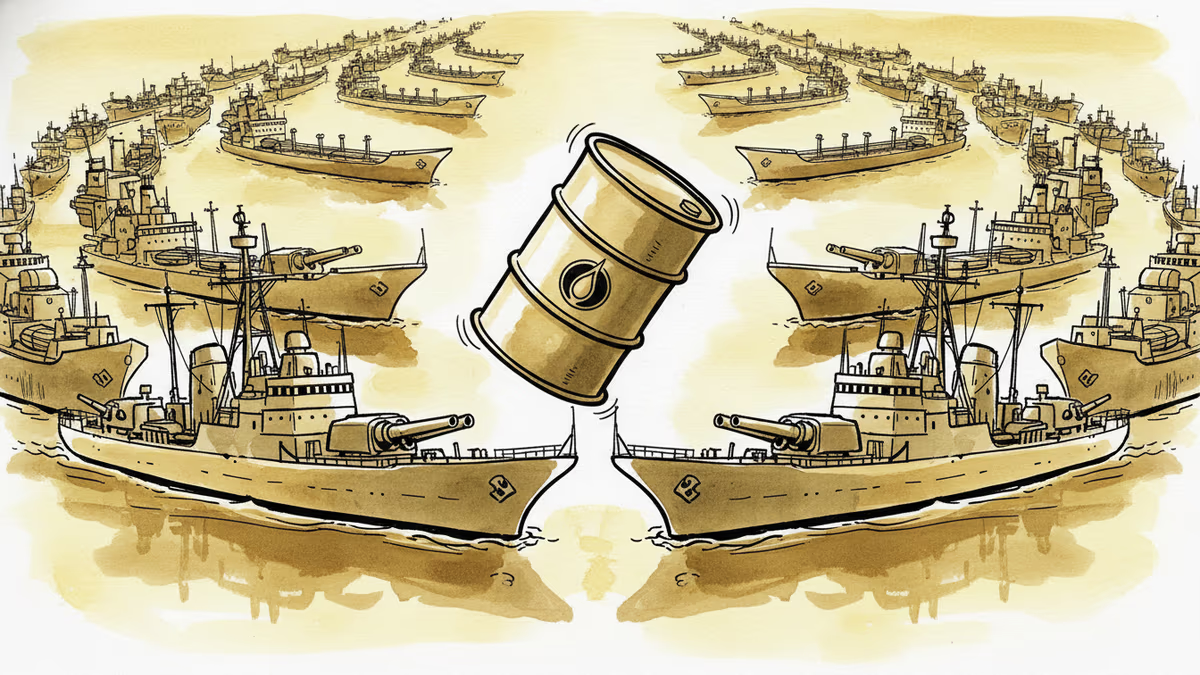
Guns in the Strait: What the US-Iran Skirmish Really Means
US and Iranian forces exchanged fire in the Strait of Hormuz during a commercial vessel escort mission. Here's why a brief clash in a 34km-wide waterway can shake global energy markets.
The world's most important 34 kilometers just got a little more dangerous.
US and Iranian forces exchanged fire in the Strait of Hormuz during a brief escort mission to shepherd commercial vessels through the waterway. No major casualties have been reported, and the confrontation was short-lived. But in a chokepoint where one-fifth of the world's oil supply transits every single day, even a skirmish carries weight that extends far beyond the Gulf.
The Narrowest Bottleneck in Global Trade
The Strait of Hormuz is, by almost any measure, the single most consequential stretch of water in the global economy. At its narrowest, it is just 34 kilometers wide. Through it flows roughly 17 million barrels of crude oil per day, plus approximately 25% of the world's liquefied natural gas trade. There is no alternative route. Unlike the Red Sea, where ships can divert around the Cape of Good Hope at significant cost, the Strait of Hormuz has no bypass. If it closes, it simply closes.
The countries most exposed are in Asia — Japan, South Korea, India, and China together account for the bulk of the Gulf's oil export destinations. But the price shock from a genuine closure would be global and near-instantaneous.
Why This Happened Now
The context matters as much as the incident itself. The Trump administration's return to a maximum-pressure posture on Iran has steadily ratcheted up tensions since early 2025. Washington reimposed sweeping oil sanctions with the stated goal of driving Iranian crude exports to zero. Tehran, for its part, has repeatedly threatened to close the strait as a countermeasure — a threat it has made before but never fully executed.

Layered on top of this is the residual instability from Houthi attacks on Red Sea shipping that began in late 2023. The US Navy has been running escort and deterrence operations across the broader region. For Iran, American warships operating in waters it considers its strategic backyard represent a provocation in their own right. The conditions for friction have been building for months.
What Markets Are Actually Pricing In
Oil markets responded to the news, though the move was tempered by countervailing forces: OPEC+ has been signaling production increases, and global demand forecasts have been revised downward amid trade war anxieties. The result is a market caught between geopolitical risk premium pushing prices up and macroeconomic headwinds pushing them down.
For energy traders and defense analysts, the more relevant question isn't today's price tick — it's the risk distribution. A brief exchange of fire is one thing. A sustained campaign of harassment against commercial shipping, or a formal blockade declaration, is another order of magnitude entirely. During the Red Sea crisis of 2023–2024, shipping insurance rates for the affected corridor surged by several hundred percent and some carriers rerouted entirely, adding 10–14 days to voyage times. Hormuz offers no such rerouting option.
The Stakeholder Map
The interests at play here don't align neatly. Washington wants to maintain freedom of navigation as a legal and strategic principle while squeezing Iran economically — two goals that create friction in the same waterway. Tehran needs leverage, and the strait is its most credible card, but actually playing that card would devastate its own oil revenues and invite a military response it cannot sustain. Riyadh and Abu Dhabi quietly depend on American naval presence to keep their own exports flowing, even as they publicly maintain diplomatic distance from US-Iran brinkmanship. Beijing, which imports more Gulf oil than anyone, has the most to lose from a closure but the least direct influence over the parties involved.
That structural misalignment — everyone with an interest in stability, but no shared mechanism to enforce it — is what makes the strait perpetually volatile.
This content is AI-generated based on source articles. While we strive for accuracy, errors may occur. We recommend verifying with the original source.
Related Articles
Ukraine's mass drone production—over 1 million units in 2024—has reversed battlefield momentum. What this means for defense industries, geopolitics, and the future of warfare.
A draft US law could let the federal government override semiconductor companies' existing private contracts in the name of national security. Here's what's at stake for the industry.
Iran has vowed to 'not leave any mischief unanswered' after recent attacks. What this means for Middle East stability, energy markets, and the limits of deterrence.
Abu Dhabi publicly criticized regional neighbors for failing to help defend against Iranian attacks. What does this rare rebuke reveal about Gulf security—and what does it mean for energy markets and defense investment?
Ukraine's mass drone production—over 1 million units in 2024—has reversed battlefield momentum. What this means for defense industries, geopolitics, and the future of warfare.
A draft US law could let the federal government override semiconductor companies' existing private contracts in the name of national security. Here's what's at stake for the industry.
Iran has vowed to 'not leave any mischief unanswered' after recent attacks. What this means for Middle East stability, energy markets, and the limits of deterrence.
Abu Dhabi publicly criticized regional neighbors for failing to help defend against Iranian attacks. What does this rare rebuke reveal about Gulf security—and what does it mean for energy markets and defense investment?
Thoughts
Share your thoughts on this article
Sign in to join the conversation