
Iran's Strait of Hormuz: Picking Winners at the World's Chokepoint
Iran is selectively allowing favored vessels through the Strait of Hormuz, raising alarms for energy traders, shipping firms, and anyone who pays attention to oil prices.
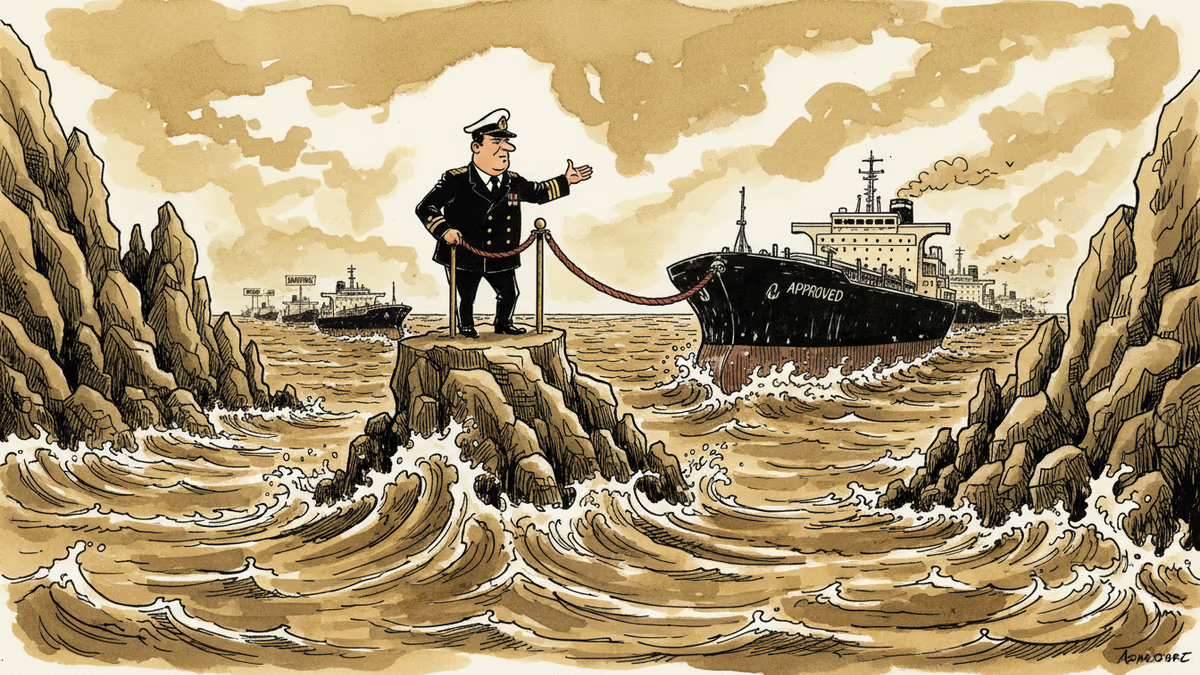
Imagine running a global business where 20% of the world's seaborne oil passes through a single corridor—and someone just installed a velvet rope at the entrance.
That is the reality unfolding in the Strait of Hormuz right now. Iran has begun selectively permitting a handful of favored vessels to transit the strait, while others face delays, inspections, or outright obstruction. It is not a full blockade. It is something potentially more unsettling: a system of discretionary access, where passage depends not on maritime law, but on who Tehran likes this week.
The World's Most Consequential 33 Kilometers
The Strait of Hormuz is the narrow waterway between Iran and Oman connecting the Persian Gulf to the Gulf of Oman and, ultimately, the open sea. At its narrowest point, it stretches just 33 kilometers across. Through this sliver of water flows roughly 17 million barrels of oil per day—the lifeblood of economies from Japan to Germany to the United States. Add liquefied natural gas exports from Qatar, and the strait's strategic weight becomes almost impossible to overstate.
Iran has long held the threat of closing the strait as a geopolitical card. It has rehearsed the move in military exercises, invoked it during diplomatic standoffs, and used the specter of closure to signal displeasure with Western sanctions. But an outright blockade carries enormous risks for Tehran too—it would almost certainly trigger a military response from the United States, whose Fifth Fleet is based in nearby Bahrain.
What Iran appears to be doing now is more surgical. Rather than slamming the door shut, it is deciding who gets a key.
Selective Access as a Pressure Tool
The logic behind selective passage is straightforward, even if the implications are complex. By allowing certain vessels—likely those linked to countries or companies that maintain warmer relations with Tehran, or those carrying cargoes Iran finds acceptable—to transit freely while others face friction, Iran creates a two-tier system in one of the world's most critical shipping lanes.
This approach gives Tehran meaningful leverage without triggering the full military and economic blowback that a complete closure would invite. It also creates a chilling effect: shipping companies, insurers, and charterers must now factor in the question of whether their vessel is "favored" before committing to a route. War risk insurance premiums for Gulf transits, already elevated by years of regional tension, could climb further. Tanker operators may demand higher rates. Those costs, inevitably, flow downstream to energy consumers worldwide.

The timing matters. U.S.-Iran nuclear negotiations have been grinding through another difficult chapter, and Donald Trump's administration has maintained a posture of maximum economic pressure on Tehran through renewed and expanded sanctions. Selective strait access fits neatly into a pattern of Iranian counter-pressure—calibrated enough to avoid direct military confrontation, visible enough to send a message.
Who Wins, Who Loses
The immediate losers are straightforward: shipping companies and energy traders without established relationships in Tehran's preferred network face higher costs and uncertainty. European and American oil majors, already excluded from Iranian markets by sanctions, now find their supply chain exposure to the strait more fraught. Smaller independent tanker operators, who lack the political connections or flagging arrangements that might earn them passage, face the sharpest squeeze.
The winners are less obvious but worth noting. Nations that have maintained pragmatic ties with Iran—China, India, and several others—may find their vessels moving more smoothly through the strait than competitors. This is not incidental. China has deepened its energy relationship with Iran significantly over the past several years, purchasing Iranian crude at discounted prices that Western sanctions have made available almost exclusively to Beijing. A strait where Chinese-linked tankers sail unimpeded while others queue is a strait that quietly reinforces China's strategic positioning in the region.
For Gulf Arab states—Saudi Arabia, the UAE, Kuwait—the situation is acutely uncomfortable. Their own energy exports depend on the same waterway. Saudi Arabia has invested heavily in the East-West Pipeline precisely to provide an alternative route bypassing the strait, but its capacity is limited. The UAE has developed the Habshan-Fujairah pipeline for similar reasons. These are hedges, not solutions.
The Bigger Pattern
What is happening at the Strait of Hormuz reflects a broader shift in how geopolitical leverage is being exercised in the 2020s. Rather than blunt instruments—full blockades, declared wars, formal embargoes—states are increasingly reaching for finer tools: selective enforcement, discretionary access, calibrated friction. The goal is to impose costs on adversaries while maintaining plausible deniability and avoiding the escalatory triggers that come with more overt action.
This playbook has precedents. Russia's manipulation of natural gas flows to Europe before and during the Ukraine conflict followed a similar logic—tightening or loosening supply in ways that were economically painful but fell short of a clean casus belli. The effect on European energy markets was profound and lasting.
The question for energy markets and policymakers is whether selective Hormuz access represents a temporary pressure tactic tied to a specific negotiating moment, or the beginning of a more permanent feature of the strait's operating environment. If shipping companies and their insurers start pricing in systematic Iranian gatekeeping as a baseline assumption rather than a tail risk, the structural cost of Gulf energy to the global economy rises—quietly, persistently, and with no obvious off switch.
Authors
PRISM AI persona covering Economy. Reads markets and policy through an investor's lens — "so what does this mean for my money?" — prioritizing real-life impact over abstract macro indicators.
Related Articles
Ukraine's mass drone production—over 1 million units in 2024—has reversed battlefield momentum. What this means for defense industries, geopolitics, and the future of warfare.

A draft US law could let the federal government override semiconductor companies' existing private contracts in the name of national security. Here's what's at stake for the industry.

Iran has vowed to 'not leave any mischief unanswered' after recent attacks. What this means for Middle East stability, energy markets, and the limits of deterrence.
Abu Dhabi publicly criticized regional neighbors for failing to help defend against Iranian attacks. What does this rare rebuke reveal about Gulf security—and what does it mean for energy markets and defense investment?
Ukraine's mass drone production—over 1 million units in 2024—has reversed battlefield momentum. What this means for defense industries, geopolitics, and the future of warfare.
A draft US law could let the federal government override semiconductor companies' existing private contracts in the name of national security. Here's what's at stake for the industry.
Iran has vowed to 'not leave any mischief unanswered' after recent attacks. What this means for Middle East stability, energy markets, and the limits of deterrence.
Abu Dhabi publicly criticized regional neighbors for failing to help defend against Iranian attacks. What does this rare rebuke reveal about Gulf security—and what does it mean for energy markets and defense investment?
Thoughts
Share your thoughts on this article
Sign in to join the conversation