
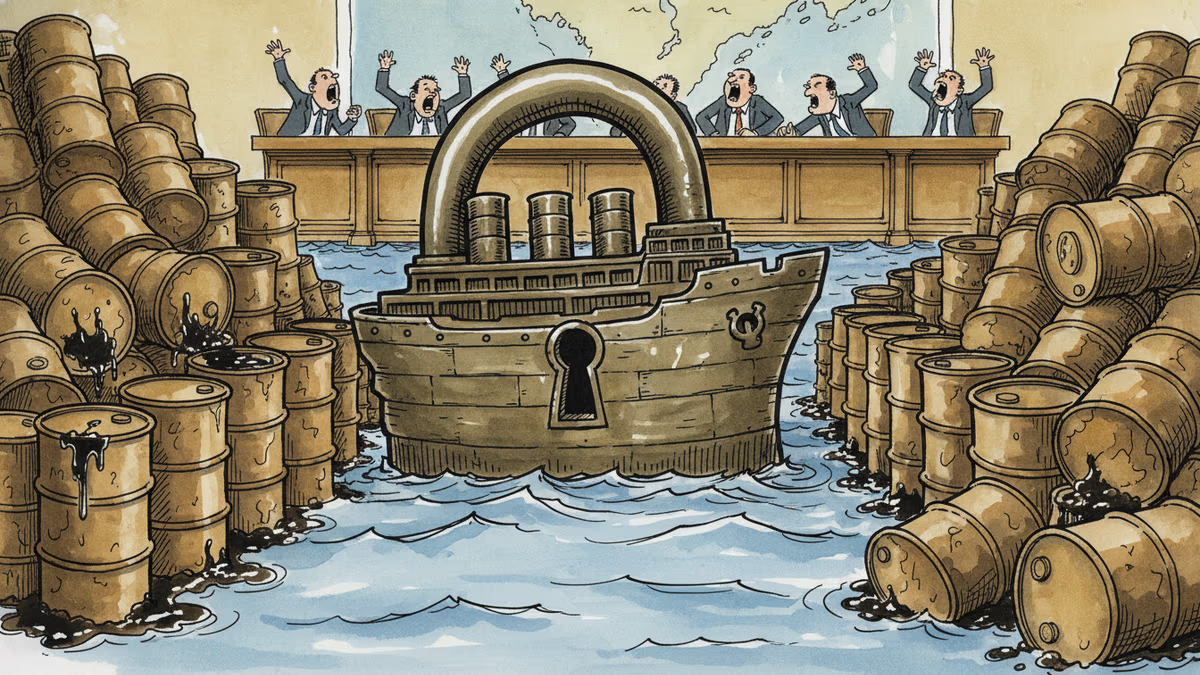
The Strait That Holds the World's Gas Prices Hostage
Washington and Tehran failed again to agree on terms to reopen the Strait of Hormuz. With 20% of global seaborne oil at stake, every day of deadlock has a price—and consumers are paying it.
The world's most important 34-kilometer stretch of water is still closed—and every failed negotiating session is worth roughly 3% on a barrel of crude.
What Happened, and Why It Matters Now
Talks between Washington and Tehran collapsed again this week without a deal. The gap is familiar: the US insists Iran freeze its nuclear program and halt support for regional proxy forces before any sanctions relief; Iran demands sanctions be lifted first. Neither side blinked. Brent crude jumped nearly 3% on the news, extending a rally that has already rattled energy markets for weeks.
The Strait of Hormuz is the chokepoint through which roughly 20 million barrels of oil pass every day—about one-fifth of all seaborne oil traded globally. Saudi Arabia, Iraq, UAE, Kuwait, and Iran itself all funnel exports through it. There is no quick alternative. The longest viable detour, around the southern tip of Africa, adds weeks to shipping times and hundreds of dollars per cargo to costs.
This isn't a background diplomatic story. It's a supply shock in slow motion.
Winners, Losers, and the Uncomfortable Middle
The beneficiaries of prolonged deadlock are easy to identify. US shale producers are quietly thriving. ExxonMobil and Chevron reported stronger-than-expected margins last quarter, and the math only improves as prices climb. Gulf states outside the strait—Saudi Arabia and the UAE—are also cashing in, redirecting buyers toward their own pipelines and ports.

The losers are spread wider. Asia bears the heaviest burden: Japan, South Korea, and India collectively import the majority of their crude from the Middle East, almost all of it through Hormuz. European refiners, already navigating post-Russia supply adjustments, face a second front of cost pressure. And at the end of the chain, consumers in every oil-importing economy are absorbing the hit at the pump and in rising freight costs on virtually everything they buy.
There's also an uncomfortable middle. Iran itself is caught in a bind of its own making. Yes, a blocked strait gives Tehran leverage—every uptick in global oil prices is a reminder of what's at stake. But Iran's own economy is cracking under the weight of sanctions and internal mismanagement. The rial has lost significant value, inflation is punishing ordinary Iranians, and hardliners who reject any compromise are making it politically dangerous for negotiators to move.
The Negotiation Trap
Here's the structural problem: the incentives to reach a deal are asymmetric, and not in the way most people assume.
For the US, a deal would lower energy prices—which is politically appealing domestically—but it would also hand Iran a sanctions lifeline and require difficult concessions on nuclear oversight. Meanwhile, American energy companies are doing just fine. The urgency to close a deal, measured in dollars and political capital, is lower in Washington than the rhetoric suggests.
For Iran, the calculus is equally tangled. Supreme Leader Khamenei's government can frame prolonged standoff as resistance against imperial pressure—a useful domestic narrative. But the economic pain is real and accumulating. The question isn't whether Iran wants relief; it's whether the political cost of accepting terms is lower than the economic cost of rejecting them. Right now, that calculation is on a knife's edge.
Meanwhile, the rest of the world—importers, shippers, airlines, manufacturers—waits with no seat at the table.
This content is AI-generated based on source articles. While we strive for accuracy, errors may occur. We recommend verifying with the original source.
Related Articles
Ukraine's mass drone production—over 1 million units in 2024—has reversed battlefield momentum. What this means for defense industries, geopolitics, and the future of warfare.
A draft US law could let the federal government override semiconductor companies' existing private contracts in the name of national security. Here's what's at stake for the industry.
Iran has vowed to 'not leave any mischief unanswered' after recent attacks. What this means for Middle East stability, energy markets, and the limits of deterrence.
Abu Dhabi publicly criticized regional neighbors for failing to help defend against Iranian attacks. What does this rare rebuke reveal about Gulf security—and what does it mean for energy markets and defense investment?
Ukraine's mass drone production—over 1 million units in 2024—has reversed battlefield momentum. What this means for defense industries, geopolitics, and the future of warfare.
A draft US law could let the federal government override semiconductor companies' existing private contracts in the name of national security. Here's what's at stake for the industry.
Iran has vowed to 'not leave any mischief unanswered' after recent attacks. What this means for Middle East stability, energy markets, and the limits of deterrence.
Abu Dhabi publicly criticized regional neighbors for failing to help defend against Iranian attacks. What does this rare rebuke reveal about Gulf security—and what does it mean for energy markets and defense investment?
Thoughts
Share your thoughts on this article
Sign in to join the conversation