
Iran Fired First. Now What?
The US launched strikes on Iran after Tehran attacked American destroyers. What triggered the escalation, who stands to lose, and where does this go from here?
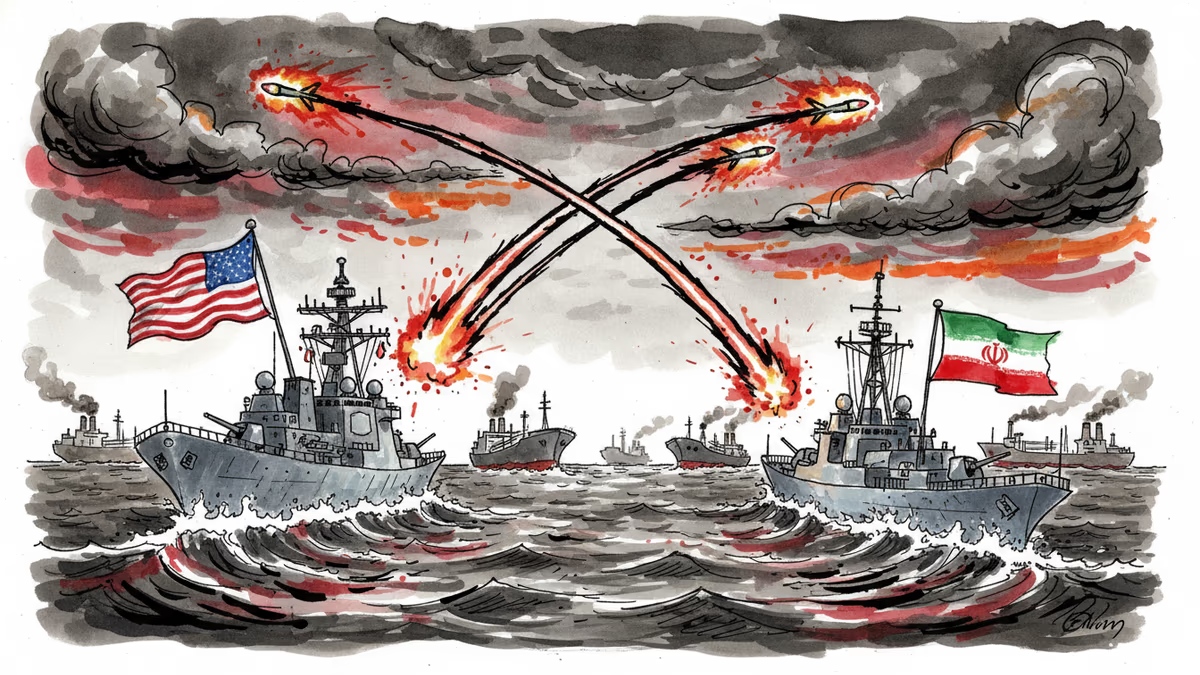
The last time American destroyers came under direct fire from a state actor, it was 1988. Now it's happened again—and Washington didn't wait long to respond.
The United States has confirmed it carried out military strikes against Iran following what it describes as a direct Iranian attack on American naval destroyers. Washington says Tehran fired first. The strikes mark one of the most significant direct military confrontations between the two countries in decades, raising immediate questions about what comes next—for the region, for oil markets, and for a world already stretched thin by overlapping crises.
What We Know: Destroyers, Strikes, and a Contested Narrative
According to the US Defense Department, Iranian forces launched an attack on American destroyer-class warships operating in the region. Washington's response was swift: strikes on Iranian targets, justified under the right of self-defense. The administration has framed the sequence clearly—Iran attacked, America responded.
Tehran has not yet confirmed the same sequence of events. Iranian state media, as is typical in such confrontations, is likely to offer a competing account of who provoked whom and when. That gap in the official record matters enormously, because in a conflict where both sides have domestic audiences to manage and international coalitions to hold together, narrative control is as strategically important as the strikes themselves.
What is not in dispute: American naval vessels were targeted, and the United States has now conducted offensive military operations against Iranian soil or Iranian-linked assets. That is a threshold that has not been formally crossed in this manner for a very long time.
Why Now—and Why This Matters Beyond the Headlines
The timing is not incidental. Iran has spent the better part of two years watching its regional proxy network—Hezbollah in Lebanon, Hamas in Gaza, Houthi forces in Yemen—absorb significant military pressure from Israel and, indirectly, from American support for Israeli operations. Tehran's strategic depth has been eroding. A direct strike on US naval assets could reflect frustration, a miscalculation, or a deliberate decision to raise the stakes before a negotiated settlement becomes unavoidable.

On the American side, the decision to strike back immediately rather than pursue a diplomatic channel first signals a posture of deterrence-through-action. Whether that posture stabilizes the situation or accelerates it depends almost entirely on what Iran does in the next 48 to 72 hours.
For energy markets, the implications are already being felt. The Strait of Hormuz—through which roughly 20% of the world's traded oil passes—runs directly through the geography of this confrontation. Any sustained military exchange that threatens tanker traffic there doesn't just spike oil prices; it disrupts supply chains across Asia, Europe, and beyond. Consumers who are already managing elevated energy costs will feel a direct line between geopolitical decisions made in Washington and Tehran and the price at the pump.
Three Stakeholders, Three Very Different Problems
The Gulf states find themselves in an acutely uncomfortable position. Saudi Arabia and the UAE have spent years carefully managing relationships with both Washington and Tehran, pursuing economic diversification that requires regional stability. A hot war between the US and Iran is their worst-case scenario—not because they sympathize with Tehran, but because instability in the Gulf is existential for economies built on energy exports and foreign investment.
China is watching with a calculation that goes beyond the immediate military exchange. Beijing has positioned itself as a mediator in the region—it brokered the Saudi-Iran normalization agreement in 2023—and a full-scale US-Iran confrontation would test that role severely. It also complicates China's energy security, given its deep dependence on Gulf oil. Beijing has every incentive to push for de-escalation, but limited leverage over Tehran's military decision-making.
European governments face the familiar dilemma of being close American allies who have nonetheless spent years trying to preserve the diplomatic architecture around Iran's nuclear program. If this confrontation expands, the JCPOA framework—already on life support—becomes effectively irrelevant, and Europe loses whatever remaining influence it held as a diplomatic interlocutor.
The Question No One Can Answer Yet
The hardest problem in any military escalation between the US and Iran isn't the first exchange—it's the second and third. Both sides have historically shown a capacity to absorb limited confrontations without going to full war. The 2020 killing of Qasem Soleimani and Iran's subsequent missile strikes on Iraqi bases housing US troops followed that pattern: escalation, then a mutual decision to step back from the brink.
But patterns break. The variables that determined restraint in 2020 are not identical to the variables in 2026. Iran's internal political situation, the state of its economy under sanctions, and the condition of its regional proxy network are all different. So is the American political context.
This content is AI-generated based on source articles. While we strive for accuracy, errors may occur. We recommend verifying with the original source.
Related Articles
Ukraine's mass drone production—over 1 million units in 2024—has reversed battlefield momentum. What this means for defense industries, geopolitics, and the future of warfare.
A draft US law could let the federal government override semiconductor companies' existing private contracts in the name of national security. Here's what's at stake for the industry.
Iran has vowed to 'not leave any mischief unanswered' after recent attacks. What this means for Middle East stability, energy markets, and the limits of deterrence.
Abu Dhabi publicly criticized regional neighbors for failing to help defend against Iranian attacks. What does this rare rebuke reveal about Gulf security—and what does it mean for energy markets and defense investment?
Ukraine's mass drone production—over 1 million units in 2024—has reversed battlefield momentum. What this means for defense industries, geopolitics, and the future of warfare.
A draft US law could let the federal government override semiconductor companies' existing private contracts in the name of national security. Here's what's at stake for the industry.
Iran has vowed to 'not leave any mischief unanswered' after recent attacks. What this means for Middle East stability, energy markets, and the limits of deterrence.
Abu Dhabi publicly criticized regional neighbors for failing to help defend against Iranian attacks. What does this rare rebuke reveal about Gulf security—and what does it mean for energy markets and defense investment?
Thoughts
Share your thoughts on this article
Sign in to join the conversation