
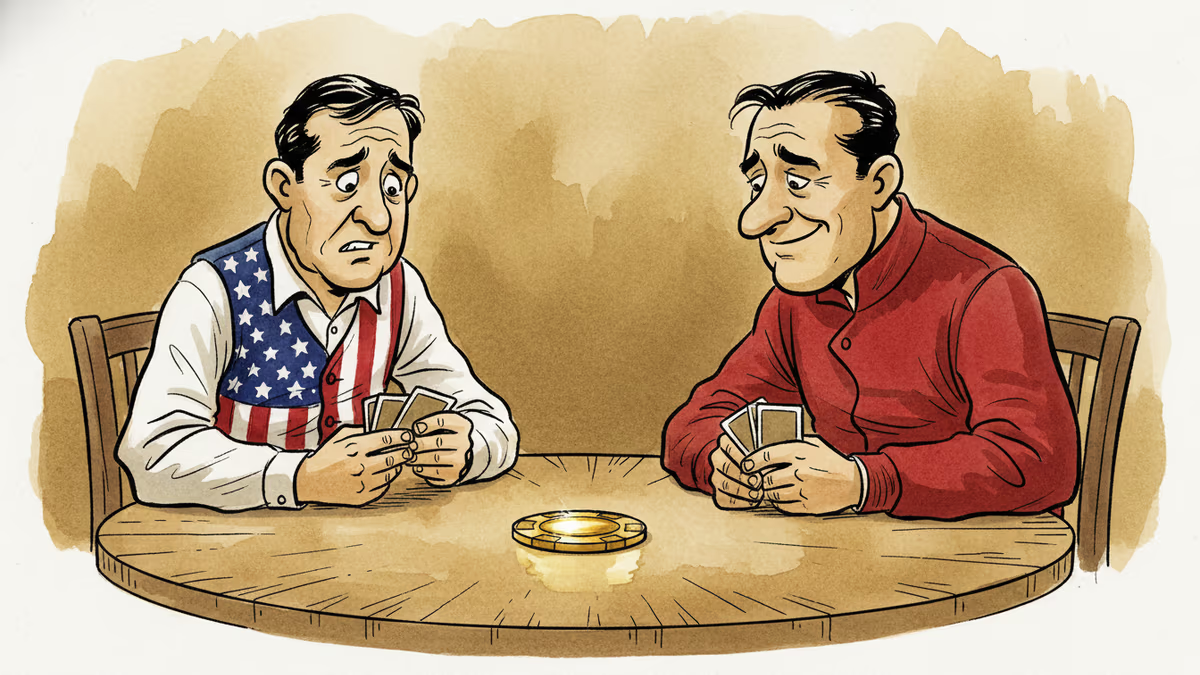
America Lost Its Cards. China's Afraid to Say So.
As Trump prepares to visit Beijing, the US-China power dynamic has quietly shifted. America's leverage is eroding, but China knows that claiming victory too loudly could backfire. A deep dive into the new balance of power.
The most dangerous moment at a negotiating table isn't when one side runs out of cards. It's when the other side notices.
That's where Washington and Beijing find themselves as Trump prepares to visit the Chinese capital. On the surface, it's a diplomatic milestone. Beneath it, something more consequential is unfolding: American leverage is eroding faster than it's being replaced, and China is carefully avoiding the temptation to say so out loud.
What America Has Lost
For decades, US negotiating power over China rested on three pillars: the world's largest consumer market as a carrot, dollar-based financial sanctions as a stick, and a network of allies to amplify both.
All three are wobbling simultaneously.
The tariff strategy that was supposed to punish China has landed awkwardly at home. At 145% average tariffs on Chinese goods, American companies from Apple to Walmart are absorbing costs, raising prices, or watching margins shrink. The Congressional Budget Office estimates the tariff burden functions as a tax increase of roughly $1,200 per American household annually. The weapon was aimed at Beijing but is landing in Des Moines.
Financial sanctions, once near-absolute in their power, have lost some of their edge. The aggressive use of dollar weaponization after Russia's 2022 invasion accelerated a quiet diversification away from dollar dependency. China has steadily expanded yuan-denominated trade networks across the Middle East, Southeast Asia, and Africa. The share of global trade settled in dollars has declined from roughly 50% in 2015 to around 47% by 2024 — a modest shift that nonetheless signals a direction of travel.
The alliance front has fractured. Trump's sweeping tariffs didn't distinguish between adversaries and partners. The EU, Canada, Japan, and South Korea all found themselves in the crossfire. Building a coalition to contain China requires allied trust — and that trust has been strained by the same administration trying to build the coalition.
Why China Isn't Celebrating
None of this means Beijing is in a comfortable position. China's calculus is considerably more complicated than it appears from the outside.

The Chinese economy is navigating its own structural headwinds. The property sector — which once accounted for roughly 25% of GDP when related industries are included — remains in prolonged distress. Youth unemployment has hovered near 20%. Deflationary pressure has persisted despite stimulus. Domestic consumption has underperformed expectations year after year.
Exports have been the pressure valve. China's goods exports to the US totaled approximately $500 billion in 2023. Losing meaningful access to that market isn't an abstraction — it's a direct hit to the manufacturing employment base that underpins social stability.
There's also what might be called the paradox of visible victory. If the global narrative solidifies around China having forced America to the table on unfavorable terms, it doesn't weaken American resolve — it inflames it. No US president can survive the domestic political optics of having "lost to China." Beijing understands that humiliating Washington publicly would harden the very opposition it's trying to soften. The goal isn't triumph. It's a durable arrangement that lets both sides claim they won.
So China's strategy has been calibrated pressure without escalation: restricting rare earth exports, reducing purchases of American agricultural products, pausing Boeing orders. Cards played visibly enough to signal capability, quietly enough to avoid triggering an irreversible rupture.
The Scorecard
| Dimension | United States | China |
|---|---|---|
| Primary leverage | Market access, financial sanctions (weakening) | Supply chains, rare earths, US Treasury holdings |
| Domestic pressure | Inflation, midterm political cycle | Property crisis, youth unemployment |
| Alliance position | Strained (EU, Japan friction) | Expanding (Global South) |
| Negotiating goal | Reduce trade deficit, preserve tech supremacy | Tariff removal, ease tech restrictions |
| Time horizon | Short-term pressure advantage, long-term disadvantage | Willing to absorb short-term pain |
Why This Moment Is Different
The timing of Trump's Beijing visit isn't incidental. The 2026 midterm elections are close enough that tariff-driven inflation is becoming a live political liability. A negotiated outcome — any outcome that can be packaged as a win — has real domestic value for the administration.
Xi Jinping faces his own internal pressures. Party legitimacy is increasingly tied to economic performance, and a prolonged trade war that visibly damages growth creates uncomfortable questions about strategic judgment.
Both leaders need a deal they can sell at home. That shared need is, paradoxically, the most stabilizing force in the relationship right now — and the most likely source of a cosmetic agreement that changes the numbers without changing the structure.
History is instructive here. The 2020 Phase One trade deal required China to purchase an additional $200 billion in US goods over two years. Actual compliance reached roughly 60% of targets. The deal was announced with fanfare, quietly underperformed, and the structural issues — technology transfer, subsidies, market access — were left entirely unresolved. Both sides called it a success.
For businesses and policymakers watching from outside the bilateral, the key question isn't whether a deal gets announced. It's whether the deal addresses any of the underlying architecture: semiconductor export controls, investment screening, the treatment of Chinese firms on US exchanges. Those structural questions have been conspicuously absent from the pre-visit diplomatic signaling.
This content is AI-generated based on source articles. While we strive for accuracy, errors may occur. We recommend verifying with the original source.
Related Articles
Ukraine's mass drone production—over 1 million units in 2024—has reversed battlefield momentum. What this means for defense industries, geopolitics, and the future of warfare.
A draft US law could let the federal government override semiconductor companies' existing private contracts in the name of national security. Here's what's at stake for the industry.
Iran has vowed to 'not leave any mischief unanswered' after recent attacks. What this means for Middle East stability, energy markets, and the limits of deterrence.
Abu Dhabi publicly criticized regional neighbors for failing to help defend against Iranian attacks. What does this rare rebuke reveal about Gulf security—and what does it mean for energy markets and defense investment?
Ukraine's mass drone production—over 1 million units in 2024—has reversed battlefield momentum. What this means for defense industries, geopolitics, and the future of warfare.
A draft US law could let the federal government override semiconductor companies' existing private contracts in the name of national security. Here's what's at stake for the industry.
Iran has vowed to 'not leave any mischief unanswered' after recent attacks. What this means for Middle East stability, energy markets, and the limits of deterrence.
Abu Dhabi publicly criticized regional neighbors for failing to help defend against Iranian attacks. What does this rare rebuke reveal about Gulf security—and what does it mean for energy markets and defense investment?
Thoughts
Share your thoughts on this article
Sign in to join the conversation