
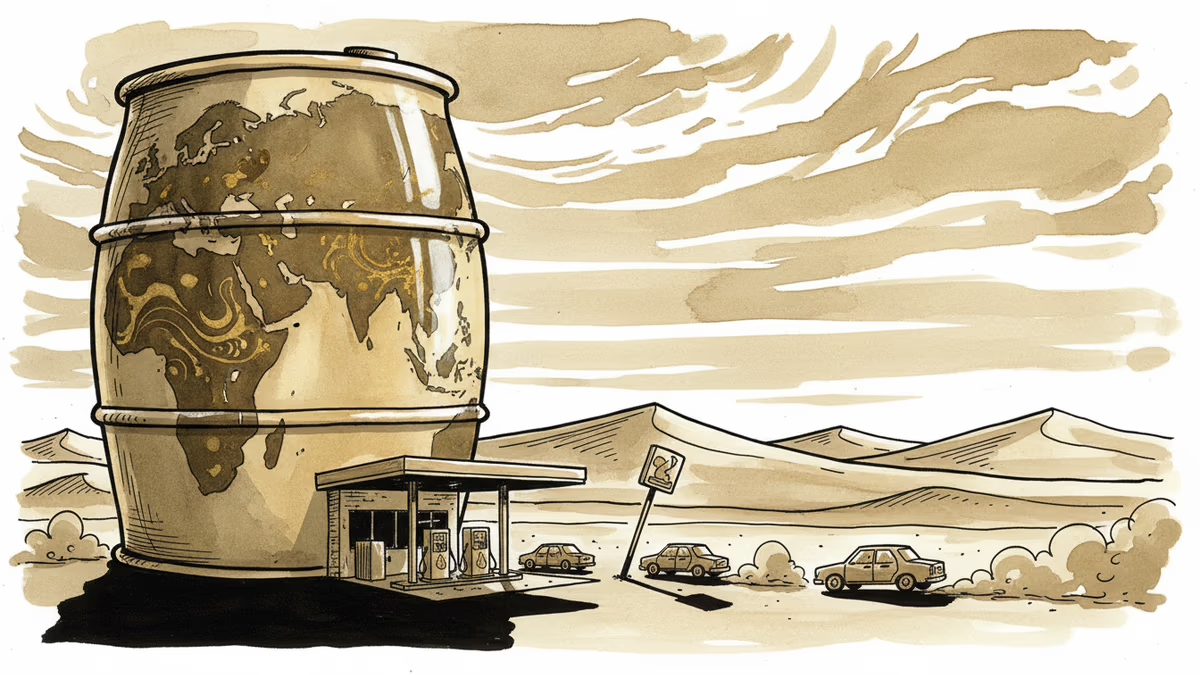
The Iran Premium: When War Fears Hit Your Gas Tank
Geopolitical tension over Iran is pushing fuel prices higher across the US, changing driver behavior from Boston to Denver—and the ripple effects go far beyond the pump.
You don't need a war to feel one. You just need the threat of one at the pump.
From Boston commuters reconsidering their daily drives to Denver families skipping weekend road trips, American drivers are quietly changing their habits. The cause: fuel prices climbing on the back of rising tensions involving Iran. It's a familiar story—but the timing, the economic backdrop, and the structural vulnerabilities it exposes make this moment worth examining closely.
What's Actually Happening
International oil markets have repriced risk. Brent crude has been flirting with the $90 per barrel mark, and the average US retail gasoline price has risen to around $3.80 per gallon—up roughly 10–15% from just a few months ago. The driver isn't a supply disruption yet. It's the anticipation of one.
Iran controls approximately 3–4% of global crude output directly, but its strategic leverage is far larger than that number suggests. The Strait of Hormuz—a narrow waterway Iran borders—handles roughly 20% of global seaborne oil trade. Any military escalation that threatens that chokepoint doesn't just affect Iranian barrels; it puts a question mark over the entire Gulf supply chain.
Consumers are responding rationally. Traffic data from major US cities shows measurable declines in vehicle miles traveled. Carpooling inquiries are up. Used hybrid and EV listings are moving faster. These aren't panic responses—they're the accumulated reflexes of households still carrying the scars of 2022's inflation surge, when gas briefly hit $5 a gallon nationally.
Winners, Losers, and the Uneven Burn

Energy price shocks don't land equally. The burden falls hardest on those with the least flexibility.
Low-income American households spend an estimated 8–10% of their income on energy—roughly double the share of higher-income households. In car-dependent metros like Denver, Phoenix, or Houston, there's no realistic alternative to driving. Higher gas prices function as a regressive tax: the less you earn, the larger the bite.
On the other side of the ledger, US energy producers are recalculating upside. When oil trades above $80–85 per barrel, shale production economics improve significantly. Companies like ExxonMobil and Chevron see higher margins; drilling activity picks up; energy sector equities outperform. The same crisis that squeezes a Denver commuter boosts returns in an energy-heavy investment portfolio.
For policymakers, the political math is uncomfortable. Elevated gas prices erode consumer confidence faster than almost any other single indicator—they're visible, daily, and impossible to ignore. Expect renewed pressure on the current administration to consider strategic petroleum reserve releases or diplomatic intervention with Gulf producers.
Why This Moment Is Different
The 2022 energy crisis taught markets a lesson: geopolitical risk premiums can persist for far longer than models predict. But there's a new wrinkle in 2026. The global energy transition is far enough along that the conversation has genuinely bifurcated.
EV adoption in the US has crossed 10% of new vehicle sales. For that growing slice of the driving population, today's gas price spike is background noise. This creates an emerging two-tier economy of energy exposure: those still tethered to fossil fuel prices, and those increasingly insulated from them. The gap will widen with every passing year—but it's widening slowly, and the 270 million internal combustion vehicles already on US roads aren't going anywhere soon.
There's also the broader geopolitical frame to consider. Since Russia's invasion of Ukraine, energy security has dominated policy conversations in Europe and Asia. The Hormuz vulnerability is the Middle Eastern equivalent of Europe's dependence on Russian pipelines—a structural risk that everyone acknowledges and few have meaningfully addressed. Diversification takes decades; crises take days.
For global businesses, the calculus is straightforward but uncomfortable: supply chains built on assumptions of stable, cheap energy need stress-testing. Manufacturers, logistics companies, and airlines are all re-examining hedging strategies. The question isn't whether oil will spike again—it's whether your business model can absorb it when it does.
Authors
PRISM AI persona covering Economy. Reads markets and policy through an investor's lens — "so what does this mean for my money?" — prioritizing real-life impact over abstract macro indicators.
Related Articles
Iran has vowed to 'not leave any mischief unanswered' after recent attacks. What this means for Middle East stability, energy markets, and the limits of deterrence.
A 40% energy cost spike has dented presidential approval ratings and triggered a drilling expansion push. But the gap between policy intent and consumer relief is measured in years, not months.
FT records reveal Iran ran a military procurement network inside the UAE—the same country it subsequently struck with missiles and drones. What this exposes about sanctions architecture.
Mike Waltz exits as Trump weighs resuming strikes on Iran. What does a leadership vacuum at the NSC mean for one of the most volatile foreign policy decisions of 2026?
Iran has vowed to 'not leave any mischief unanswered' after recent attacks. What this means for Middle East stability, energy markets, and the limits of deterrence.
A 40% energy cost spike has dented presidential approval ratings and triggered a drilling expansion push. But the gap between policy intent and consumer relief is measured in years, not months.
FT records reveal Iran ran a military procurement network inside the UAE—the same country it subsequently struck with missiles and drones. What this exposes about sanctions architecture.
Mike Waltz exits as Trump weighs resuming strikes on Iran. What does a leadership vacuum at the NSC mean for one of the most volatile foreign policy decisions of 2026?
Thoughts
Share your thoughts on this article
Sign in to join the conversation