
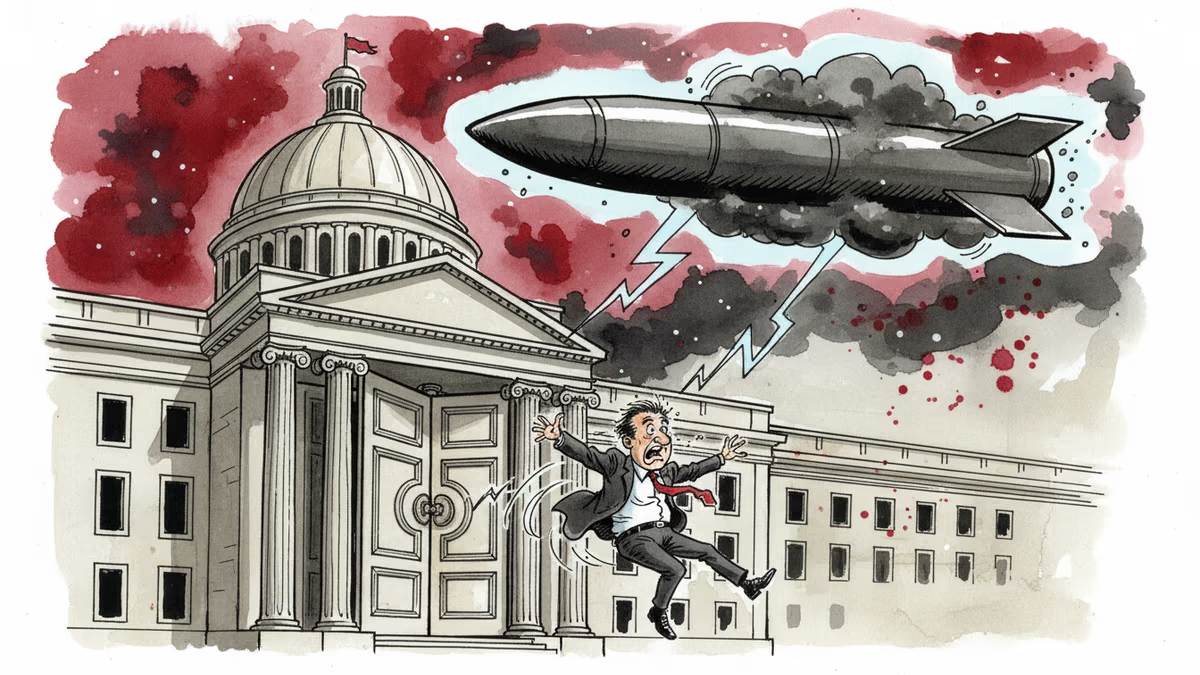
The National Security Adviser Who Left at the Wrong Moment
Mike Waltz exits as Trump weighs resuming strikes on Iran. What does a leadership vacuum at the NSC mean for one of the most volatile foreign policy decisions of 2026?
The last person you want to lose when deciding whether to bomb a country is the person whose job it is to coordinate that decision.
Mike Waltz, the U.S. National Security Adviser, has departed his post — and the timing could hardly be more consequential. According to sources familiar with the matter, President Trump is actively weighing whether to resume military strikes against Iran, even as diplomatic back-channels remain fragile and negotiations over Tehran's nuclear program sit at an unresolved crossroads.
The Man Who Left, and the Moment He Left In
Waltz, a former Army Green Beret and Florida congressman, was one of the more hawkish voices in Trump's inner circle on Iran. His departure — framed publicly as a transition rather than a firing — follows a turbulent stretch inside the National Security Council, including the fallout from the so-called "Signalgate" episode earlier this year, in which sensitive military planning discussions were inadvertently shared in a group chat that included a journalist.
That incident damaged Waltz's standing with the president, according to people close to the White House. But his exit now, at precisely the moment Iran policy reaches an inflection point, strips the administration of institutional continuity at the NSC — the body responsible for integrating intelligence, military options, and diplomatic strategy into coherent advice for the president.
The NSC is not a department with a clear deputy who simply steps up. It is, by design, built around the personal relationship between the adviser and the president. A vacancy there is not a bureaucratic inconvenience. It is a gap in the architecture of decision-making itself.
The Iran Equation: Diplomacy or Strikes?
The backdrop makes Waltz's departure especially significant. Trump entered his second term with a stated preference for a negotiated deal over military action on Iran — a posture that surprised many analysts given his 2018 withdrawal from the JCPOA and the 2020 killing of General Qasem Soleimani. Special Envoy Steve Witkoff has been leading indirect talks with Iranian officials, with three rounds of negotiations reported since March 2026.
But those talks have stalled over the central question of uranium enrichment. Iran currently enriches uranium to 60% purity — well above the 3.67% cap set under the original 2015 deal, and uncomfortably close to the 90% weapons-grade threshold. Tehran insists it will not dismantle its enrichment infrastructure. Washington insists it must. Neither side has moved significantly.

Meanwhile, Israel — which has carried out its own strikes on Iranian facilities — is pressing Washington not to accept a weak deal. The Israeli government's position, communicated directly to senior U.S. officials, is that any agreement that leaves Iran's enrichment capacity intact is functionally worthless.
It is against this backdrop — a stalled negotiation, an impatient ally, and an unpredictable president — that the national security adviser's chair sits empty.
Who Gains, Who Worries
The departure reshapes the internal balance of the foreign policy apparatus in ways that matter. Waltz was considered a restraining force on some of the more impulsive options under discussion. His exit potentially elevates the influence of figures more aligned with a harder line — including voices from the Pentagon and from outside the formal NSC structure who have the president's ear informally.
For Iran, the signal is ambiguous. A leadership change at the NSC could mean the diplomatic track loses its internal champion. Or it could mean nothing — Trump has shown a consistent willingness to override his own advisers regardless of who holds the title.
For U.S. allies in the Gulf, particularly Saudi Arabia and the UAE, the concern is different: unpredictability. Both countries have made significant economic bets on regional stability, and the prospect of a sudden escalation — decided without the usual interagency process — is precisely the scenario their own security planners fear most.
For Congress, the vacancy raises a procedural question that has lingered since the first Trump term: how much oversight can legislators exercise over a national security process that is increasingly informal, personality-driven, and resistant to traditional institutional checks?
The Broader Pattern
This is not the first time a senior national security official has exited the Trump orbit at a moment of acute crisis. The churn at the NSC — across both Trump terms — has been documented extensively. Four national security advisers served during Trump's first term alone. The institutional memory that career officials provide has been repeatedly disrupted.
What makes this moment different is the specific nature of the decision on the table. Strikes on Iran would not be a limited tactical operation. They would carry the real possibility of regional escalation, involving Hezbollah, Houthi forces, and potentially direct Iranian retaliation against U.S. assets in Iraq, Syria, and the Gulf. The decision architecture around such a choice — the red teams, the second-order consequence modeling, the legal reviews — requires exactly the kind of sustained, experienced leadership that a vacant NSC chair cannot provide.
The administration will name a successor. The process will continue. But the question of whether the right conversations are happening, with the right people, in the right sequence — that is harder to answer from the outside.
This content is AI-generated based on source articles. While we strive for accuracy, errors may occur. We recommend verifying with the original source.
Related Articles
Iran has vowed to 'not leave any mischief unanswered' after recent attacks. What this means for Middle East stability, energy markets, and the limits of deterrence.
Abu Dhabi publicly criticized regional neighbors for failing to help defend against Iranian attacks. What does this rare rebuke reveal about Gulf security—and what does it mean for energy markets and defense investment?
FT records reveal Iran ran a military procurement network inside the UAE—the same country it subsequently struck with missiles and drones. What this exposes about sanctions architecture.
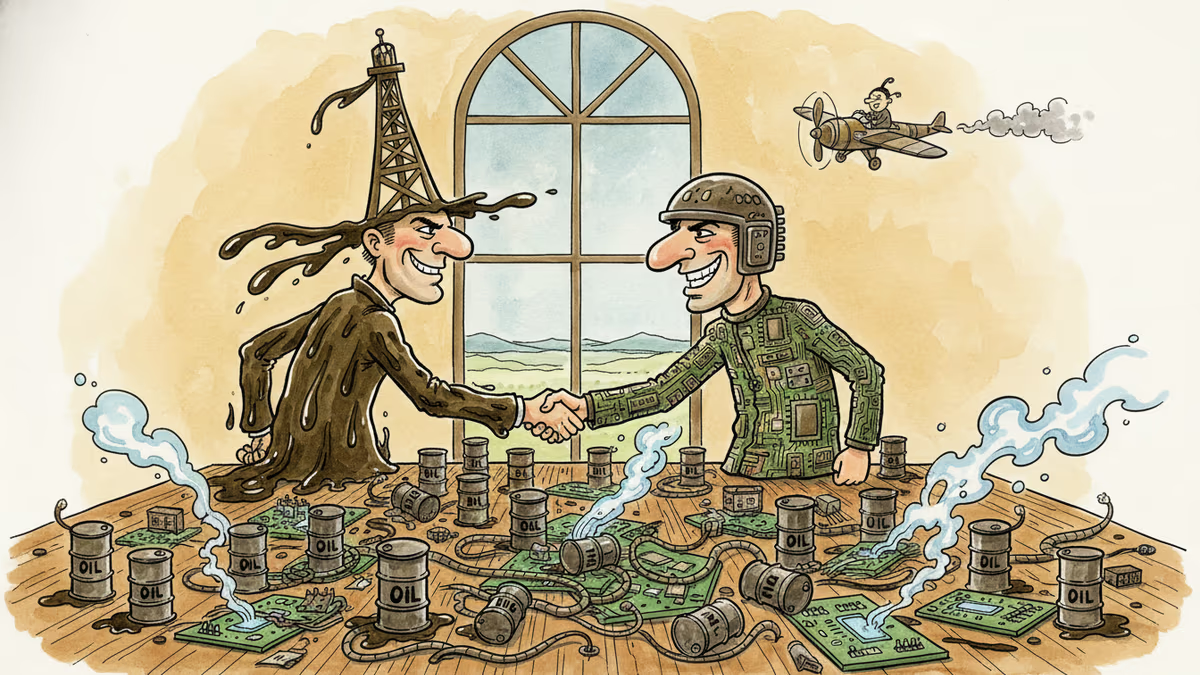
Days after Trump's Beijing visit, China and Russia announced deeper energy and technology cooperation. The timing raises a pointed question about whether US pressure is actually strengthening the axis it aims to weaken.
Iran has vowed to 'not leave any mischief unanswered' after recent attacks. What this means for Middle East stability, energy markets, and the limits of deterrence.
Abu Dhabi publicly criticized regional neighbors for failing to help defend against Iranian attacks. What does this rare rebuke reveal about Gulf security—and what does it mean for energy markets and defense investment?
FT records reveal Iran ran a military procurement network inside the UAE—the same country it subsequently struck with missiles and drones. What this exposes about sanctions architecture.
Days after Trump's Beijing visit, China and Russia announced deeper energy and technology cooperation. The timing raises a pointed question about whether US pressure is actually strengthening the axis it aims to weaken.
Thoughts
Share your thoughts on this article
Sign in to join the conversation