
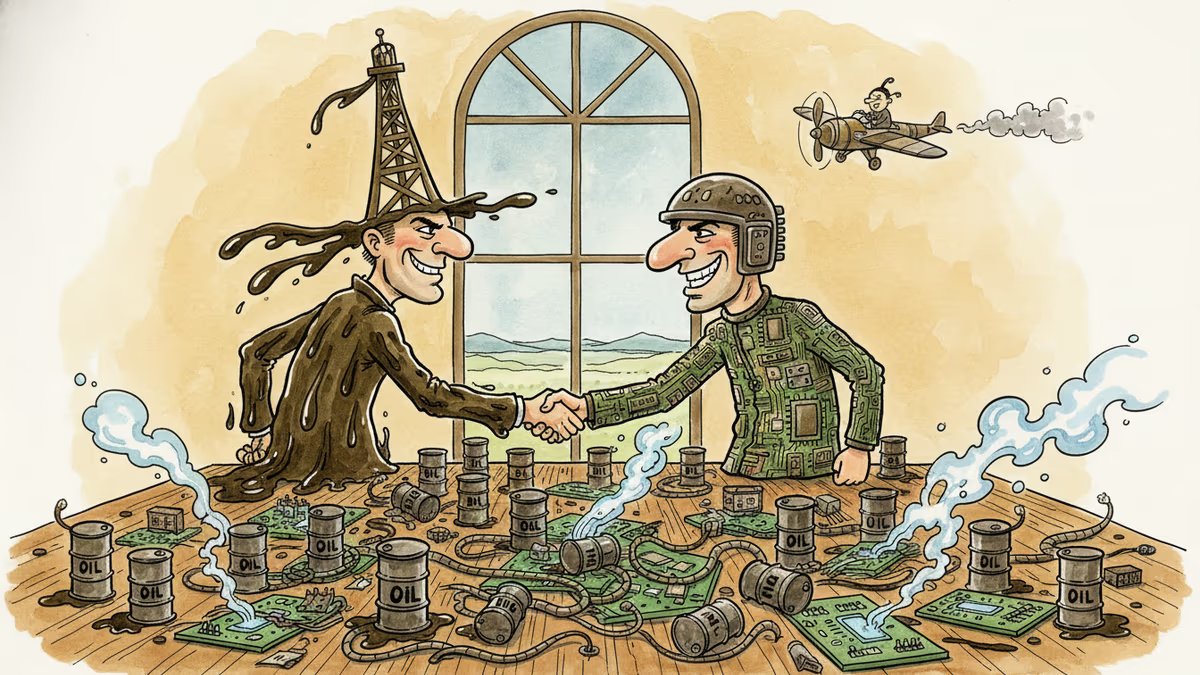
While Trump Flew Home, Xi and Putin Got to Work
Days after Trump's Beijing visit, China and Russia announced deeper energy and technology cooperation. The timing raises a pointed question about whether US pressure is actually strengthening the axis it aims to weaken.
The ink on Trump's Beijing meetings was barely dry when Xi Jinping and Vladimir Putin stepped forward to announce something of their own: expanded energy supplies and deeper technology cooperation. The timing was not coincidental.
What Actually Happened
In the days following Trump's visit to Beijing — a trip framed around trade de-escalation, semiconductor export adjustments, and fentanyl cooperation — Chinese and Russian officials publicly declared a new phase of bilateral cooperation covering two of the most strategically sensitive areas in global competition: energy and advanced technology.
On the energy side, the two governments signaled progress on expanding Russian natural gas exports to China, with the long-stalled Power of Siberia 2 pipeline project reportedly receiving fresh momentum. On technology, the cooperation framework reportedly covers semiconductors, artificial intelligence, and space applications — precisely the sectors where Western export controls have been tightening the most.
The numbers behind this relationship are already substantial. Russia's energy exports to China reached roughly $98 billion in 2023, nearly double pre-sanctions levels. China now absorbs a majority of Russia's seaborne crude oil. The energy dependency runs in both directions: Russia needs buyers; China needs stable, discounted supply.
The Pressure Paradox

Washington's strategic logic has long held that squeezing China and Russia separately would keep them from consolidating into a coherent bloc. The theory was that the two countries' interests diverge enough — territorial ambitions in Central Asia, competition for influence in the Global South, historical mistrust — that sustained Western pressure would expose those fault lines.
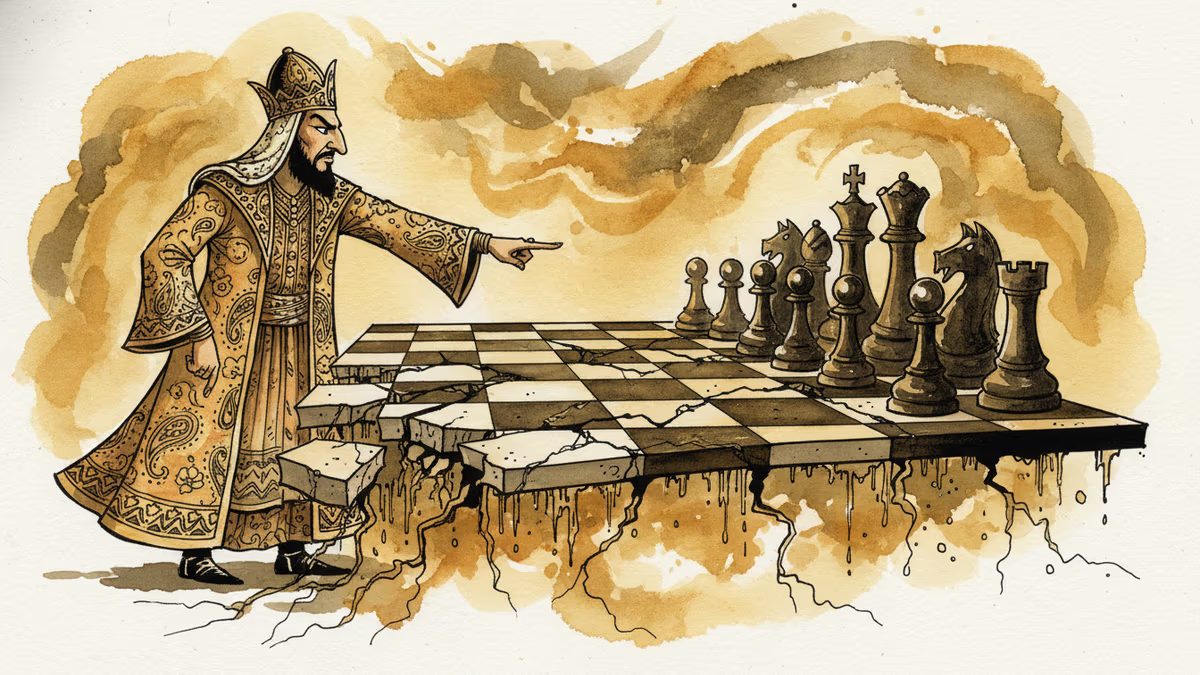
What's happening instead looks like the opposite. Every round of US semiconductor export restrictions gives Beijing a stronger incentive to deepen technology ties with Moscow, which brings legacy aerospace and military engineering expertise that China's commercial sector lacks. Every new European energy sanction pushes Russia further into economic dependence on China, which in turn gives Beijing leverage it didn't need to pay for.
The result is a relationship that neither side would have chosen freely but that external pressure keeps reinforcing. It's not an alliance built on shared values or long-term vision — analysts consistently note the deep mutual suspicion between the two governments. It's a transactional partnership built on shared adversaries.
What This Means for Markets and Policy
For energy markets, the deepening China-Russia axis has real pricing implications. If Russian gas flows increasingly east through expanded pipeline infrastructure, European and Asian buyers compete harder for LNG from the Middle East and Australia. Spot LNG prices, which have already been volatile through 2025-2026, face another structural pressure point.
For technology competition, the picture is more complex. China's semiconductor industry still depends on Western lithography equipment for cutting-edge manufacturing. Russian technical cooperation doesn't solve that bottleneck directly. But collaboration on AI applications, satellite systems, and military-adjacent technologies could help both countries develop capabilities that partially route around Western controls — not eliminating the gap, but narrowing it in specific domains.
For the Trump administration, the timing creates an awkward optic. The Beijing visit was sold domestically as a demonstration of dealmaking leverage. The immediate Chinese-Russian response suggests Beijing may have read the visit differently — as a signal that Washington is willing to negotiate, which paradoxically reduces the cost of simultaneously deepening ties with Moscow.
This content is AI-generated based on source articles. While we strive for accuracy, errors may occur. We recommend verifying with the original source.
Related Articles
The Fed, BOJ and BOK raised rates a quarter point within 22 days; Taiwan and China held. What each said, plus the impact on Korean borrowers and the won.
Ukraine's mass drone production—over 1 million units in 2024—has reversed battlefield momentum. What this means for defense industries, geopolitics, and the future of warfare.
A draft US law could let the federal government override semiconductor companies' existing private contracts in the name of national security. Here's what's at stake for the industry.
Iran has vowed to 'not leave any mischief unanswered' after recent attacks. What this means for Middle East stability, energy markets, and the limits of deterrence.
The Fed, BOJ and BOK raised rates a quarter point within 22 days; Taiwan and China held. What each said, plus the impact on Korean borrowers and the won.
Ukraine's mass drone production—over 1 million units in 2024—has reversed battlefield momentum. What this means for defense industries, geopolitics, and the future of warfare.
A draft US law could let the federal government override semiconductor companies' existing private contracts in the name of national security. Here's what's at stake for the industry.
Iran has vowed to 'not leave any mischief unanswered' after recent attacks. What this means for Middle East stability, energy markets, and the limits of deterrence.
Thoughts
Share your thoughts on this article
Sign in to join the conversation