
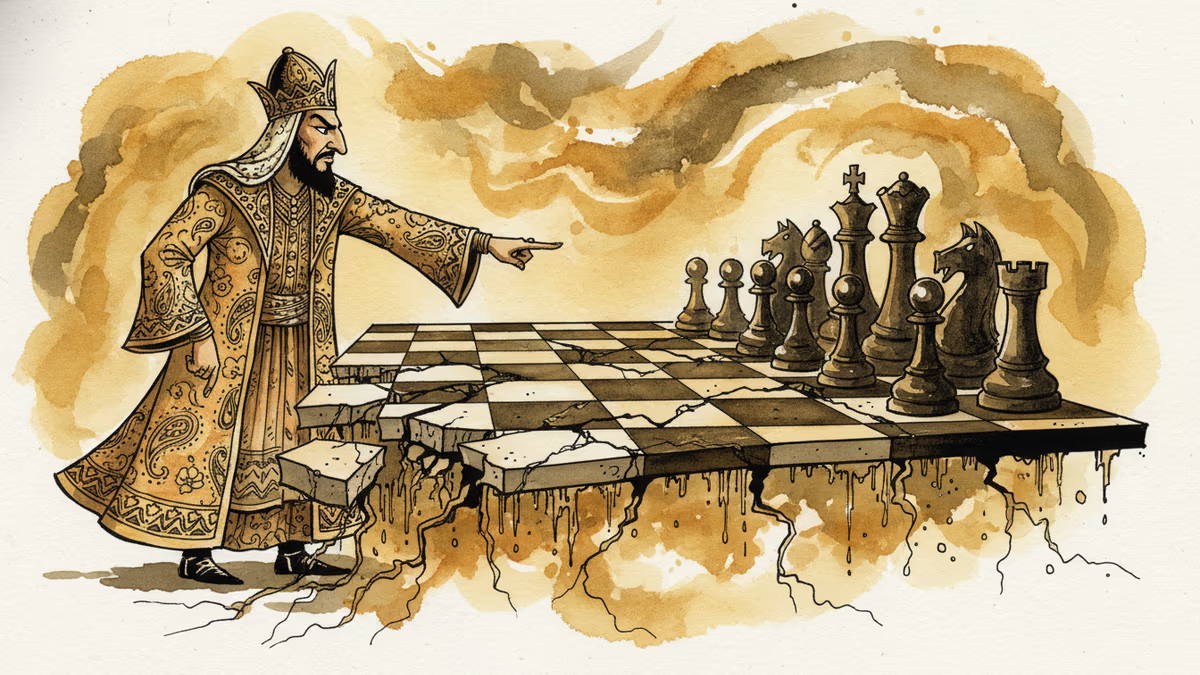
Tehran's Warning: When Does Rhetoric Become Action?
Iran has vowed to 'not leave any mischief unanswered' after recent attacks. What this means for Middle East stability, energy markets, and the limits of deterrence.
The most dangerous words in geopolitics aren't declarations of war. They're promises of retaliation with no specified timeline.
Following recent attacks on Iranian interests, Tehran issued a stark warning: it would "not leave any mischief unanswered." The statement is deliberate, open-ended, and—by design—impossible to ignore.
What Happened, and Why It Matters
Iran's leadership responded to the attacks with an immediate and public vow of retribution. Officials characterized the strikes as malicious provocations, framing their response not as aggression but as the natural right of a sovereign state defending itself. No specific timeline or method of retaliation was announced.
That ambiguity is the point.
Iran has spent years refining a doctrine of strategic patience and asymmetric pressure. Rather than direct confrontation, Tehran has historically channeled its responses through its network of regional proxies—Hezbollah in Lebanon, Houthi forces in Yemen, and affiliated militias across Iraq and Syria. This "Axis of Resistance" has allowed Iran to project power while maintaining plausible deniability. The current warning fits neatly within that playbook.
But the playbook is under strain. Over the past 19 months, the Gaza war has reshaped the regional calculus. Hezbollah suffered significant losses in its 2024 confrontation with Israel. The Houthis have been under sustained military pressure. Iran's forward network—the very infrastructure of its deterrence strategy—has been degraded.
The Geometry of Escalation

The Middle East is currently operating on multiple overlapping tension axes simultaneously, which is what makes this moment different from previous cycles of Iranian rhetoric.
In April and October 2024, Iran and Israel exchanged direct strikes for the first time in their decades-long shadow war. That threshold—once considered unthinkable—has now been crossed twice. The psychological barrier is gone. Each subsequent provocation carries less of the restraining weight that once kept both sides from direct engagement.
Nuclear diplomacy adds another layer. Indirect talks between Washington and Tehran have resumed under the Trump administration, but remain fragile. Iran's hardliners view any appearance of capitulation as existential weakness. A muted response to attacks would hand domestic critics a weapon. The public warning, then, serves an internal audience as much as an external one—it's a signal to the Revolutionary Guard, to parliament, to the street: we have not been humbled.
The Trump administration's posture complicates the picture further. Washington has re-engaged its "maximum pressure" campaign against Tehran while simultaneously signaling it wants to avoid direct military entanglement in the region. That creates a narrow channel: Iran knows the U.S. will respond forcefully if American assets are directly targeted, but believes it has more room to maneuver below that threshold.
Who's Watching, and What They're Calculating
Israel will treat the warning as confirmation of a threat it has long argued requires preemptive action. Prime Minister Netanyahu's government has consistently used the Iranian threat as both a security imperative and a domestic political instrument. Expect continued military readiness signaling—and the possibility of preemptive strikes if Tehran's actions move from words toward weapons.
The Gulf states, particularly Saudi Arabia, face a different dilemma. The 2023 Saudi-Iran normalization—brokered by China—was one of the most consequential diplomatic shifts in the region in years. Riyadh has invested political capital in a cautious détente with Tehran. Renewed hostilities threaten that investment, and with it, the broader project of Gulf states hedging between Washington and Beijing.
Energy markets are already pricing in the uncertainty. The Strait of Hormuz carries roughly 20% of global oil supply. Iran has never actually closed the strait—doing so would devastate its own economy—but the threat alone moves prices. Brent crude has historically spiked 5–10% during acute Iran-related tension events. Traders don't need certainty; they need ambiguity, and right now there's plenty of it.
For European governments still managing energy security after the Russia-Ukraine supply disruption, another Middle East escalation cycle is the last variable they want to absorb.
This content is AI-generated based on source articles. While we strive for accuracy, errors may occur. We recommend verifying with the original source.
Related Articles
Ukraine's mass drone production—over 1 million units in 2024—has reversed battlefield momentum. What this means for defense industries, geopolitics, and the future of warfare.
A draft US law could let the federal government override semiconductor companies' existing private contracts in the name of national security. Here's what's at stake for the industry.
Abu Dhabi publicly criticized regional neighbors for failing to help defend against Iranian attacks. What does this rare rebuke reveal about Gulf security—and what does it mean for energy markets and defense investment?
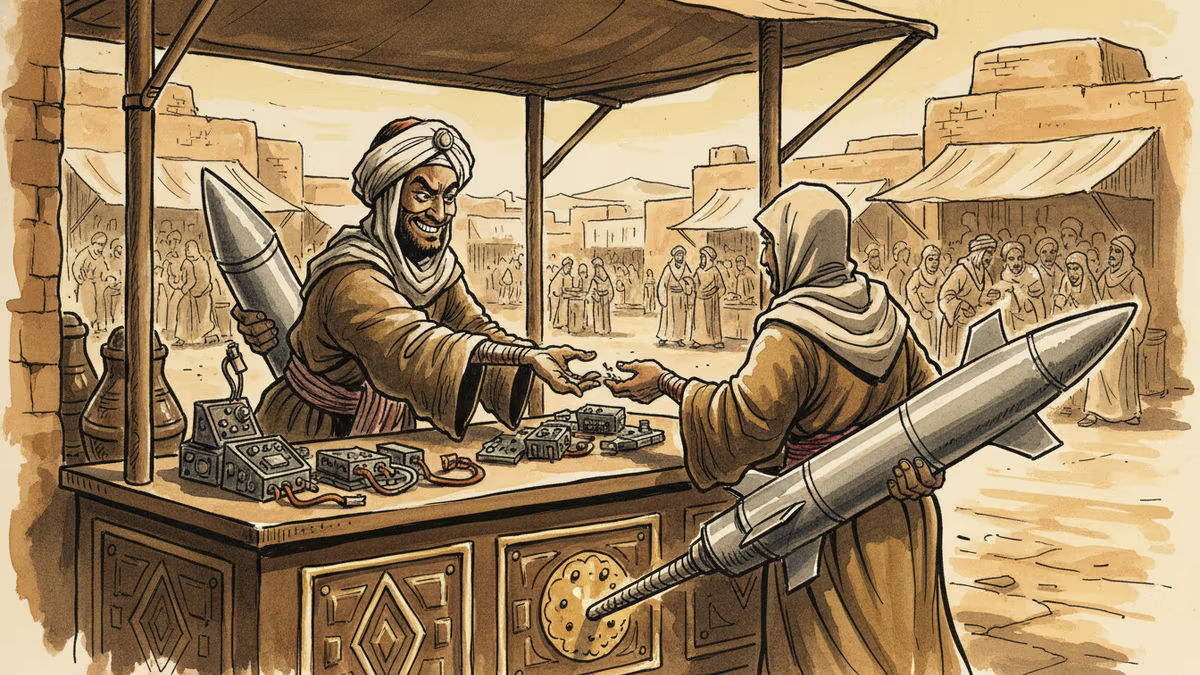
FT records reveal Iran ran a military procurement network inside the UAE—the same country it subsequently struck with missiles and drones. What this exposes about sanctions architecture.
Ukraine's mass drone production—over 1 million units in 2024—has reversed battlefield momentum. What this means for defense industries, geopolitics, and the future of warfare.
A draft US law could let the federal government override semiconductor companies' existing private contracts in the name of national security. Here's what's at stake for the industry.
Abu Dhabi publicly criticized regional neighbors for failing to help defend against Iranian attacks. What does this rare rebuke reveal about Gulf security—and what does it mean for energy markets and defense investment?
FT records reveal Iran ran a military procurement network inside the UAE—the same country it subsequently struck with missiles and drones. What this exposes about sanctions architecture.
Thoughts
Share your thoughts on this article
Sign in to join the conversation