
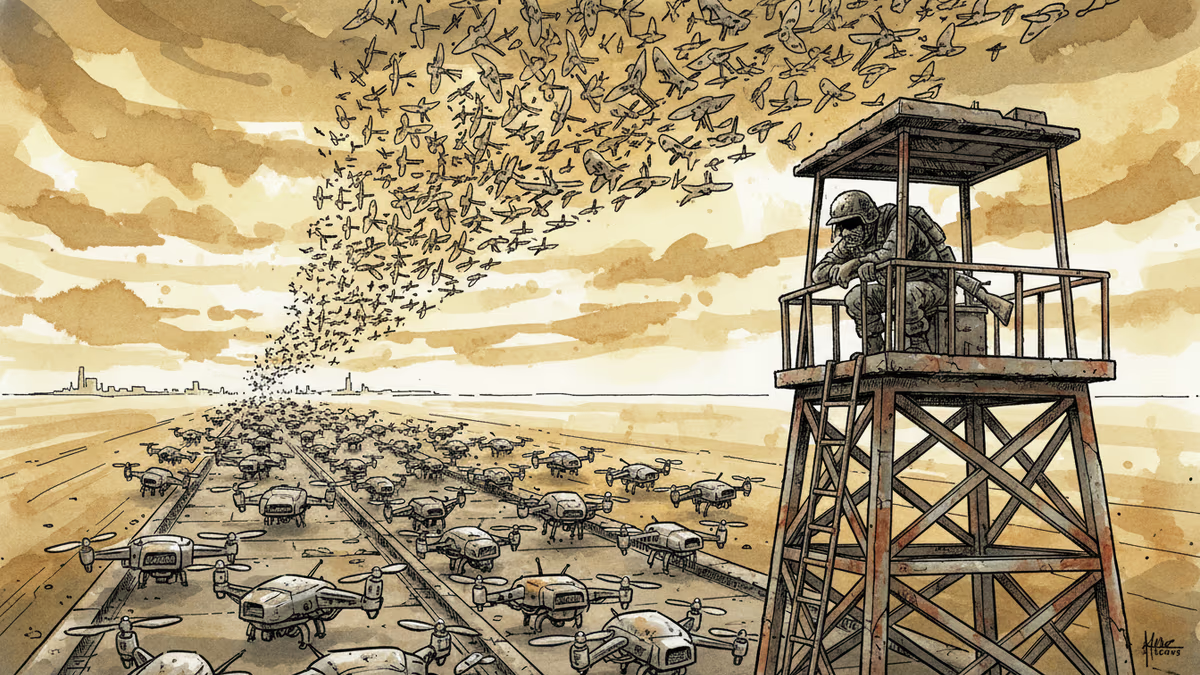
Ukraine's Drone Factories Are Rewriting the Rules of Modern War
Ukraine's mass drone production—over 1 million units in 2024—has reversed battlefield momentum. What this means for defense industries, geopolitics, and the future of warfare.
A $500 drone is destroying a $4 million tank. Multiply that by a million, and you start to understand why Ukraine's war effort has quietly turned a corner.
From Nadir to Factory Floor
By late 2023, Ukraine's position looked precarious. Western ammunition deliveries were snarled in political gridlock—most visibly in Washington. Frontline advances had stalled. Casualty rates were grinding. The narrative, both inside Ukraine and in Western capitals, had shifted toward managed decline.
Then the drone numbers started coming in.
Ukraine produced over 1 million military drones in 2024 alone—a figure that dwarfs its output from any previous year of the conflict. The government has set a target of 3 million units for 2025. More than 200 drone manufacturers are now operating across the country, ranging from state-linked enterprises to scrappy startups working out of repurposed warehouses.
These aren't precision cruise missiles. The workhorse of Ukraine's drone fleet is the FPV (first-person view) drone—a device assembled largely from commercial components, often costing between $400 and $500 per unit. Against a Russian T-90 tank priced at roughly $3–5 million, the arithmetic of attrition has been fundamentally rewritten.
The Logic of Disposable Weapons
Conventional military doctrine prizes survivability. Expensive platforms—fighter jets, artillery systems, armored vehicles—are designed to be preserved, maintained, and reused. Ukraine's drone model inverts this entirely. These weapons are built to be expended.
Open-source battlefield analysis and Ukrainian military data suggest that FPV drones accounted for a significant share of Russian armored vehicle losses in 2024—numbering in the thousands. Beyond frontline engagements, long-range drones have struck fuel depots, ammunition storage sites, and military infrastructure hundreds of kilometers inside Russian territory, disrupting logistics chains that conventional artillery couldn't reach.

The implications extend well beyond Ukraine. From Hezbollah's drone barrages against Israel to the Houthis' persistent harassment of Red Sea shipping, the past three years have seen drone warfare proliferate across multiple theaters. What Ukraine has added to this picture isn't proof that drones work—that was already established. It's proof that industrial-scale production of cheap drones is achievable in wartime conditions.
Winners, Losers, and the Defense Industry Reckoning
The traditional defense establishment is watching this with a mixture of interest and anxiety.
The big winners so far aren't the legacy primes—Lockheed Martin, BAE Systems, Rheinmetall. They're mid-tier firms with drone expertise, like Turkey's Baykar, and a new generation of defense-tech startups that can iterate hardware in weeks rather than years. In Ukraine itself, nimble civilian companies outpaced state-owned defense giants in scaling production.
For the primes, the dilemma is real. Demand for high-end platforms—fifth-generation fighters, advanced missile systems—hasn't disappeared. But the actual consumption on a modern battlefield is being driven by $500 disposable units. Defense budget allocators in NATO capitals are starting to ask uncomfortable questions about the ratio of expensive platforms to cheap, expendable systems.
Palantir, Shield AI, Anduril, and a cohort of U.S. defense-tech startups have been positioning themselves precisely for this shift—arguing that software-defined, rapidly iterable systems are the future. Ukraine's experience gives their pitch considerably more weight.
The Countermeasures Race
None of this is a one-way ratchet. Russia has invested heavily in electronic warfare—jamming systems that can sever the radio links controlling FPV drones. Intercept rates have risen substantially since 2022. Ukraine's response has been to develop fiber-optic tethered drones (immune to radio jamming), AI-assisted autonomous navigation, and acoustic signature masking.
This back-and-forth mirrors the historical pattern of offense-defense cycles in military technology—from armor versus anti-tank weapons to submarine versus sonar. Each innovation generates a countermeasure; each countermeasure generates a new innovation. The difference now is the speed of the cycle, measured in months rather than decades.
Supply chains add another layer of fragility. A significant share of drone components—motors, sensors, flight controllers—still originate in China. Tightening Western export controls on dual-use technology, aimed at cutting off Russian procurement, could inadvertently raise Ukraine's production costs too. The component dependency problem hasn't been solved; it's been deferred.
This content is AI-generated based on source articles. While we strive for accuracy, errors may occur. We recommend verifying with the original source.
Related Articles

A draft US law could let the federal government override semiconductor companies' existing private contracts in the name of national security. Here's what's at stake for the industry.
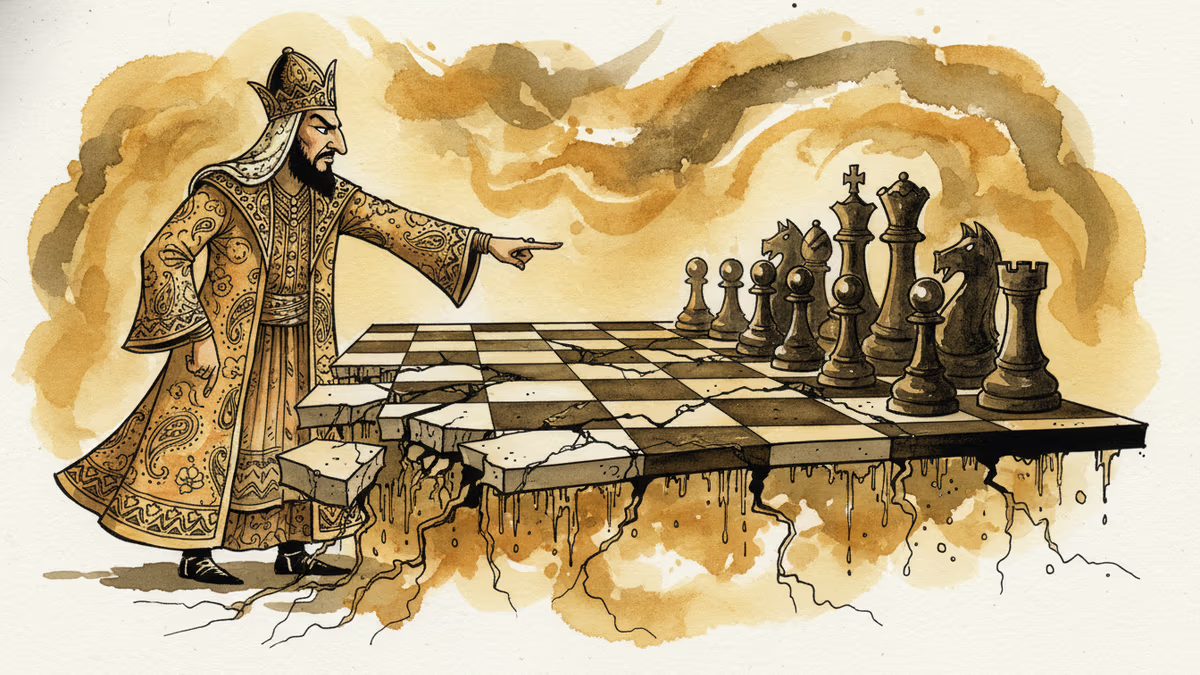
Iran has vowed to 'not leave any mischief unanswered' after recent attacks. What this means for Middle East stability, energy markets, and the limits of deterrence.
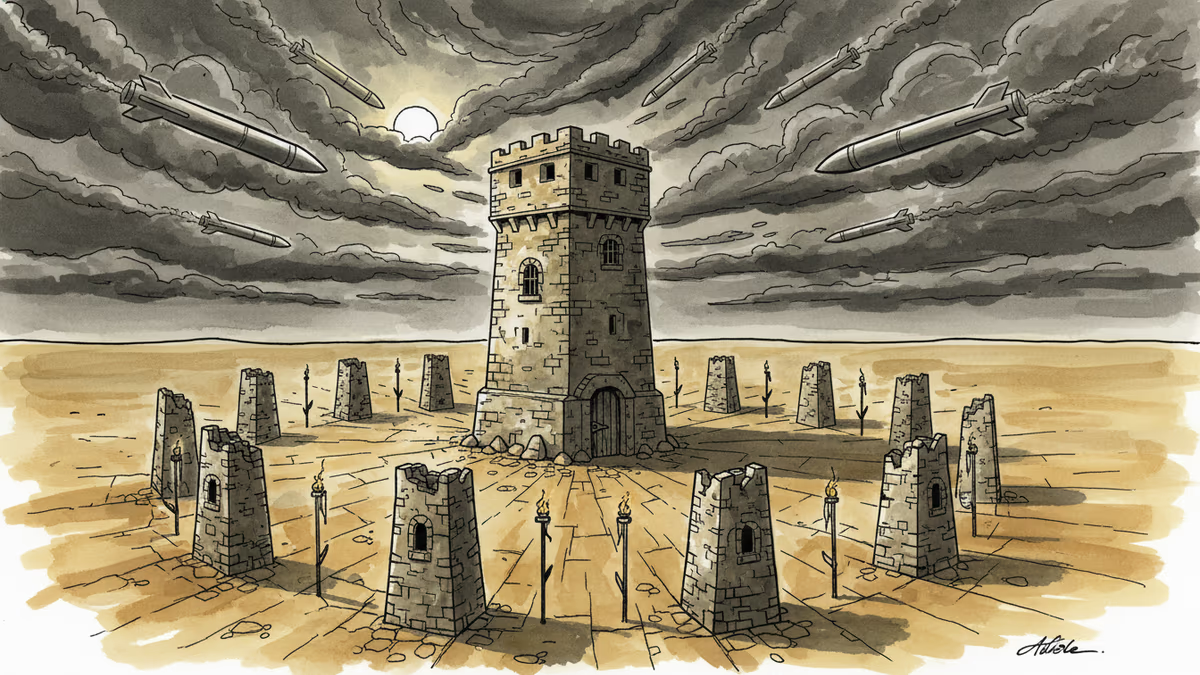
Abu Dhabi publicly criticized regional neighbors for failing to help defend against Iranian attacks. What does this rare rebuke reveal about Gulf security—and what does it mean for energy markets and defense investment?

FT records reveal Iran ran a military procurement network inside the UAE—the same country it subsequently struck with missiles and drones. What this exposes about sanctions architecture.
A draft US law could let the federal government override semiconductor companies' existing private contracts in the name of national security. Here's what's at stake for the industry.
Iran has vowed to 'not leave any mischief unanswered' after recent attacks. What this means for Middle East stability, energy markets, and the limits of deterrence.
Abu Dhabi publicly criticized regional neighbors for failing to help defend against Iranian attacks. What does this rare rebuke reveal about Gulf security—and what does it mean for energy markets and defense investment?
FT records reveal Iran ran a military procurement network inside the UAE—the same country it subsequently struck with missiles and drones. What this exposes about sanctions architecture.
Thoughts
Share your thoughts on this article
Sign in to join the conversation