
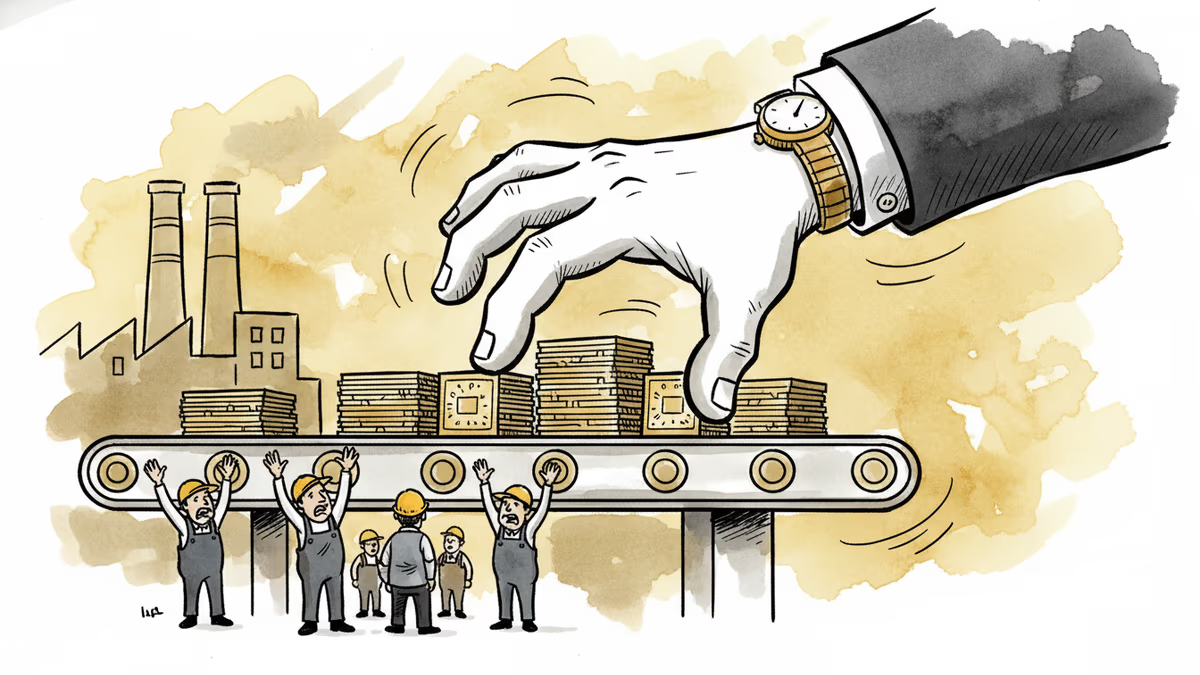
When Washington Can Void Your Chip Contract
A draft US law could let the federal government override semiconductor companies' existing private contracts in the name of national security. Here's what's at stake for the industry.
You spent billions building a fab on American soil, signed multi-year supply deals with your biggest customers, and collected your CHIPS Act subsidy. Now imagine the federal government telling you to tear up those contracts and fill Washington's order first.
That scenario is no longer hypothetical. A draft piece of legislation circulating in the US Congress contains provisions that would allow the federal government to compel semiconductor manufacturers to override existing private contracts when national security conditions are met. The bill hasn't passed—but the industry is already reading the fine print.
What the Draft Actually Says
The core mechanism is a government priority access clause. Under specific triggering conditions—broadly defined around national security or critical supply chain disruptions—federal authorities could require chipmakers to deprioritize commercial customers and redirect output toward government needs.
The draft reportedly includes some compensation provisions for companies that face breach-of-contract liabilities as a result. But the details matter enormously here, and those details remain vague. How broad is the definition of "national security"? Which agencies hold the trigger? What counts as adequate compensation when a company loses a flagship customer relationship?
On its face, the provision looks like a wartime contingency—a way to ensure military hardware, medical devices, and critical infrastructure get chips when it matters most. In practice, the ambiguity of the language is what worries legal teams across the semiconductor sector.
The Stakes for Global Chipmakers

This isn't just a domestic US story. Any company operating fabs on American soil—or receiving CHIPS Act funding—could fall within scope.
Samsung is building a $17 billion foundry in Taylor, Texas. SK Hynix has committed to an HBM packaging facility in Indiana. TSMC's Arizona fabs are already partially operational. All of these companies have existing long-term supply agreements with commercial customers—Nvidia, Apple, AMD, Qualcomm—that were negotiated without a government override clause in mind.
If the law passes in its current form, a US subsidiary of a Korean or Taiwanese company could be legally required to shuffle its delivery queue based on Washington's priorities, regardless of what the parent company's contracts say. That's a new kind of sovereignty question the semiconductor industry hasn't had to answer before.
A Carrot That's Becoming a Stick
The broader context here is important. The CHIPS Act was sold to the industry as an incentive—subsidies and tax credits to bring manufacturing back to American soil. Companies responded. Over $400 billion in private semiconductor investment has been announced in the US since the act passed in 2022.
But the relationship between government and chipmakers is quietly shifting. Subsidies came with strings: hiring commitments, profit-sharing provisions, restrictions on expanding in certain countries. This new draft adds another string—potential control over who you sell to.
The industry's counterargument is straightforward: contract predictability is the foundation of long-term capital allocation. A fab costs $20–30 billion to build and takes years to reach full yield. Companies make those bets because they can sign binding agreements with customers. If those agreements can be unilaterally restructured by government order, the risk calculus for future investments changes. Ironically, a law designed to secure supply chains could introduce exactly the kind of uncertainty that makes supply chains fragile.
Not everyone sees it that way. Defense hawks argue that the 2020–2021 chip shortage—which idled auto plants and delayed consumer electronics globally—proved that market mechanisms alone can't guarantee supply of a strategically critical input. From that view, a government backstop isn't a distortion of the market; it's insurance against the next crisis.
This content is AI-generated based on source articles. While we strive for accuracy, errors may occur. We recommend verifying with the original source.
Related Articles

Ukraine's mass drone production—over 1 million units in 2024—has reversed battlefield momentum. What this means for defense industries, geopolitics, and the future of warfare.

Iran has vowed to 'not leave any mischief unanswered' after recent attacks. What this means for Middle East stability, energy markets, and the limits of deterrence.

Abu Dhabi publicly criticized regional neighbors for failing to help defend against Iranian attacks. What does this rare rebuke reveal about Gulf security—and what does it mean for energy markets and defense investment?

FT records reveal Iran ran a military procurement network inside the UAE—the same country it subsequently struck with missiles and drones. What this exposes about sanctions architecture.
Ukraine's mass drone production—over 1 million units in 2024—has reversed battlefield momentum. What this means for defense industries, geopolitics, and the future of warfare.
Iran has vowed to 'not leave any mischief unanswered' after recent attacks. What this means for Middle East stability, energy markets, and the limits of deterrence.
Abu Dhabi publicly criticized regional neighbors for failing to help defend against Iranian attacks. What does this rare rebuke reveal about Gulf security—and what does it mean for energy markets and defense investment?
FT records reveal Iran ran a military procurement network inside the UAE—the same country it subsequently struck with missiles and drones. What this exposes about sanctions architecture.
Thoughts
Share your thoughts on this article
Sign in to join the conversation