
Abu Dhabi's Lonely Defense: A Gulf Alliance Under Strain
Abu Dhabi publicly criticized regional neighbors for failing to help defend against Iranian attacks. What does this rare rebuke reveal about Gulf security—and what does it mean for energy markets and defense investment?
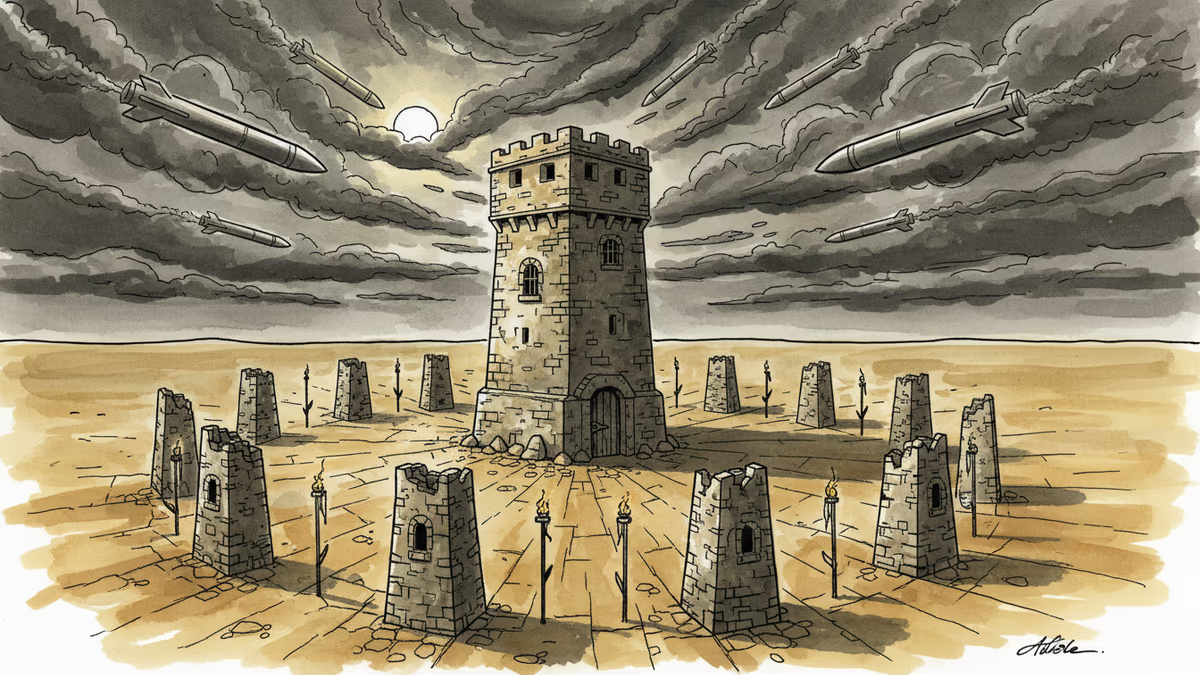
Alliances reveal their true nature not in peacetime declarations, but in the moment someone actually needs help. Abu Dhabi looked around during an Iranian attack—and found the neighboring watchtowers empty.
What Happened
Abu Dhabi has publicly criticized fellow regional states for failing to do enough to help defend against Iranian attacks. The rebuke, delivered through diplomatic channels but unmistakably pointed, breaks from the usual Gulf Cooperation Council (GCC) practice of airing grievances behind closed doors. The message, stripped of diplomatic softening, was this: we fought largely alone.
The backdrop matters. Iran has spent years applying layered pressure across the Gulf—proxy warfare through Houthi rebels in Yemen, drone and missile strikes, and maritime harassment. The January 2022 Houthi drone and missile attack on Abu Dhabi killed 3 people and struck infrastructure on UAE soil, marking one of the most direct assaults on a Gulf capital in recent memory. UAE responded with independent military action and diplomatic pressure. What it didn't get, by its own account, was adequate solidarity from neighbors who share the same threat environment.
Why This, Why Now
The timing isn't incidental. US-Iran nuclear negotiations are currently underway, and their outcome will reshape the Gulf's security architecture in ways that are difficult to predict. By publicly naming regional inaction, Abu Dhabi is doing two things simultaneously: signaling to Washington that Gulf states can't be taken for granted as a unified bloc, and pressuring neighbors to recommit to collective defense before any new regional deal is struck.
There's also the fault line opened by Saudi Arabia's 2023 diplomatic normalization with Iran, brokered by Beijing. Since Riyadh and Tehran shook hands, several GCC members have quietly recalibrated their posture—avoiding direct confrontation with Iran and hedging their bets. Abu Dhabi's frustration is, in part, a response to that hedging. The GCC was built on the premise of collective security; what happens when members disagree on who the threat actually is?

The Money Behind the Grievance
This isn't just a diplomatic spat. UAE is the world's 7th largest crude oil producer, and ADNOC operates with a capacity exceeding 4 million barrels per day. Any scenario involving Strait of Hormuz disruption or escalating regional conflict directly translates into energy supply risk—and price volatility that reaches every fuel pump and power grid connected to Gulf exports.
If GCC collective defense credibility erodes, member states will spend more defending themselves individually. That means capital diverted from economic diversification—the Vision 2030 projects, the UAE Net Zero investments, the post-oil transition spending—and redirected toward military procurement. The winners in that scenario are Western defense contractors, and increasingly Asian ones too: South Korea's LIG Nex1 has already exported its Cheongung-II air defense system to the UAE, a deal that reflects Abu Dhabi's deliberate effort to diversify its security partnerships beyond the US.
For investors, the key variable is whether Gulf geopolitical risk premium gets repriced. Stable oil prices can coexist with elevated regional tension—until they can't. The gap between Aramco's long-term production contracts and the security assumptions baked into them deserves closer scrutiny.
The Harder Question No One Wants to Answer
The GCC was designed in 1981 to present a unified front against exactly the kind of Iranian pressure Abu Dhabi is describing. Decades later, the alliance's members have divergent relationships with Tehran, divergent dependencies on Washington, and divergent economic interests. Qatar hosts the largest US air base in the region while maintaining functional ties with Iran. Saudi Arabia has just normalized with Tehran. Bahrain hosts the US Fifth Fleet but is also home to a Shia majority with cultural ties to Iran.
Collective security requires a shared definition of the threat. The GCC increasingly lacks one.
This content is AI-generated based on source articles. While we strive for accuracy, errors may occur. We recommend verifying with the original source.
Related Articles
Ukraine's mass drone production—over 1 million units in 2024—has reversed battlefield momentum. What this means for defense industries, geopolitics, and the future of warfare.
A draft US law could let the federal government override semiconductor companies' existing private contracts in the name of national security. Here's what's at stake for the industry.
Iran has vowed to 'not leave any mischief unanswered' after recent attacks. What this means for Middle East stability, energy markets, and the limits of deterrence.
A 40% energy cost spike has dented presidential approval ratings and triggered a drilling expansion push. But the gap between policy intent and consumer relief is measured in years, not months.
Ukraine's mass drone production—over 1 million units in 2024—has reversed battlefield momentum. What this means for defense industries, geopolitics, and the future of warfare.
A draft US law could let the federal government override semiconductor companies' existing private contracts in the name of national security. Here's what's at stake for the industry.
Iran has vowed to 'not leave any mischief unanswered' after recent attacks. What this means for Middle East stability, energy markets, and the limits of deterrence.
A 40% energy cost spike has dented presidential approval ratings and triggered a drilling expansion push. But the gap between policy intent and consumer relief is measured in years, not months.
Thoughts
Share your thoughts on this article
Sign in to join the conversation