
Trump Flies to Beijing With an Iran Problem He Can't Solve Alone
Trump arrives in Beijing as the Iran war strains global energy markets. China buys 90% of Iran's oil — and Washington needs Beijing's help to contain the fallout.
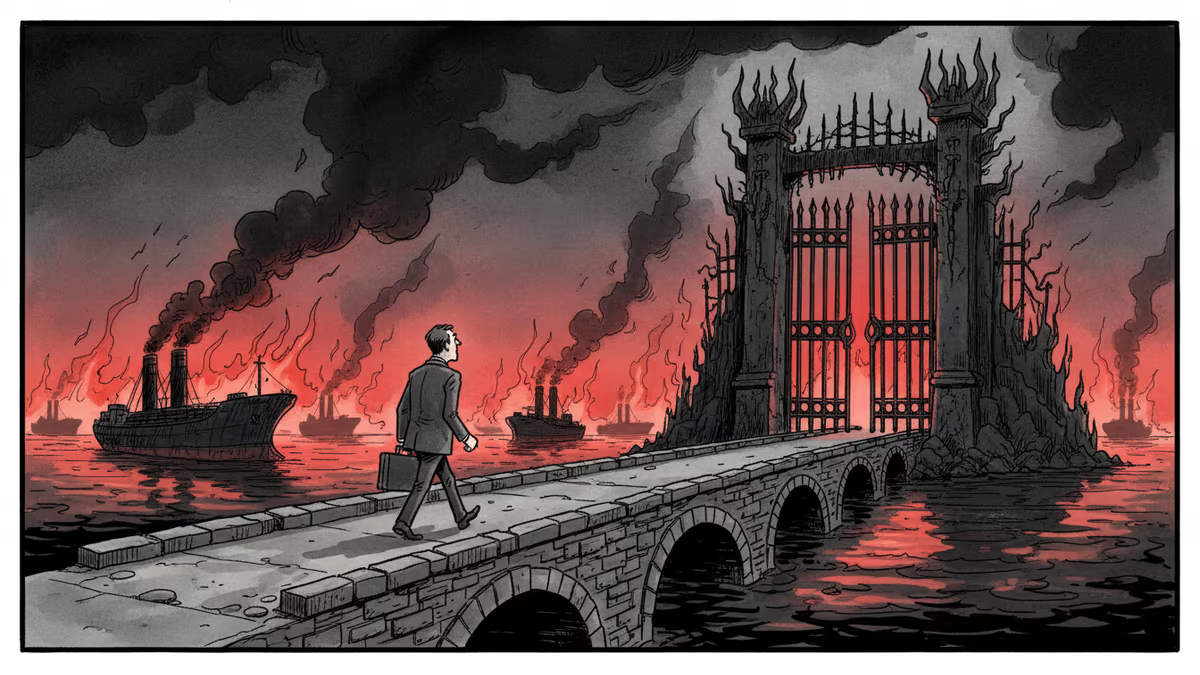
The Strait of Hormuz is closed, oil markets are rattled, and the American president is flying to Beijing to ask for help.
Donald Trump lands in the Chinese capital on Wednesday evening, with a formal opening ceremony and meeting with Xi Jinping scheduled for Thursday morning. The trip wraps Friday, and Washington says Beijing will host a reciprocal visit later this year. The White House framed the trip as being of "tremendous symbolic significance," focused on "rebalancing the relationship with China and prioritising reciprocity and fairness."
That's the diplomatic language. The underlying reality is more urgent.
The Problem on the Table
The Iran war is the elephant in the room — or rather, in the South China Sea, the Persian Gulf, and every energy market in between. When the US and Israel struck Iran, Tehran's response was to close the Strait of Hormuz, the narrow chokepoint through which roughly 20% of the world's seaborne oil passes. The disruption has rippled across global energy markets, hitting Asian economies that depend on Middle Eastern imports particularly hard.
Washington's case against Beijing is blunt. Treasury Secretary Scott Bessent laid it out on Fox News last week: "Iran is the largest state sponsor of terrorism, and China has been buying 90 percent of their energy, so they are funding the largest state sponsor of terrorism." A senior administration official said Trump could "apply pressure" on China over Iranian oil purchases and Beijing's sale of potential dual-use military-civilian goods to Tehran.
China's position is deliberately ambiguous. Beijing hosted Iranian Foreign Minister Abbas Araghchi last week and called for an end to the war and the reopening of Hormuz. At the same time, it has flatly refused to recognize Washington's "unilateral" sanctions on Iran's oil sector. The message from Beijing: we want stability, but we won't take orders from Washington on how to achieve it.
Beyond Iran, the agenda reportedly includes China's support for Russia, trade disputes, and rare earth minerals — the latter a critical input for the US tech sector that China dominates globally. Business executives from Boeing and several agricultural companies are traveling with the US delegation, a signal that commercial incentives are also on the table.

On Taiwan, a senior administration official preemptively closed the door: no change in the US position is expected. China claims the self-governing island as its territory; the US maintains deep security and economic commitments to Taipei. That particular minefield stays unaddressed.
Why This Trip, Why Now
The visit was originally scheduled for earlier in 2026 but was postponed in March — overtaken by the US-Israel military campaign against Iran. That delay itself tells a story: the war reshuffled Washington's entire diplomatic calendar.
The timing now reflects a specific kind of pressure. The Iran conflict's costs are mounting at home and abroad. Energy disruptions are feeding inflation. Seafarers are stranded in the Strait of Hormuz. Southeast Asian leaders spent their recent ASEAN summit grappling with the war's economic fallout. Trump needs a win — or at least a de-escalation — and China holds a piece of that puzzle.
But the leverage cuts both ways. The US has sanctioned Iranian oil, yet China refuses to recognize those sanctions and has the economic heft to absorb secondary pressure — at least for now. Military options to stop Chinese oil purchases from Iran don't exist in any practical sense. That leaves diplomacy, which is precisely why Air Force One is headed to Beijing.
Three Ways to Read This Meeting
Washington's calculation is transactional: offer China economic incentives — Boeing contracts, agricultural deals, perhaps tariff adjustments — in exchange for reducing support for Iran and, implicitly, Russia. The public "terrorism funding" rhetoric from Bessent reads less as a sincere accusation and more as pre-negotiation pressure, establishing a high ceiling before the real bargaining begins.
Beijing's calculation is more structurally constrained. Iranian oil is a meaningful share of China's energy imports, and energy security is a core strategic priority for Xi's government. Publicly capitulating to American pressure would be politically costly domestically. Yet a prolonged Hormuz closure hurts China too — it disrupts the same supply chains China depends on. Beijing's dual move of hosting Araghchi while refusing to recognize US sanctions is a careful attempt to signal influence without conceding sovereignty over its foreign policy choices.
For energy-importing nations — South Korea, Japan, India, the ASEAN bloc — the stakes of this meeting are immediate and material. Their energy costs, inflation rates, and industrial output are directly tied to whether Hormuz reopens. Neither Washington nor Beijing is negotiating on their behalf, yet both will claim credit if stability returns.
This content is AI-generated based on source articles. While we strive for accuracy, errors may occur. We recommend verifying with the original source.
Related Articles

Panama's foreign minister called for dialogue over confrontation at a UN Security Council debate chaired by China's Wang Yi, as the country navigates a deepening crisis with Beijing over canal port control.

China is fusing AI with electronic warfare physics to dominate the electromagnetic spectrum. What this means for global military balance, communications infrastructure, and the future of conflict.

Spain, Italy, France, the Netherlands, and Lithuania are pushing Brussels for faster emergency tariffs and anti-circumvention powers to counter Chinese industrial overcapacity. Here's what's at stake.

Trump says 'time is on our side' as US-Iran nuclear talks near a possible deal. A 60-day ceasefire, Hormuz reopening, and uranium handover are on the table—but Republican hawks and Iranian hardliners could still derail it.
Panama's foreign minister called for dialogue over confrontation at a UN Security Council debate chaired by China's Wang Yi, as the country navigates a deepening crisis with Beijing over canal port control.
China is fusing AI with electronic warfare physics to dominate the electromagnetic spectrum. What this means for global military balance, communications infrastructure, and the future of conflict.
Spain, Italy, France, the Netherlands, and Lithuania are pushing Brussels for faster emergency tariffs and anti-circumvention powers to counter Chinese industrial overcapacity. Here's what's at stake.
Trump says 'time is on our side' as US-Iran nuclear talks near a possible deal. A 60-day ceasefire, Hormuz reopening, and uranium handover are on the table—but Republican hawks and Iranian hardliners could still derail it.
Thoughts
Share your thoughts on this article
Sign in to join the conversation