
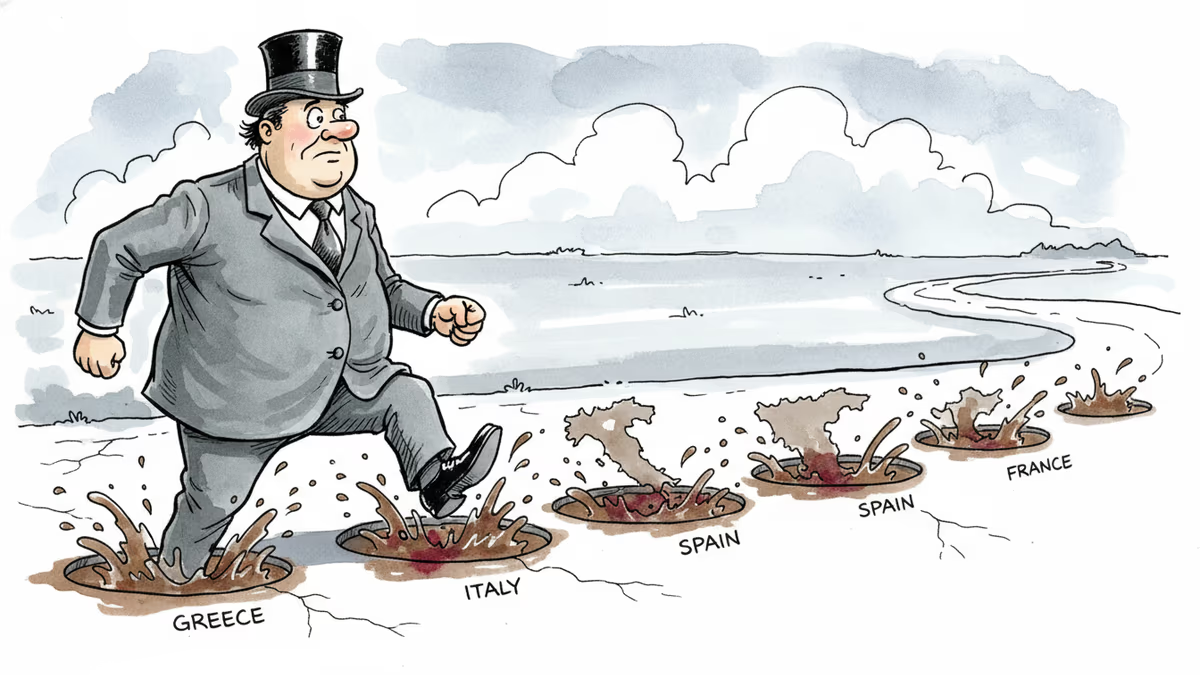
America's Foreign Policy Has a Pattern Problem
From Ukraine to Libya to Afghanistan, U.S. foreign policy keeps repeating the same two failures. Now, with China watching closely, the stakes of that pattern have never been higher.
The most dangerous thing about a mistake isn't making it once. It's not recognizing it the second time, or the third.
That is the quiet indictment running through serious critiques of American foreign policy today—not that the United States lacks power, but that it keeps deploying that power in ways that ignore what history has already taught.
Two Failures, Repeated
Foreign policy analysts who study American missteps tend to identify two recurring failure modes. The first is failing to deter aggression early. The second is removing governments without building what comes next.
Russia's full-scale invasion of Ukraine in 2022 is the most cited example of the first. After Moscow annexed Crimea in 2014, the Western response—sanctions, diplomatic pressure, limited military aid—was calibrated to avoid escalation. Whether that calibration inadvertently signaled tolerance is now a matter of serious debate. What is not debated is the outcome: eight years later, Putin tested the next threshold. Unchecked aggression, the historical record suggests, tends to grow its own appetite.
Libya and Afghanistan illustrate the second failure with painful clarity. In 2011, NATO air power helped topple Muammar Gaddafi. What followed was not a transition to stability but a decade of civil war, competing militias, and a Mediterranean migrant crisis that reshaped European politics. In Afghanistan, twenty years of U.S. presence ended with Kabul falling to the Taliban in eleven days. The regime changed. The state did not.
Iran sits at the intersection of both failures. Tehran has spent decades building a regional architecture of destabilization—Hezbollah in Lebanon, the Houthis in Yemen, proxy militias across Iraq and Syria. American policy toward Iran has oscillated between pressure and engagement without resolving the underlying dynamic. The Middle East today reflects the accumulated cost of that inconsistency.
Why China Changes the Calculus
These cases would be instructive on their own. They become urgent because of what comes next: China.

Xi Jinping's government has steadily increased military pressure on Taiwan, extended its footprint in the South China Sea, and watched the Western response to Russia's invasion with evident interest. The question Beijing is asking—the question every strategic actor asks—is whether American commitments are credible.
For decades, U.S. policy toward Taiwan operated under deliberate ambiguity: enough commitment to deter invasion, not enough clarity to provoke it. That balance depended on one thing above all else—the belief that America would act. Belief, in deterrence theory, is the entire mechanism. It cannot be stored. It has to be continuously earned.
The problem is that the recent pattern of American behavior has made that belief harder to sustain. Not because U.S. military capability has diminished, but because the consistency of U.S. resolve has been questioned—by allies in Europe wondering about NATO commitments, by partners in Asia recalibrating their hedging strategies, and, most consequentially, by decision-makers in Beijing drawing their own conclusions from the available evidence.
The Counterarguments Deserve Hearing
The case against American foreign policy is compelling, but it is not the only case.
Some strategists push back hard on the narrative of American failure. Libya's collapse, they argue, owed as much to tribal fractures that predated Gaddafi as to any Western miscalculation. Afghanistan's fall reflected decades of institutional corruption that no external power could have resolved through sustained presence—the question was never whether to leave, but whether staying longer would have changed the underlying conditions. Nation-building, on this view, hits a ceiling that is structural, not a matter of American will.
On China, the debate is genuinely open. Hawks argue that only credible military deterrence—more defense spending, clearer commitments, stronger alliances—can prevent the kind of miscalculation that produced Ukraine. Doves counter that economic interdependence remains a powerful brake on conflict, and that confrontational posturing risks becoming a self-fulfilling prophecy. Neither side has a clean empirical record to stand on.
There is also the domestic dimension. American foreign policy does not emerge from a strategic planning office in a vacuum. It is shaped by electoral cycles, congressional budgets, public opinion, and the competing priorities of an administration managing simultaneous crises. The gap between long-term strategic logic and short-term political incentives is not a bug unique to Washington—but in a country with global commitments, that gap has global consequences.
What Allies Are Actually Doing
Perhaps the most telling signal is not what governments say, but what they are quietly doing.
Germany has reversed decades of defense restraint and committed to significant military spending increases. Japan has reinterpreted its pacifist constitution to allow a more active defense posture. Countries across Southeast Asia are hedging—deepening security ties with Washington while carefully preserving economic relationships with Beijing. The Philippines has granted the U.S. expanded basing access; it has also not closed the door on Beijing.
This is what hedging looks like when allies are uncertain. It is not abandonment. It is insurance—purchased precisely because the primary guarantee feels less reliable than it once did.
This content is AI-generated based on source articles. While we strive for accuracy, errors may occur. We recommend verifying with the original source.
Related Articles

Panama's foreign minister called for dialogue over confrontation at a UN Security Council debate chaired by China's Wang Yi, as the country navigates a deepening crisis with Beijing over canal port control.
Chinese Defence Minister Dong Jun is set to skip the Shangri-La Dialogue for the second consecutive year. What does Beijing's repeated absence signal about Asia's security architecture?

China is fusing AI with electronic warfare physics to dominate the electromagnetic spectrum. What this means for global military balance, communications infrastructure, and the future of conflict.

Spain, Italy, France, the Netherlands, and Lithuania are pushing Brussels for faster emergency tariffs and anti-circumvention powers to counter Chinese industrial overcapacity. Here's what's at stake.
Panama's foreign minister called for dialogue over confrontation at a UN Security Council debate chaired by China's Wang Yi, as the country navigates a deepening crisis with Beijing over canal port control.
Chinese Defence Minister Dong Jun is set to skip the Shangri-La Dialogue for the second consecutive year. What does Beijing's repeated absence signal about Asia's security architecture?
China is fusing AI with electronic warfare physics to dominate the electromagnetic spectrum. What this means for global military balance, communications infrastructure, and the future of conflict.
Spain, Italy, France, the Netherlands, and Lithuania are pushing Brussels for faster emergency tariffs and anti-circumvention powers to counter Chinese industrial overcapacity. Here's what's at stake.
Thoughts
Share your thoughts on this article
Sign in to join the conversation