
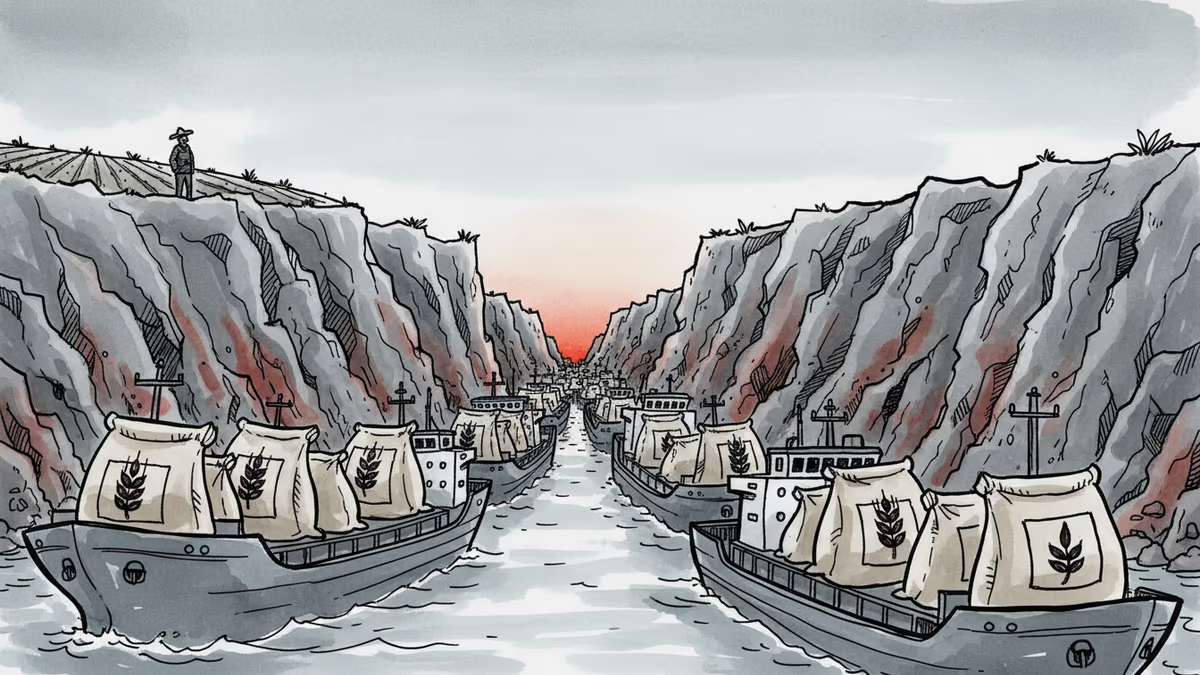
No Fertilizer, No Harvest: Hormuz Blockade Hits Global Food Supply
A US-Israeli blockade of the Strait of Hormuz since February 2026 is threatening the global fertilizer supply chain. With planting season approaching, the UN warns of cascading food security shocks.
The bombs fall in the Middle East. The hunger comes six months later, somewhere else entirely.
That's the quiet arithmetic of modern conflict — and it's playing out right now. Since the United States and Israel launched joint strikes on Iran in February 2026, the Strait of Hormuz has been effectively blockaded. The 33-kilometer chokepoint that handles a significant share of the world's oil also carries something less discussed but equally vital: the fertilizers that feed billions.
A UN official has now issued a direct warning — the coming planting season is at risk. For countries already staggering under fertilizer shortages and surging input costs, this is not an abstract geopolitical development. It's a threat to next autumn's harvest.
The Bottleneck the World Forgot
Most people know Hormuz as an oil chokepoint. Fewer realize it's also a critical artery for agricultural inputs. Iran, Qatar, Saudi Arabia, and the UAE — all Hormuz-adjacent — are among the world's top producers and exporters of nitrogen fertilizers, ammonia, and potash. A significant share of what farmers in South Asia, East Africa, and Southeast Asia spread on their fields each spring passes through this strait.
Since the blockade began, shipping companies have been rerouting around the Cape of Good Hope — adding two to three weeks to delivery times and substantially increasing freight costs. For farmers in import-dependent nations, timing is everything. The primary planting window across the Northern Hemisphere runs from April through June. Fertilizer that arrives in July doesn't plant a crop. It sits in a warehouse while yields collapse.
The food crisis doesn't announce itself at the moment of conflict. It arrives at the dinner table months later.
China's Calculated Silence
The most strategically significant actor in this story may be the one saying the least. China, according to reporting, has offered political support to the parties involved — while maintaining careful ambiguity about its own exposure.

The tension is real. China is the world's largest fertilizer producer and exporter. A prolonged Hormuz blockade increases global demand for Chinese agricultural inputs, potentially expanding Beijing's market share at a moment of geopolitical friction. That's a structural windfall.
But China is also deeply dependent on Middle Eastern energy. Hormuz disruptions squeeze its own supply chains. Whether Beijing leans into the opportunity or quietly pushes for de-escalation to protect its energy flows is a calculation that will shape the next phase of this crisis — and it's one that Beijing has every incentive to keep opaque.
Who Pays the Price
The shock is not distributed equally. Countries with foreign exchange reserves, diversified suppliers, and strategic fertilizer stockpiles — India, Brazil, the United States — can absorb short-term disruptions. They'll pay more. They won't go hungry.
The countries that can't absorb this are the ones already on the edge. Ethiopia, Bangladesh, Pakistan, Egypt — nations that never fully recovered from the 2022–2023 fertilizer price spike triggered by the war in Ukraine. For them, another supply shock isn't a cost problem. It's a calorie problem.
The World Food Programme currently estimates more than 300 million people are facing acute food insecurity globally. That number was calculated before this disruption.
Western governments, meanwhile, face a tension they haven't publicly resolved: the military objective of constraining Iran's nuclear program versus the humanitarian and economic costs radiating outward through supply chains they don't directly control. Strikes can be precise. Their economic consequences are not.
What Comes Next
The immediate variable is duration. A short blockade — measured in weeks — creates price spikes and logistical headaches. A blockade that stretches through May and June disrupts the planting season in ways that compound over months. Agricultural economists often cite a six-to-nine month lag between input supply shocks and food price effects at the consumer level.
The diplomatic variable is China. If Beijing chooses to act as a stabilizing supplier — offering fertilizer exports at scale to vulnerable nations — it could blunt the worst food security outcomes while simultaneously building political capital across the Global South. That's not charity. That's influence.
For global investors and commodity traders, fertilizer futures and agricultural commodity prices are already reflecting the uncertainty. The question is whether the conflict trajectory gives markets anything to price with confidence.
This content is AI-generated based on source articles. While we strive for accuracy, errors may occur. We recommend verifying with the original source.
Related Articles

Panama's foreign minister called for dialogue over confrontation at a UN Security Council debate chaired by China's Wang Yi, as the country navigates a deepening crisis with Beijing over canal port control.

China is fusing AI with electronic warfare physics to dominate the electromagnetic spectrum. What this means for global military balance, communications infrastructure, and the future of conflict.

Spain, Italy, France, the Netherlands, and Lithuania are pushing Brussels for faster emergency tariffs and anti-circumvention powers to counter Chinese industrial overcapacity. Here's what's at stake.

Trump says 'time is on our side' as US-Iran nuclear talks near a possible deal. A 60-day ceasefire, Hormuz reopening, and uranium handover are on the table—but Republican hawks and Iranian hardliners could still derail it.
Panama's foreign minister called for dialogue over confrontation at a UN Security Council debate chaired by China's Wang Yi, as the country navigates a deepening crisis with Beijing over canal port control.
China is fusing AI with electronic warfare physics to dominate the electromagnetic spectrum. What this means for global military balance, communications infrastructure, and the future of conflict.
Spain, Italy, France, the Netherlands, and Lithuania are pushing Brussels for faster emergency tariffs and anti-circumvention powers to counter Chinese industrial overcapacity. Here's what's at stake.
Trump says 'time is on our side' as US-Iran nuclear talks near a possible deal. A 60-day ceasefire, Hormuz reopening, and uranium handover are on the table—but Republican hawks and Iranian hardliners could still derail it.
Thoughts
Share your thoughts on this article
Sign in to join the conversation