
Iran Hit a Korean Ship. Now Trump Wants Seoul's Navy.
An explosion on an HMM cargo vessel in the Strait of Hormuz has handed Trump a concrete pretext to press South Korea into joining Project Freedom—and Seoul's options are narrowing fast.
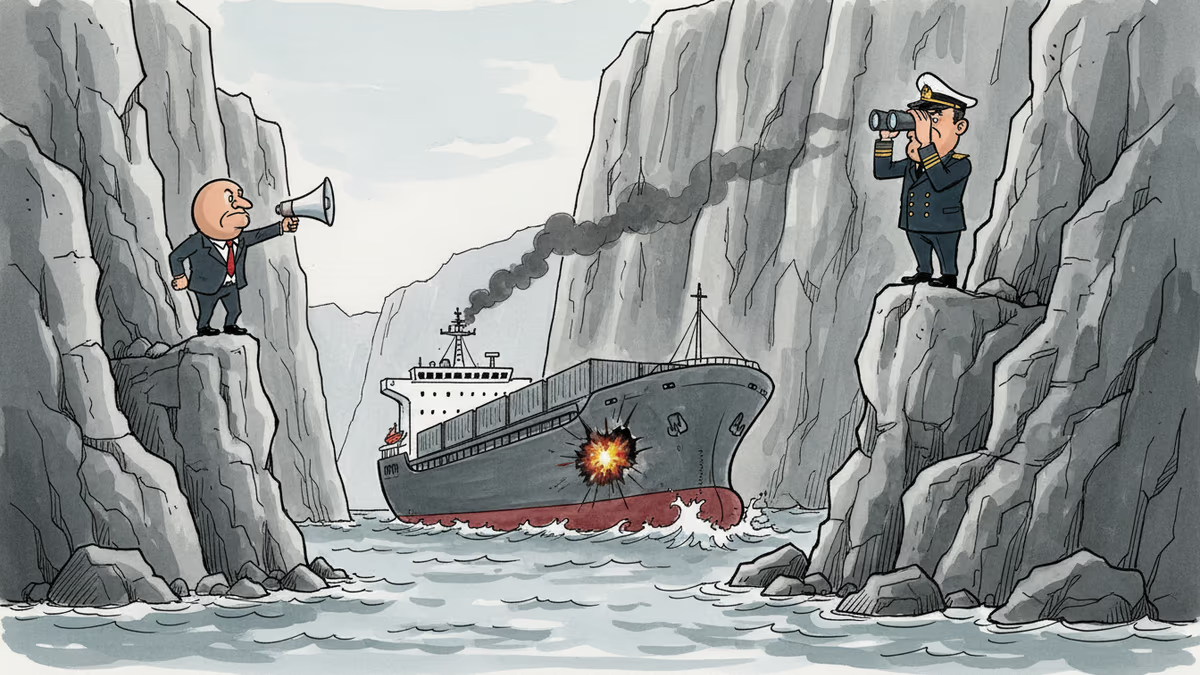
The crew of 24 aboard the HMM cargo vessel had no warning. The Panama-flagged ship, operated by one of South Korea's largest shipping firms, was anchored in UAE waters near the Strait of Hormuz when the explosion struck on May 4. Six South Koreans and 18 foreign nationals were on board. No one died—but the political shockwave traveled instantly to Washington.
Within hours, Donald Trump was on Truth Social: "Iran has taken some shots at unrelated Nations with respect to the Ship Movement, PROJECT FREEDOM, including a South Korean Cargo Ship. Perhaps it's time for South Korea to come and join the mission!"
An exclamation point at the end. An invitation that reads like a summons.
What Project Freedom Actually Is
The United States launched Project Freedom on May 4—a military operation designed to reopen the Strait of Hormuz, which Iran has effectively blockaded during the ongoing U.S.-Israeli war against Tehran. The strait is not a peripheral waterway. Roughly one-fifth of the world's oil supply moves through it, along with fertilizer, liquefied natural gas, and a significant share of global container trade.
CENTCOM Commander Admiral Brad Cooper confirmed that U.S. forces destroyed six Iranian fast boats and intercepted cruise missiles and drones as the operation launched. Trump's own count was seven. The discrepancy is minor; the message is not. The U.S. has deployed guided-missile destroyers, more than 100 land- and sea-based aircraft, multi-domain unmanned platforms, and 15,000 service members. Under the operation's current framework, the Navy advises commercial ships on mine avoidance and stands ready to intervene if Iran attacks—but full naval escorts are not yet on the table, according to U.S. officials.
Two U.S.-flagged merchant vessels successfully transited the strait on the first day of the operation. CENTCOM posted the update on X, framing it as proof of concept.

The Squeeze on Seoul
For South Korea, the Strait of Hormuz is not an abstraction. A substantial share of the country's crude oil imports passes through it. HMM, the company whose vessel was struck, is a flagship of South Korea's export-driven economy. The explosion did not just damage a ship—it punctured Seoul's preferred posture of careful neutrality.
Trump's pressure on South Korea has been building. Last month, he publicly declared that Seoul was "not helpful" to the U.S., despite American troops being stationed "in harm's way" in a country located "right next to" North Korea's nuclear arsenal. The framing was deliberate: you benefit from our protection, now show it.
The European precedent makes the stakes concrete. Countries that declined to support the Iran campaign or refused Trump's calls for naval assistance have faced consequences. The Pentagon announced the withdrawal of roughly 5,000 troops from Germany. Trump threatened to raise tariffs on EU cars and trucks from 15% to 25%. Seoul has not been told explicitly what non-compliance would cost—but the pattern is visible.
Participating carries its own risks. South Korea maintains trade and diplomatic ties with Iran. Beijing, which has its own complex relationship with Tehran, would be watching. And sending warships into a contested strait where a Korean vessel has just been hit is not a decision any government makes lightly.
The Contradictions Washington Is Holding
On the same day Trump issued his public call-out of South Korea, he told Fox News that Iranian negotiators were "far more malleable" and signaled optimism about peace talks. He also warned that Iranian forces targeting U.S. vessels would be "blown off the face of the Earth." Both statements were made within hours of each other.
This is not necessarily incoherence—it may be deliberate ambiguity, a negotiating style Trump has used before. But it creates a difficult environment for allies trying to calibrate their own responses. If a ceasefire is genuinely close, joining a military operation in the strait carries different implications than if the conflict is set to escalate. Seoul is being asked to make a consequential decision with incomplete information about where Washington itself is headed.
The fragile ceasefire that appeared to be forming between the U.S. and Iran looks more precarious after Project Freedom's launch. Whether the operation accelerates a deal or derails one remains genuinely unclear.
This content is AI-generated based on source articles. While we strive for accuracy, errors may occur. We recommend verifying with the original source.
Related Articles

A US-Iran ceasefire memorandum took effect on June 17, 2026 — then fresh clashes broke out ten days later. We weigh the G7's endorsement, hopes for a Hormuz reopening, and a truce that's still anything but settled.

Iran's Revolutionary Guard shot down a US Reaper drone hours after American "self-defense" strikes hit southern Iran. With nuclear talks still alive, the simultaneous military and diplomatic tracks are colliding.

Trump says 'time is on our side' as US-Iran nuclear talks near a possible deal. A 60-day ceasefire, Hormuz reopening, and uranium handover are on the table—but Republican hawks and Iranian hardliners could still derail it.

Trump says a US-Iran nuclear deal is 'largely negotiated.' Iran calls it a 'Persian-style peace.' Both sides claim victory. Here's what's actually at stake.
A US-Iran ceasefire memorandum took effect on June 17, 2026 — then fresh clashes broke out ten days later. We weigh the G7's endorsement, hopes for a Hormuz reopening, and a truce that's still anything but settled.
Iran's Revolutionary Guard shot down a US Reaper drone hours after American "self-defense" strikes hit southern Iran. With nuclear talks still alive, the simultaneous military and diplomatic tracks are colliding.
Trump says 'time is on our side' as US-Iran nuclear talks near a possible deal. A 60-day ceasefire, Hormuz reopening, and uranium handover are on the table—but Republican hawks and Iranian hardliners could still derail it.
Trump says a US-Iran nuclear deal is 'largely negotiated.' Iran calls it a 'Persian-style peace.' Both sides claim victory. Here's what's actually at stake.
Thoughts
Share your thoughts on this article
Sign in to join the conversation