
The $46 Trillion Blind Spot America Can't Afford to Ignore
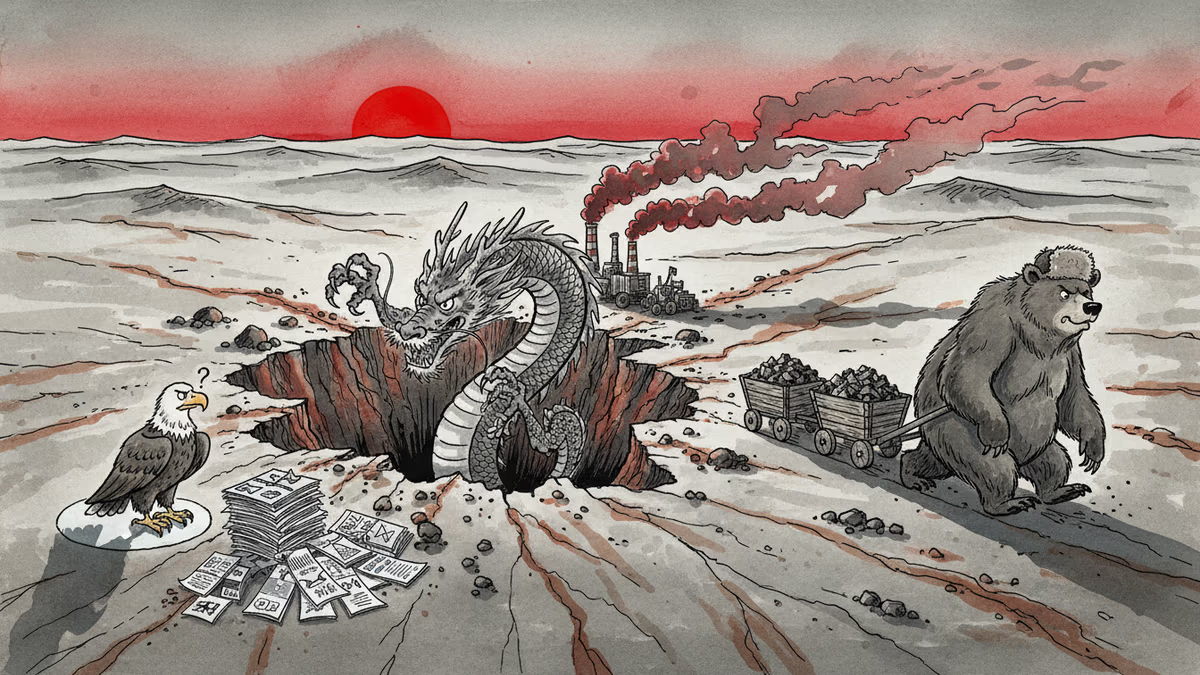
China controls 49% of Central Asia's critical mineral exports. Russia holds 20%. The United States? Just 2.1%. As AI and green energy reshape global power, this gap may prove decisive.
China controls 49% of Central Asia's critical mineral exports. Russia holds another 20%. The United States — despite two administrations of diplomatic summits and headline-grabbing deals — accounts for just 2.1%.
That number is not a trade statistic. It is a strategic vulnerability.
A Treasure Chest the Size of a Continent
Central Asia has long been treated as a geopolitical afterthought by Washington — a region important for counterterrorism corridors and pipeline politics, but not much else. That framing is dangerously outdated.
The World Bank values Kazakhstan alone at $46 trillion in mineral deposits across 5,000 documented sites. Kazakhstan has been the world's largest uranium producer since 2009, supplying over 40% of global uranium output in 2025. In April of that year, geologists announced the discovery of a rare-earth element field in the Karaganda region estimated at up to 20 million metric tons — potentially making Kazakhstan the third-largest source of critical minerals on Earth. The deposit includes neodymium, cerium, lanthanum, and yttrium: the building blocks of EV motors, wind turbines, and precision-guided weapons.
Uzbekistan holds largely untapped reserves of tungsten, lithium, gallium, germanium, vanadium, and copper. In March 2025, Tashkent launched a $2.6 billion initiative to develop mineral resources across 76 sites. Tajikistan, a small mountainous country often overlooked in these discussions, supplies one quarter of the world's antimony — a material essential for batteries and defense technologies — making it the world's second-largest producer.
Across the region, at least 32 of the 60 minerals designated critical by the U.S. government are present in significant quantities. The region exports over $15 billion in critical minerals annually.
Deals That Sell Planes, Not Pipelines
Washington has not been idle. The C5+1 diplomatic framework, launched under Obama in 2015, has continued through Biden and into Trump's second term. In September and November 2025, Kazakhstan and Uzbekistan signed $64 billion in deals with American companies. All five Central Asian presidents visited the White House in November 2025. In February 2026, the presidents of Kazakhstan and Uzbekistan returned to Washington for a dedicated Critical Minerals Summit.
But look past the ceremony and the picture shifts. The bulk of those $64 billion in agreements involved Central Asian governments buying American goods — 32 Boeing jets, 300 trains. Actual U.S. investment flowing into the region was far thinner: a John Deere agricultural machinery factory in Kazakhstan producing 3,000 units stands as one of the more concrete examples.

America has been selling products. China and Russia have been buying mines.
According to the Oxus Society's Central Asian Resource Tracker, China accounts for just under 49% of the region's critical mineral exports, and Russia for roughly 20%. EU countries claim 6.4%. The United States: 2.1%, most of which is silver imports from Kazakhstan.
How China Built a Structural Lock
China's dominance is not simply a matter of investment volume. It is architectural.
Beijing now holds a majority of mining permits in countries like Kyrgyzstan and Tajikistan. More importantly, it controls the downstream infrastructure. Raw ore extracted in Central Asia is typically shipped east to China for refining — the high-value stage of the supply chain. China controls 70% of global rare-earth extraction and 87% of processing. Central Asian nations, in effect, export raw material and import finished dependency.
These logistics networks are not accidental. They were built deliberately over decades through the Belt and Road Initiative, state-backed financing, and long-term offtake agreements that Western private capital has been slow to match.
Russia's position is similarly structural, if less dominant. Rosatom holds nearly a third of production at Budenovskoye, one of Kazakhstan's largest uranium mines, and in 2025 won the contract to build Kazakhstan's first nuclear power plant. Almost half of Kazakhstan's uranium is exported to Russia for enrichment. Kazakhstan's chromium — the country is the world's second-largest producer — flows almost entirely to Russia, where it is processed into heat-resistant alloys used in aircraft, missiles, and armored systems. Central Asian minerals are quietly sustaining Russian arms production.
A recent report by the Caspian Policy Center in Washington underscores the defense dimension for the United States as well: Central Asia holds substantial deposits of gallium and germanium (critical for semiconductors and radar), titanium and beryllium (essential for jet engines, F-16 airframes, and missile systems), and minerals used in precision-guided artillery. The supply chain gap is not only commercial — it is military.
Late to the Mine, But Not Locked Out
The Trump administration has moved more aggressively than its predecessor on this front, signing over $14 billion in critical minerals deals in its first year. In November 2025, California-based Cove Capital signed a $1.1 billion U.S. government-backed agreement to develop two tungsten deposits in Kazakhstan — a metal where China controls 80% of global extraction. The deal has not yet received actual government financing.
America's allies are also carving out positions. Turkey accounts for 11% of Central Asian critical mineral exports, dominating Uzbekistan's copper trade and Tajikistan's aluminum and manganese. Canada is the fourth-largest importer of the region's minerals, with Cameco Corporation operating the world's fifth-largest uranium mine through a joint venture with Kazatomprom.
Central Asian governments themselves are signaling openness. Kazakhstan has introduced over 100 amendments to its subsoil use legislation, introducing electronic auctions, priority rights for strategic investors, and digitized licensing. The welcome mat is out — the question is whether Washington will step through the door before the structural lock becomes permanent.
The gap between signing a deal and operating a mine remains the core American vulnerability. Private capital demands returns on timelines that state-backed Chinese financing does not. Without patient capital, government loan guarantees that actually disburse, and processing infrastructure built on-site rather than in China, contract announcements risk becoming press releases rather than supply chain pivots.
This content is AI-generated based on source articles. While we strive for accuracy, errors may occur. We recommend verifying with the original source.
Related Articles

Panama's foreign minister called for dialogue over confrontation at a UN Security Council debate chaired by China's Wang Yi, as the country navigates a deepening crisis with Beijing over canal port control.

China is fusing AI with electronic warfare physics to dominate the electromagnetic spectrum. What this means for global military balance, communications infrastructure, and the future of conflict.

Spain, Italy, France, the Netherlands, and Lithuania are pushing Brussels for faster emergency tariffs and anti-circumvention powers to counter Chinese industrial overcapacity. Here's what's at stake.

Trump says a US-Iran nuclear deal is 'largely negotiated.' Iran calls it a 'Persian-style peace.' Both sides claim victory. Here's what's actually at stake.
Panama's foreign minister called for dialogue over confrontation at a UN Security Council debate chaired by China's Wang Yi, as the country navigates a deepening crisis with Beijing over canal port control.
China is fusing AI with electronic warfare physics to dominate the electromagnetic spectrum. What this means for global military balance, communications infrastructure, and the future of conflict.
Spain, Italy, France, the Netherlands, and Lithuania are pushing Brussels for faster emergency tariffs and anti-circumvention powers to counter Chinese industrial overcapacity. Here's what's at stake.
Trump says a US-Iran nuclear deal is 'largely negotiated.' Iran calls it a 'Persian-style peace.' Both sides claim victory. Here's what's actually at stake.
Thoughts
Share your thoughts on this article
Sign in to join the conversation