
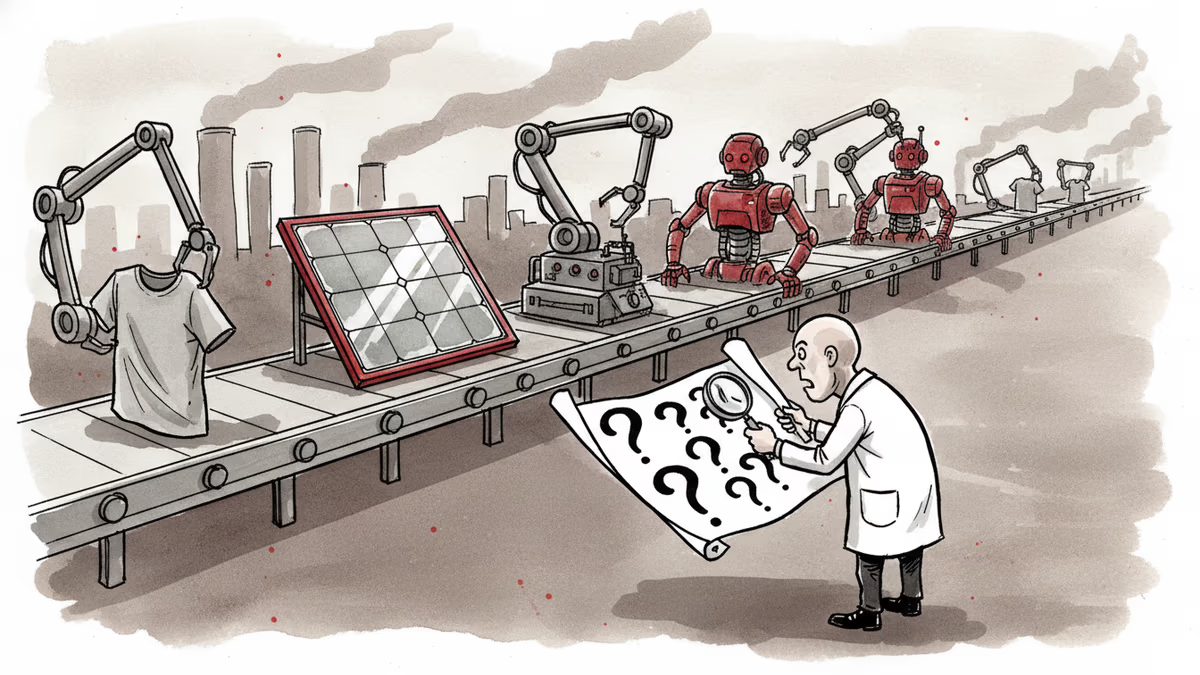
China's Industrial Rise: Subsidies Are Only Half the Story
China is already signaling its next export wave—AI, robots, and biotech—before the world has fully absorbed the EV and solar disruption. What's really driving this ascent?
Twenty years ago, the world was blindsided by cheap Chinese textiles. Today, it's still catching its breath from Chinese EVs and solar panels. And Beijing has already announced what comes next.
From "Old Three" to "New Three" to Whatever Comes After
To follow China's industrial strategy, you need to track three phrases. The "old three"—textiles, furniture, and home appliances—defined China's export identity in the early 2000s. Over roughly two decades, those gave way to the "new three": electric vehicles, batteries, and solar panels. These aren't just product categories; they're policy milestones, each representing a deliberate rung climbed on the manufacturing ladder.
What makes the current moment striking is the pace. As Zongshuai Fan, a senior policy analyst at Cambridge Industrial Innovation Policy at the University of Cambridge, notes, the transition from old to new took about twenty years. Yet barely years after the "new three" entered the global spotlight, Beijing is already promoting what it calls the "newer three": AI, industrial robots, and innovative medicines. Official messaging on this began in late 2025, and it isn't purely domestic cheerleading—these sectors are drawing real international attention.
Outside China, this trajectory is increasingly labeled "China Shock 2.0," an echo of the disruption that followed China's WTO accession in 2001. That first shock hit low-skill manufacturing workers in the US, Europe, and elsewhere with force economists are still measuring. The second is playing out in clean energy and automotive sectors. The third, if it materializes, would land in some of the highest-value industries on earth.
The Subsidy Explanation—And Its Limits
The instinctive explanation for all of this is state subsidies, and it isn't wrong. According to Fan's analysis, Chinese government funds invested an estimated $184 billion in AI firms between 2000 and 2023. Where the US relied primarily on private venture capital to build its AI ecosystem, China channeled state-backed capital far more heavily. In frontier sectors, public money has been a genuine accelerant.

But subsidies alone don't explain why China keeps climbing when other heavily subsidized industrial programs—in Southeast Asia, Latin America, and elsewhere—plateau. Fan argues that three other factors matter just as much: the depth of China's supply chain ecosystem, accumulated engineering talent, and the state's capacity to translate policy targets into operational execution.
On talent, the numbers are hard to ignore. China produces more STEM graduates annually than any other country, and a significant share flows into manufacturing and technology industries. These aren't workers doing final assembly—they're engineers iterating on design, process, and product. A job fair photographed in Fuyang, Anhui province, on April 28 illustrated the scale: thousands of young graduates, many of them technical, entering a labor market still oriented toward industry in a way that few peer economies can match.
Supply chain depth compounds this. BYD doesn't just make EVs—it makes the batteries, the chips, and increasingly the manufacturing equipment inside them. Vertical integration at that scale creates cost and speed advantages that no subsidy program in isolation can replicate.
Is the "Newer Three" Real?
Skepticism is warranted. AI, industrial robots, and innovative medicines have not yet reached the export scale of EVs or solar panels. The composition of the "newer three" will likely shift. Government signals are not the same as market outcomes.
In pharmaceuticals, Chinese firms still face significant barriers in Western markets: questions about clinical data integrity, intellectual property protections, and regulatory approval timelines. In AI, export controls on advanced semiconductors—Nvidia chips, most visibly—introduce real constraints on China's ability to develop frontier models at full speed.
And yet, the "new three" also looked premature once. In 2015, few Western automakers took Chinese EVs seriously as a competitive threat. By 2025, BYD was eroding Volkswagen's market share in Europe. The pattern of underestimation followed by disruption has repeated often enough that dismissing the "newer three" requires a specific argument, not just a general skepticism about Chinese capabilities.
For policymakers and business leaders in the US, Europe, South Korea, and Japan, the uncomfortable question isn't whether China will succeed in all three sectors—it's which ones, and on what timeline. Supply chain managers are already asking whether to diversify away from Chinese industrial robots before dependency deepens. Investors are watching whether Western governments can match the policy execution speed that Beijing is demonstrating.
This content is AI-generated based on source articles. While we strive for accuracy, errors may occur. We recommend verifying with the original source.
Related Articles

Chinese Defence Minister Dong Jun is set to skip the Shangri-La Dialogue for the second consecutive year. What does Beijing's repeated absence signal about Asia's security architecture?

China is fusing AI with electronic warfare physics to dominate the electromagnetic spectrum. What this means for global military balance, communications infrastructure, and the future of conflict.
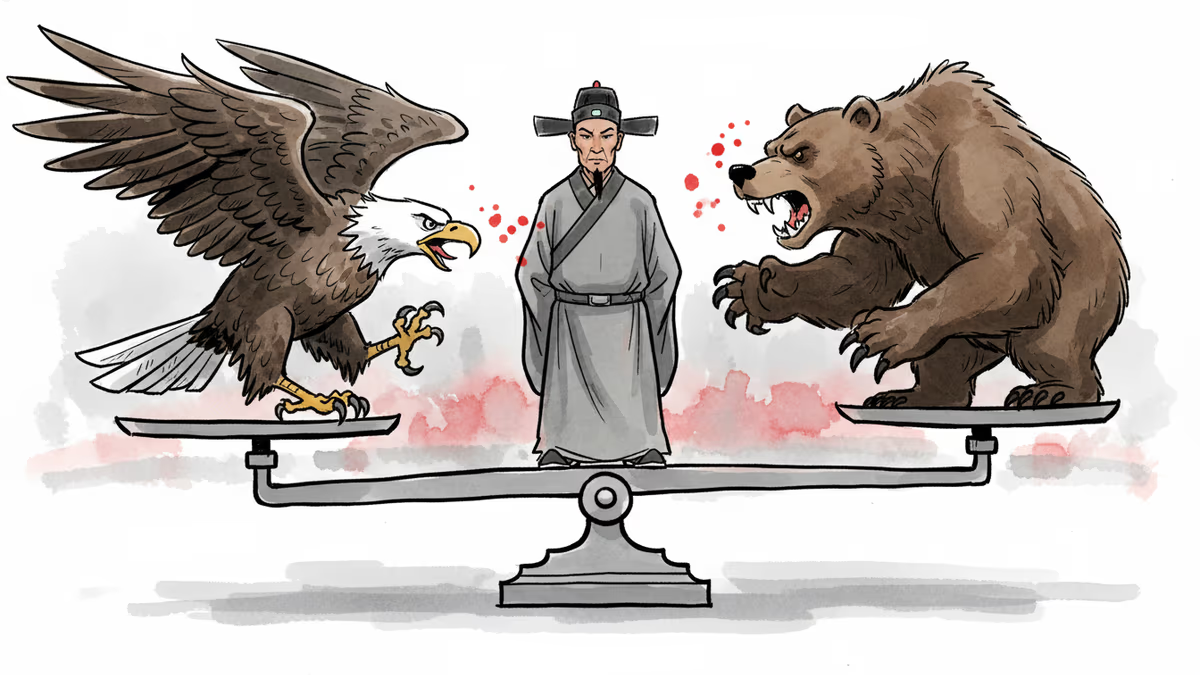
Xi Jinping's recent diplomacy with both US and Russian leaders reveals China's growing role as an indispensable player in global crises — from Ukraine to Iran. What does this mean for the international order?
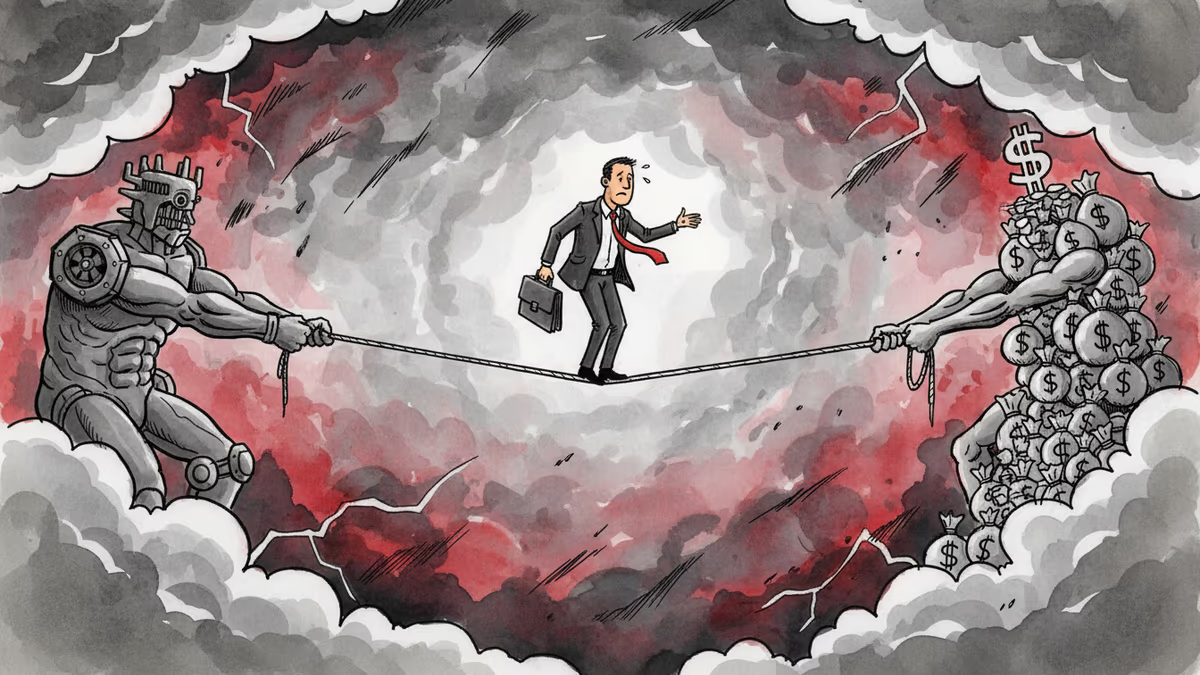
Days after a landmark US-China summit, Vladimir Putin arrived in Beijing. Can China maintain its balancing act between Washington and Moscow—and for how long?
Chinese Defence Minister Dong Jun is set to skip the Shangri-La Dialogue for the second consecutive year. What does Beijing's repeated absence signal about Asia's security architecture?
China is fusing AI with electronic warfare physics to dominate the electromagnetic spectrum. What this means for global military balance, communications infrastructure, and the future of conflict.
Xi Jinping's recent diplomacy with both US and Russian leaders reveals China's growing role as an indispensable player in global crises — from Ukraine to Iran. What does this mean for the international order?
Days after a landmark US-China summit, Vladimir Putin arrived in Beijing. Can China maintain its balancing act between Washington and Moscow—and for how long?
Thoughts
Share your thoughts on this article
Sign in to join the conversation