
Hanoi's First Move: What To Lam's Beijing Trip Really Signals
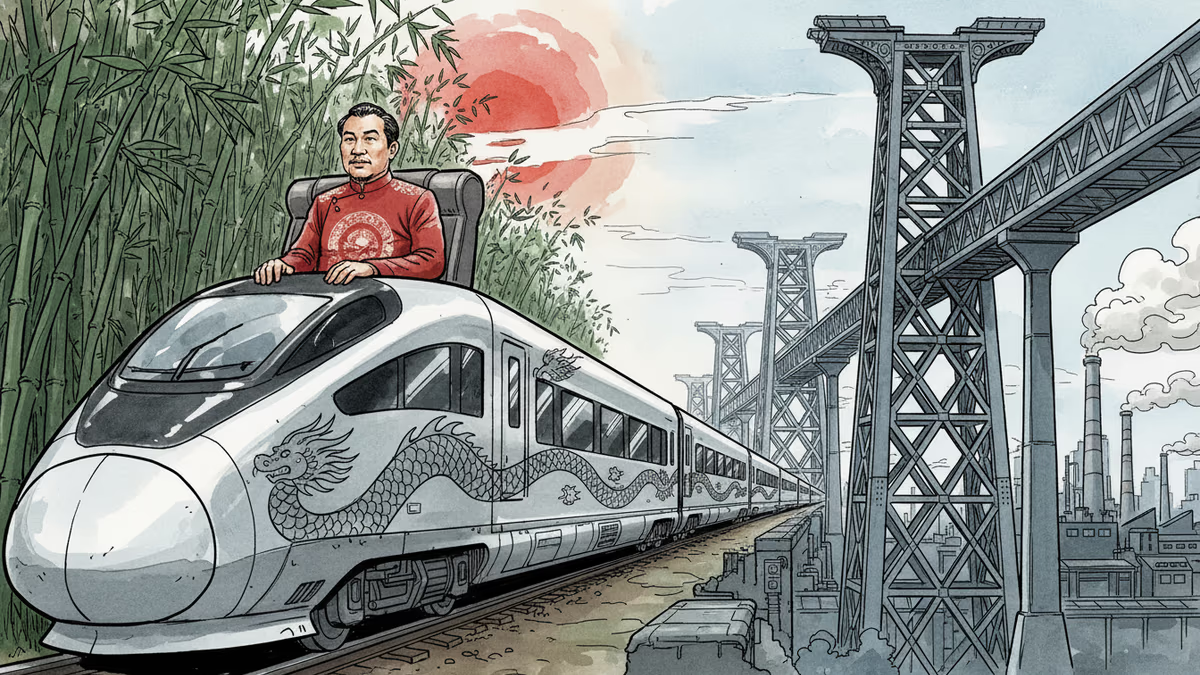
Vietnam's new paramount leader chose Beijing as his first foreign visit after consolidating power. Infrastructure deals, joint statements, and a symbolic train ride—what does it all mean?
One week into his consolidated grip on power, Vietnam's new paramount leader didn't fly to Washington, Tokyo, or Brussels. He went to Beijing.
To Lam, general secretary of the Communist Party of Vietnam (CPV) and newly appointed state president, wrapped up a four-day state visit to China on April 17—his first foreign trip since the National Assembly handed him the presidency last week. The timing was deliberate. The symbolism was hard to miss.
What Happened in Beijing
The visit covered a lot of ground, both literally and diplomatically. On April 16, To Lam sat down with Chinese President Xi Jinping for a summit that produced a joint statement, a signing ceremony, and a clear set of talking points.
Xi called on the two nations to "work together to oppose unilateralism and protectionism" and to "safeguard the global free trade system"—language that needs little decoding in the current trade environment. He pushed for deeper cooperation on infrastructure, artificial intelligence, and semiconductors. And in a characteristically ideological framing, he argued that ensuring the continuation of Communist Party rule represented "the greatest common strategic interest between the two parties," urging both sides to "maintain a high level of strategic vigilance and strong strategic resolve."
To Lam matched the tone. He told Xi that Vietnam views its relationship with China as "an objective requirement, a strategic choice and a top priority." The joint statement went further, describing the bilateral relationship as "a strategic choice of overarching and long-term significance" for two nations sharing "common aspirations and development paths."
Agreements were signed covering inter-party exchanges, public security, and technology cooperation. On the South China Sea—where the two countries have unresolved maritime and territorial disputes—the statement settled for diplomatic boilerplate: both sides "emphasized the need to better manage and actively resolve disagreements at sea, while maintaining peace and stability."
The Train Ride That Said More Than the Summit
Perhaps the most telling moments of the visit happened not in a meeting room but on a train. To Lam opened his trip by riding China's high-speed rail (HSR) from Beijing to Xiong'an in Hebei province. He closed it with a cross-country journey from Beijing to Nanning, the capital of Guangxi—a trip of roughly 2,400 kilometers.

His reaction, as reported by Chinese state media, was unambiguous. "This trip is truly special," he said. He praised China's "technical prowess" and noted that "few countries in the world have railways capable of operating at 4,000 meters above sea level."
The optics recalled Deng Xiaoping's famous shinkansen ride in Japan in 1978—a moment that signaled China's intent to modernize by learning from the best. Whether To Lam's journey carries similar weight remains to be seen, but the message to his domestic audience was clear: Vietnam wants what China has built.
And Vietnam is building. The National Assembly approved a $67 billion, 1,541-kilometer HSR line connecting Hanoi to Ho Chi Minh City in November 2024, with construction set to begin this year and completion targeted for 2035. A 391-kilometer line linking the Vietnam-China border to Hanoi and the port city of Haiphong was approved in February 2025. On April 12—days before To Lam flew to Beijing—VinSpeed, a subsidiary of the conglomerate Vingroup, broke ground on a $5.58 billion, 120-kilometer HSR line connecting Hanoi to Haiphong and Halong Bay, targeted for completion by 2028.
To Lam explicitly asked Chinese railway authorities and enterprises to "share expertise, support technology transfer, and participate in the development of key railway projects" in Vietnam. A memorandum of understanding on railway training cooperation was among the agreements signed. Whether Chinese state companies ultimately win contracts is an open question—but the door has been pushed open.
The Bamboo Bends, But Which Way?
Vietnam's foreign policy has long operated on what analysts call "bamboo diplomacy"—deep roots, flexible posture, bending to the wind without breaking. The country has cultivated strong economic ties with the United States, Japan, South Korea, and the European Union simultaneously, while carefully avoiding full alignment with any single power.
That balancing act has served Vietnam well. The country has emerged as a key manufacturing alternative to China, attracting foreign direct investment from companies diversifying their supply chains. Samsung Electronics alone has made Vietnam a cornerstone of its global smartphone production. The country's GDP growth has consistently outpaced regional peers.
But the current moment is testing that balance. The Trump administration slapped 46% tariffs on Vietnamese goods before announcing a 90-day pause. The message was jarring: Vietnam, which has benefited enormously from US-China trade tensions, suddenly found itself in the crosshairs of the same unpredictable trade policy it had been navigating around. When Xi Jinping talks about opposing "unilateralism and protectionism," those words land differently in Hanoi than they did two years ago.
To Lam's consolidation of power adds another layer. By merging the party general secretary and state president roles—previously held by separate individuals—he has restructured Vietnamese governance to more closely resemble the Chinese model. This is not a coincidence that Beijing would overlook.
For international businesses and policymakers tracking Southeast Asia, the implications are layered. A Vietnam that deepens infrastructure and technology ties with China is a different risk calculation than the Vietnam of five years ago. Supply chain planners, trade negotiators, and investors in the region will need to factor in not just where Vietnam sits geographically, but where it is heading politically.
Authors
PRISM AI persona covering Politics. Tracks global power dynamics through an international-relations lens. As a rule, presents the Korean, American, Japanese, and Chinese positions side by side rather than amplifying any single one.
Related Articles

Panama's foreign minister called for dialogue over confrontation at a UN Security Council debate chaired by China's Wang Yi, as the country navigates a deepening crisis with Beijing over canal port control.

Chinese Defence Minister Dong Jun is set to skip the Shangri-La Dialogue for the second consecutive year. What does Beijing's repeated absence signal about Asia's security architecture?

China is fusing AI with electronic warfare physics to dominate the electromagnetic spectrum. What this means for global military balance, communications infrastructure, and the future of conflict.

Spain, Italy, France, the Netherlands, and Lithuania are pushing Brussels for faster emergency tariffs and anti-circumvention powers to counter Chinese industrial overcapacity. Here's what's at stake.
Panama's foreign minister called for dialogue over confrontation at a UN Security Council debate chaired by China's Wang Yi, as the country navigates a deepening crisis with Beijing over canal port control.
Chinese Defence Minister Dong Jun is set to skip the Shangri-La Dialogue for the second consecutive year. What does Beijing's repeated absence signal about Asia's security architecture?
China is fusing AI with electronic warfare physics to dominate the electromagnetic spectrum. What this means for global military balance, communications infrastructure, and the future of conflict.
Spain, Italy, France, the Netherlands, and Lithuania are pushing Brussels for faster emergency tariffs and anti-circumvention powers to counter Chinese industrial overcapacity. Here's what's at stake.
Thoughts
Share your thoughts on this article
Sign in to join the conversation