

Five EU Nations Want Faster Tariffs Against China's Industrial Glut
Spain, Italy, France, the Netherlands, and Lithuania are pushing Brussels for faster emergency tariffs and anti-circumvention powers to counter Chinese industrial overcapacity. Here's what's at stake.
A piece of paper landed in Brussels with five signatures and one unmistakable message: Europe isn't moving fast enough.
Days before a major EU debate on China trade policy, Spain, Italy, France, the Netherlands, and Lithuania jointly called on the European Commission to take a harder line against what they termed "systemic and structural industrial overcapacity" — diplomatic language that everyone in the room understood as a direct reference to Beijing.
What They're Actually Asking For
The coalition's demands are specific and telling. They want the EU to be able to trigger emergency tariffs faster than current procedures allow. They want existing safeguard measures applied more broadly. And critically, they want new legal powers to block goods that are routed through third countries to dodge existing duties — a practice known as circumvention.
This last point matters more than it might seem. As the US has erected ever-higher walls against Chinese imports — the Trump administration's 145% tariffs being the most dramatic example — displaced Chinese exports need somewhere to go. Europe, with its relatively open market and deep consumer base, is the obvious destination. The five-nation paper is, in part, a preemptive response to that redirection.
The EU has already moved on several fronts. In 2024, it imposed additional duties of up to 35.3% on Chinese electric vehicles, and anti-dumping investigations into solar panels are ongoing. But the signatories argue these tools are too slow and too narrow for the scale of the challenge.
The Fault Lines Inside Europe
Notice who didn't sign.

Germany — the EU's largest economy and the country with the deepest industrial ties to China — is absent from the coalition. Volkswagen, BMW, and BASF generate a substantial share of their revenues in the Chinese market. Berlin has historically preferred negotiation over confrontation with Beijing, and that instinct hasn't disappeared. Hungary has been even more explicit in opposing a hawkish EU trade posture.
For any new trade instrument to become EU law, it must clear a qualified majority vote among member states. Germany's position will be pivotal. A coalition of five, however influential, is not a coalition of twenty-seven.
Beijing, meanwhile, has shown it knows how to apply pressure. China has already launched anti-dumping investigations into EU brandy, pork, and dairy products. French cognac producers took a direct hit. Spanish pork exporters are watching nervously. The countries pushing hardest for tougher measures are the same ones most exposed to Chinese retaliation — a structural tension that Brussels has yet to resolve.
Why This Moment Is Different
The timing of this push reflects something larger than a bilateral trade dispute. The postwar architecture of rules-based trade — centered on the WTO and the principle of non-discrimination — is under sustained pressure from multiple directions simultaneously.
The US has moved toward managed bilateralism. India is tightening import licensing. And now the EU's most industrially significant members are asking for tools that prioritize speed and flexibility over procedural rigor. Each of these moves is individually defensible. Collectively, they describe a world in which the universal rulebook is being replaced by a patchwork of regional shields.
China's position deserves a fair hearing in this frame. Beijing argues its industrial competitiveness reflects decades of genuine investment in technology and supply chains — not merely state subsidies. The line between industrial policy and unfair subsidy is contested terrain, and the WTO has struggled to adjudicate it cleanly. The EU's new instruments would effectively allow Brussels to make that judgment unilaterally and quickly — which is precisely what critics of the proposal find troubling.
What It Means for Businesses and Investors
For companies operating across the EU-China corridor, the direction of travel is clear even if the destination isn't. Supply chains that run through third countries — using Chinese inputs, assembled elsewhere, exported to Europe — face increasing scrutiny under any anti-circumvention regime. The compliance burden will rise.
For investors, the question is which European industries benefit from a more protected market and which lose access to China in retaliation. Steel, solar, and EV components are the obvious sectors to watch. Less obvious are the downstream effects: if Chinese EV prices are kept higher in Europe by tariffs, does that accelerate or slow the continent's own energy transition?
This content is AI-generated based on source articles. While we strive for accuracy, errors may occur. We recommend verifying with the original source.
Related Articles

Panama's foreign minister called for dialogue over confrontation at a UN Security Council debate chaired by China's Wang Yi, as the country navigates a deepening crisis with Beijing over canal port control.

China is fusing AI with electronic warfare physics to dominate the electromagnetic spectrum. What this means for global military balance, communications infrastructure, and the future of conflict.

Trump says a US-Iran nuclear deal is 'largely negotiated.' Iran calls it a 'Persian-style peace.' Both sides claim victory. Here's what's actually at stake.
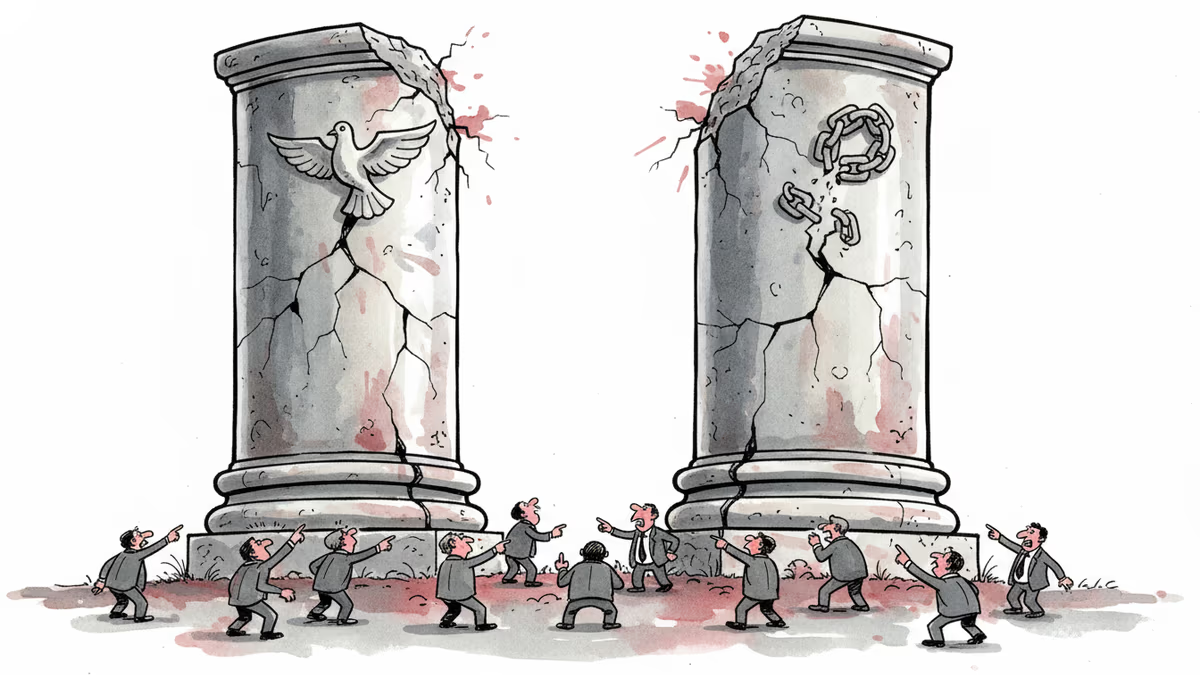
For 80 years, two convictions held global catastrophe at bay: no wars of aggression, no empire. Both are eroding simultaneously. What happened to the peace the UN was built to protect?
Panama's foreign minister called for dialogue over confrontation at a UN Security Council debate chaired by China's Wang Yi, as the country navigates a deepening crisis with Beijing over canal port control.
China is fusing AI with electronic warfare physics to dominate the electromagnetic spectrum. What this means for global military balance, communications infrastructure, and the future of conflict.
Trump says a US-Iran nuclear deal is 'largely negotiated.' Iran calls it a 'Persian-style peace.' Both sides claim victory. Here's what's actually at stake.
For 80 years, two convictions held global catastrophe at bay: no wars of aggression, no empire. Both are eroding simultaneously. What happened to the peace the UN was built to protect?
Thoughts
Share your thoughts on this article
Sign in to join the conversation