

Iran Wants a Deal — On Its Own Terms
Trump says a US-Iran nuclear deal is 'largely negotiated.' Iran calls it a 'Persian-style peace.' Both sides claim victory. Here's what's actually at stake.
Both sides are claiming they won — and that's usually when a deal gets complicated.
President Donald Trump declared this week that a nuclear agreement with Iran is "largely negotiated." Secretary of State Marco Rubio confirmed "significant progress" in talks. From Tehran, Iranian officials responded with a striking phrase: the outcome would be a "Persian-style peace" — implying a settlement on Iran's terms, not Washington's.
When two parties simultaneously announce victory in a negotiation, one of two things is true: either the deal is genuinely balanced, or one side is telling a story to its domestic audience. In this case, the gap between the two narratives is wide enough to drive a missile through.
Why Now: Economics and a Weakened Hand
Iran's decision to engage seriously in talks isn't driven by goodwill. It's driven by pressure. Years of US-led sanctions have hollowed out the Iranian economy — the Iranian rial has lost more than 90% of its value over the past decade, inflation is chronic, and oil export revenues have been severely constrained.
But the timing goes beyond economics. Iran's regional network — what it calls the "Axis of Resistance" — has taken serious hits. Hamas was devastated in the Gaza war. Hezbollah lost key leadership in Israeli strikes in 2024. The Assad regime in Syria collapsed. The proxies and partners Iran spent decades cultivating have been simultaneously weakened. When your external leverage erodes, the negotiating table starts to look more attractive.
For the Trump administration, the calculus is different but equally practical. Walking away from the JCPOA in 2018 was a signature move of Trump's first term. Replacing it with something — anything — that can be framed as stronger would be a diplomatic win. With midterm elections approaching and no shortage of foreign policy fires to manage, a deal with Iran would be a headline the White House badly wants.
What 'Persian-Style Peace' Actually Means
The phrase Iran's officials used isn't decorative. Persian diplomatic tradition has historically favored agreements that preserve face over those that formalize defeat. By invoking it, Iranian negotiators are sending a message to their domestic audience: we didn't capitulate — we negotiated.

Iran's known demands cluster around three points. First, comprehensive sanctions relief — not phased, not conditional on behavior, but substantive and immediate. Second, the right to maintain some uranium enrichment capacity. Third — and most structurally difficult — a legally binding guarantee that the next US administration cannot unilaterally exit the deal.
That third demand is the fault line. Under the US constitutional framework, executive agreements can be reversed by the next president's pen. A treaty would require Senate ratification — a near-impossible threshold in today's political environment. Iran remembers 2018. It wants a lock on the door. The US cannot provide one.
On the American side, the core demand is reportedly a "complete and verifiable" dismantlement of Iran's nuclear program. Iran's position on retaining enrichment capability is a direct contradiction. Both sides are describing a deal. They may not be describing the same deal.
The Stakeholders Who Aren't at the Table
Israel views any agreement that leaves Iran with enrichment capacity as a bad deal, full stop. Prime Minister Netanyahu's government will use its relationship with Trump to push for harder terms — and has significant leverage to do so. The question is whether Washington is willing to let Tel Aviv's red lines define American negotiating positions.
The Gulf states — Saudi Arabia, the UAE, and others — want Iran's nuclear threat contained, but they don't want a sanctions-free Iran flush with oil revenue competing for regional dominance. A stronger Iran economically is a more assertive Iran geopolitically. Their support for a deal is conditional and quiet.
China and Russia are formally outside the talks but remain Iran's largest oil customer and diplomatic backstop, respectively. A successful deal that reintegrates Iran into Western economic systems would reduce Tehran's dependence on Beijing and Moscow. Neither capital has an obvious incentive to cheer for success.
If It Holds, If It Doesn't
A finalized agreement would send Iranian oil back into global markets at scale, adding supply pressure to prices already navigating OPEC+ production decisions. Energy markets would react quickly. Beyond commodities, a deal would reshape the security architecture of the Middle East in ways that ripple through defense spending, alliance structures, and the calculus of every regional actor.
A collapse is its own kind of event. Iran's uranium enrichment is currently at 60% purity — technically weeks away from weapons-grade 90% if the decision were made to sprint. A failed negotiation restarts the clock on military option discussions in both Washington and Jerusalem, and puts European allies back in the uncomfortable position of choosing sides.
This content is AI-generated based on source articles. While we strive for accuracy, errors may occur. We recommend verifying with the original source.
Related Articles

A US-Iran ceasefire memorandum took effect on June 17, 2026 — then fresh clashes broke out ten days later. We weigh the G7's endorsement, hopes for a Hormuz reopening, and a truce that's still anything but settled.

Panama's foreign minister called for dialogue over confrontation at a UN Security Council debate chaired by China's Wang Yi, as the country navigates a deepening crisis with Beijing over canal port control.
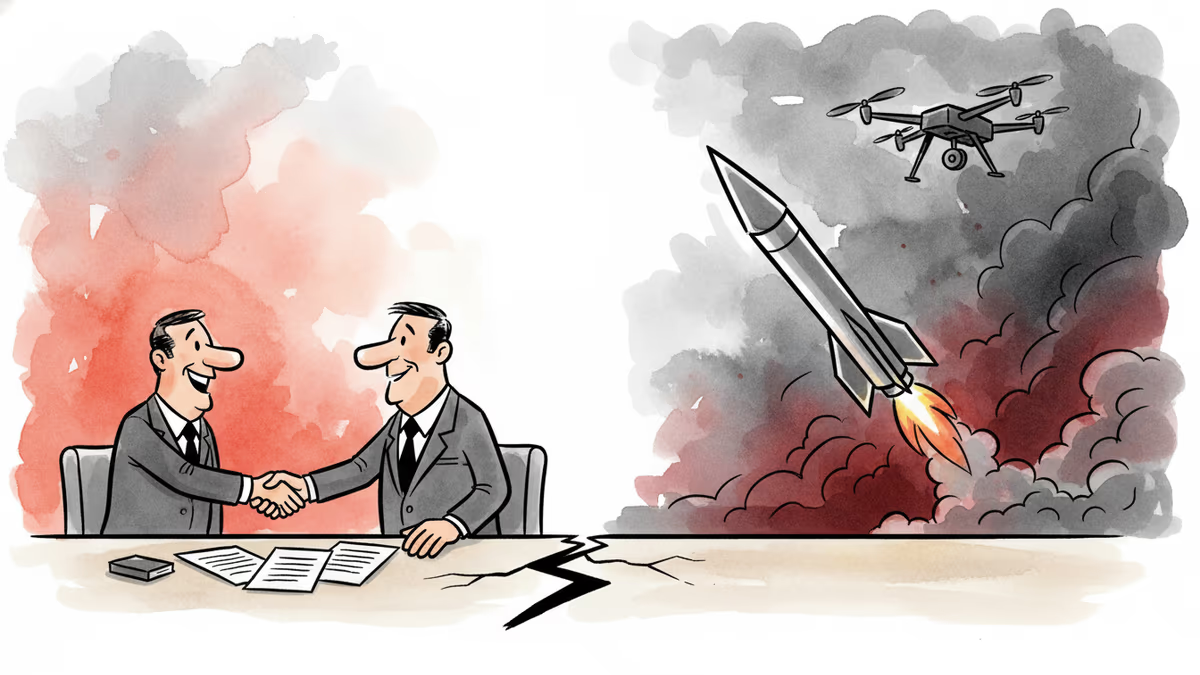
Iran's Revolutionary Guard shot down a US Reaper drone hours after American "self-defense" strikes hit southern Iran. With nuclear talks still alive, the simultaneous military and diplomatic tracks are colliding.

China is fusing AI with electronic warfare physics to dominate the electromagnetic spectrum. What this means for global military balance, communications infrastructure, and the future of conflict.
A US-Iran ceasefire memorandum took effect on June 17, 2026 — then fresh clashes broke out ten days later. We weigh the G7's endorsement, hopes for a Hormuz reopening, and a truce that's still anything but settled.
Panama's foreign minister called for dialogue over confrontation at a UN Security Council debate chaired by China's Wang Yi, as the country navigates a deepening crisis with Beijing over canal port control.
Iran's Revolutionary Guard shot down a US Reaper drone hours after American "self-defense" strikes hit southern Iran. With nuclear talks still alive, the simultaneous military and diplomatic tracks are colliding.
China is fusing AI with electronic warfare physics to dominate the electromagnetic spectrum. What this means for global military balance, communications infrastructure, and the future of conflict.
Thoughts
Share your thoughts on this article
Sign in to join the conversation