
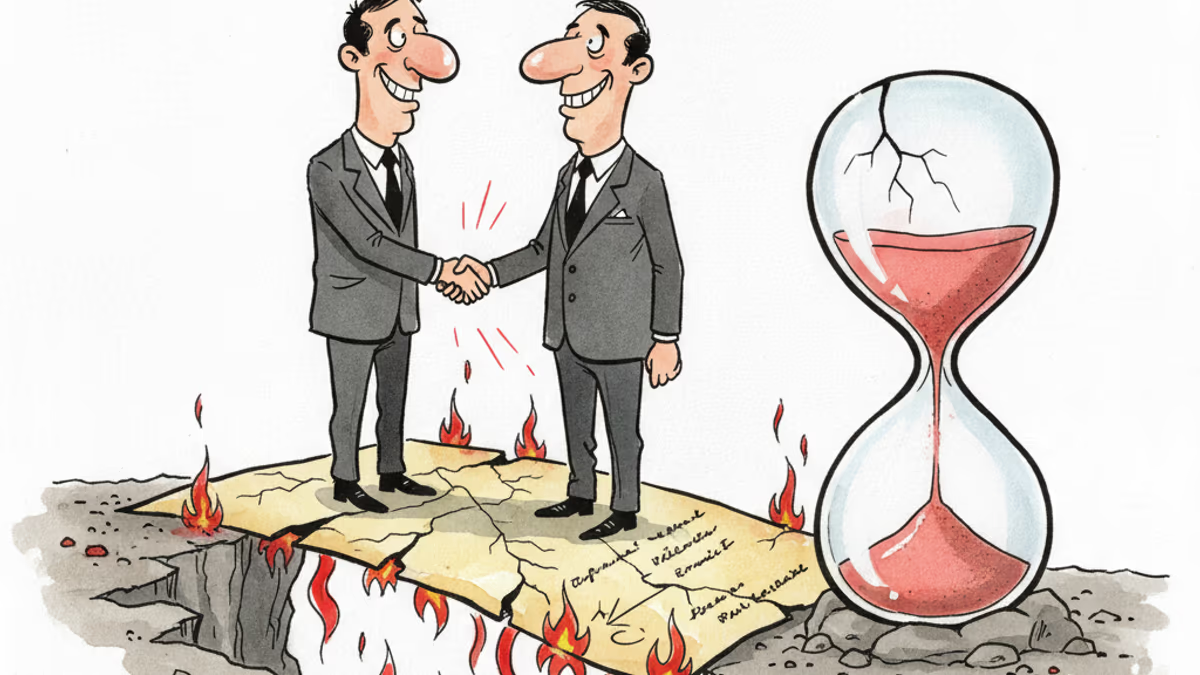
Ten Days After the Ceasefire Memo, US and Iran Trade Fire Again: The 60-Day Clock Keeps Ticking
A US-Iran ceasefire memorandum took effect on June 17, 2026 — then fresh clashes broke out ten days later. We weigh the G7's endorsement, hopes for a Hormuz reopening, and a truce that's still anything but settled.
The memo was signed on June 17. The fighting resumed on June 28. In barely ten days, the world watched a war stop and then flare again.
On June 17, 2026, the United States and Iran signed a memorandum of understanding (MoU) to halt a war that had dragged on for four months. A White House official told CBS that the memo commits the two sides to a 60-day ceasefire and is currently “in effect.” That same day, a G7 summit wrapping up in Évian-les-Bains, France, welcomed the deal in a joint statement. Yet as of today, July 1, whether the ceasefire is actually holding on the ground remains an open question.
What Was Signed — A Framework, Not a Treaty
The memo is a skeleton agreement: roughly 800 words across 14 articles. It's not a final peace treaty. It's closer to a frame that punts the hardest questions to follow-on talks over the next 60 days, with the option to extend. Pakistan's prime minister brokered it, which is why it's often called the “Islamabad memorandum.”
Even the way it was signed departs from a conventional treaty. US President Donald Trump and Iranian President Masoud Pezeshkian didn't meet face to face — they signed remotely. Earlier, on June 14, US Vice President JD Vance and Iranian parliament speaker Mohammad Bagher Ghalibaf reportedly signed digitally first. In other words, the image of a “leader-to-leader treaty inked across a table” sits some distance from how this actually came together.
The full text hasn't been officially released by the White House either. Al Jazeera, NPR and others published versions they obtained, but these amount to “the US-side account of an unpublished memo,” and the exact wording may differ from outlet to outlet. Based on those obtained copies, the core provisions read as follows:
- An immediate and permanent end to military operations across all fronts, including Lebanon
- The US lifting its naval blockade within 30 days; Iran clearing mines within 30 days
- A $300 billion reconstruction and economic-development plan led by the US and regional partners
- A full phased lifting of sanctions on Iran
- Iran reaffirming it will not develop nuclear weapons, with enriched material handled under IAEA supervision
- The final deal to be ratified by a binding UN Security Council resolution
The G7's Endorsement, and the Question Marks It Leaves
That same day, G7 leaders said in their joint statement: “We welcome the agreement between the United States and Iran secured under the strong leadership of President Trump.” The statement also declared that it “reaffirms that Iran must never acquire a nuclear weapon.” Both sentences can be checked against the full text published by GOV.UK and the Élysée Palace.
Unanimous backing from all seven governments is the strongest card the optimists hold. The document, after all, spells out a permanent end to hostilities, the lifting of the blockade, a large reconstruction fund, and Security Council ratification. On expectations that Hormuz shipping would reopen, global oil prices slipped and Asian markets rebounded.
But the same statement also tightened sanctions on Russia — a reminder of the wider energy geopolitics this deal sits inside. Hopes for peace in the Middle East and sanctions on Russian energy now share a single document.
PRISM Insight — Hidden Context
It's worth weighing the word “signed” more carefully. This wasn't a treaty inked in person. It was a remote signature, preceded by a digital signing between a vice president and a parliament speaker, framing 14 articles the White House still hasn't released. The fighting that spread to Bahrain and Kuwait on June 28 laid bare just how thin that frame is.

The Reversal Ten Days Later — Why “Fragile” Is the Word
Just over ten days after the signing, on June 28, the situation buckled. Iran struck Bahrain and Kuwait (per CNN's live coverage on June 28), and both countries condemned the attacks. Trump warned, in effect, that if the attacks continued Iran would “no longer exist,” while reports followed that Tehran had threatened to walk away from talks. Both the Washington-based CSIS and the UK House of Commons Library have described this ceasefire as “fragile.”
At the heart of the dispute is a clash over interpretation. Iran says the US recognized its right to enrich uranium; the US denies it. The two sides also tell different stories about how far IAEA inspections are allowed to go. It's a sign that the memo papered over the conflict without resolving it.
Then there's the Israel variable. This war began as a joint US-Israeli operation, yet the parties to the memo are the US and Iran. Israel's own position, along with conditions for disarming Hezbollah in Lebanon, remains a separate wildcard — and the G7 statement itself referenced Hezbollah's disarmament.
So two readings sit side by side. One expects stabilization, pointing to the permanent end to hostilities and the reconstruction and ratification steps written into the text. The other questions how long it can last, pointing to the June 28 clashes and the unresolved disputes.
So What About the Price at the Pump — Four Regions Do the Math
One reason this deal grips global attention is the Strait of Hormuz. According to the EIA, Hormuz is the passage for about 20% of the world's oil consumption (based on roughly 20 million barrels a day). Measured by seaborne crude trade, that share rises to 25–27%. The two figures rest on different baselines and shouldn't be used interchangeably.
Energy-importing economies run the numbers a little differently.
South Korea is relieved but isn't easing off its push to diversify. The Middle East supplies around 34.4% of its naphtha imports — the feedstock for petrochemicals — so a blockade or a hit to facilities lands directly on refiners' and petrochemical makers' raw-material supply. Even so, the Korea Institute for International Economic Policy (KIEP) expects that even with an early ceasefire, oil would hold nearer $90 a barrel rather than returning to the pre-war $63. A prolonged blockade, it warns, leaves room for $100 to $117.
Japan leans toward “cautious optimism.” Hopes of a Hormuz reopening lifted the Nikkei average and eased oil prices, but with roughly 40% of its petrochemical feedstock coming from the Middle East, a blockade ripples through the entire value chain, not just fuel. The Nikkei framed this as the structural vulnerability of a resource-poor nation.
In the English-speaking world, claims of a Trump diplomatic win run up against domestic skepticism. The White House stresses the memo is in effect, while CSIS and others flag the unpublished provisions and the disputes over nuclear inspections and enrichment rights as unresolved.
For readers in the Chinese-speaking world, this is a place to stick closely to the facts. China is the largest buyer of Iranian crude; during the blockade at least two China-bound tankers turned back, and on May 8 a tanker carrying Chinese crew was reportedly hit. Chinese Foreign Minister Wang Yi is reported to have urged Iran to “keep negotiating” and said that “resuming hostilities would be unwise.” Taiwan's government has issued no confirmed official position; as an energy importer, coverage there centered on the response in oil and equity markets.
PRISM Insight — Reader Impact
“So what does this mean for my fuel bill?” Hormuz carries about 20% of global oil consumption (EIA). Prices dipped on hopes the strait would reopen, but KIEP still pegs oil near $90 a barrel even with an early ceasefire. With the Middle East supplying 34.4% of South Korea's naphtha and about 40% of Japan's petrochemical feedstock, ceasefire headlines may not translate into cheaper prices any time soon.
The 60-Day Clock Keeps Running
The memo took effect provisionally, with a 60-day negotiating window attached. Only if both sides untangle the two sticking points within that window — the right to enrich and IAEA inspections — does it move toward a final deal. The text goes as far as Security Council ratification and setting up an enforcement body to monitor compliance, but whether that body actually functions looks likely to decide how permanent any of this proves.
That makes the next 30 days the first real test. Whether the lifting of the naval blockade and the mine clearance the memo promises are actually carried out, and whether the gap over enrichment rights and IAEA inspections narrows, will determine whether this truce hardens into an agreement or slides back into another round of fighting.
This content is AI-generated based on source articles. While we strive for accuracy, errors may occur. We recommend verifying with the original source.
Related Articles
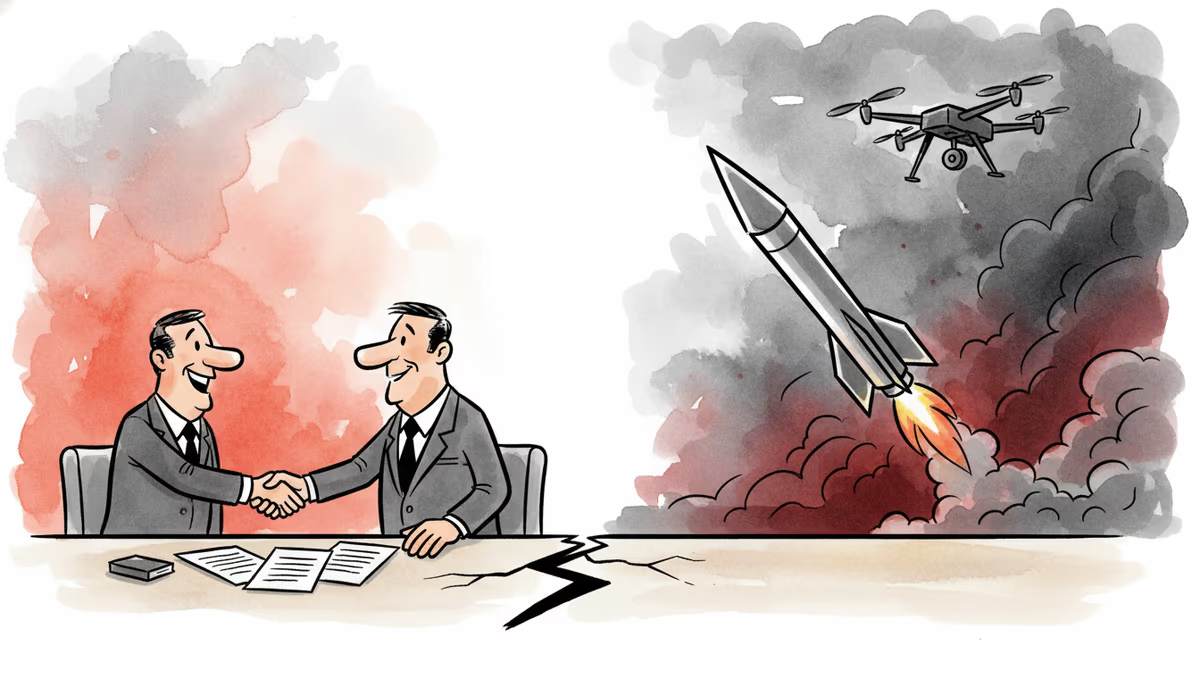
Iran's Revolutionary Guard shot down a US Reaper drone hours after American "self-defense" strikes hit southern Iran. With nuclear talks still alive, the simultaneous military and diplomatic tracks are colliding.

Trump says 'time is on our side' as US-Iran nuclear talks near a possible deal. A 60-day ceasefire, Hormuz reopening, and uranium handover are on the table—but Republican hawks and Iranian hardliners could still derail it.

Trump says a US-Iran nuclear deal is 'largely negotiated.' Iran calls it a 'Persian-style peace.' Both sides claim victory. Here's what's actually at stake.
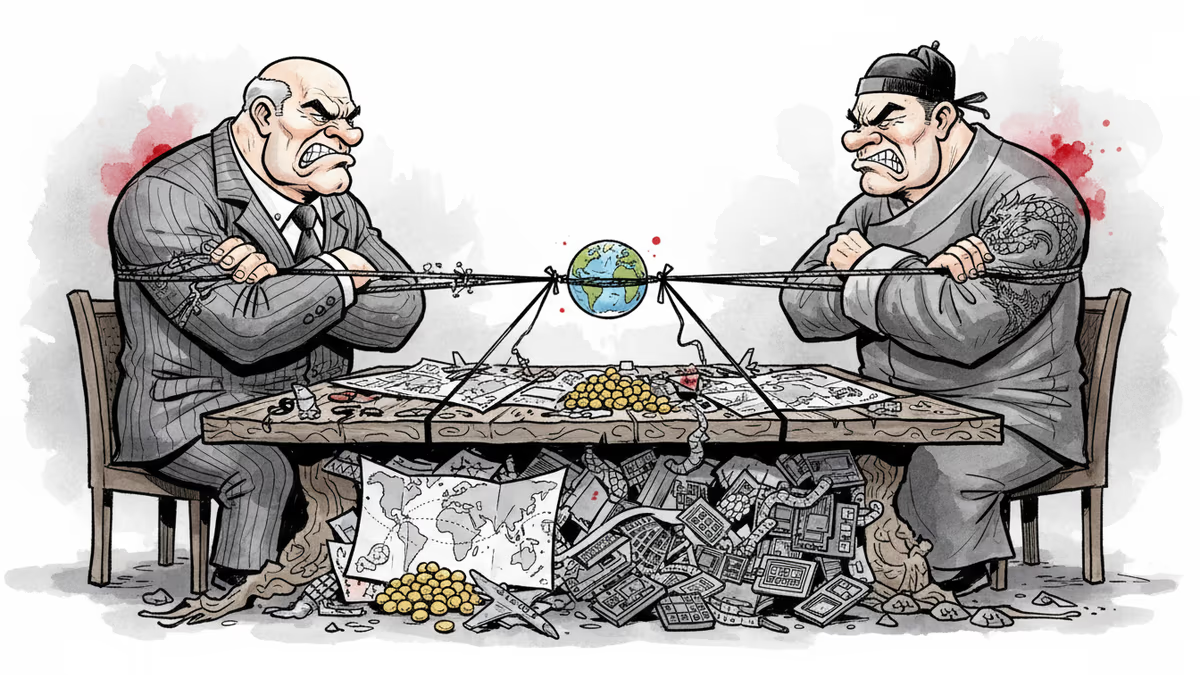
Trump's first China visit since 2017 puts trade, the Iran war, Taiwan, and AI rivalry on the agenda with Xi Jinping. What each side wants—and what neither can afford to concede.
Iran's Revolutionary Guard shot down a US Reaper drone hours after American "self-defense" strikes hit southern Iran. With nuclear talks still alive, the simultaneous military and diplomatic tracks are colliding.
Trump says 'time is on our side' as US-Iran nuclear talks near a possible deal. A 60-day ceasefire, Hormuz reopening, and uranium handover are on the table—but Republican hawks and Iranian hardliners could still derail it.
Trump says a US-Iran nuclear deal is 'largely negotiated.' Iran calls it a 'Persian-style peace.' Both sides claim victory. Here's what's actually at stake.
Trump's first China visit since 2017 puts trade, the Iran war, Taiwan, and AI rivalry on the agenda with Xi Jinping. What each side wants—and what neither can afford to concede.
Thoughts
Share your thoughts on this article
Sign in to join the conversation