

Trump Tells Iran Negotiators to Slow Down—But Why Now?
Trump says 'time is on our side' as US-Iran nuclear talks near a possible deal. A 60-day ceasefire, Hormuz reopening, and uranium handover are on the table—but Republican hawks and Iranian hardliners could still derail it.
Two days ago, Trump said the deal was "largely negotiated." Now he's telling his team not to rush.
On Sunday, US President Donald Trump posted on Truth Social that he had instructed his negotiators "not to rush into a deal" with Iran, adding that "time is on our side." The message landed just 48 hours after he declared an agreement had been "largely negotiated"—a statement that sent speculation of an imminent announcement rippling through international media. The reversal, if it is one, raises a question worth sitting with: is this caution, or is this leverage?
What's Actually on the Table
According to US media reports, the framework under discussion involves three main elements: a 60-day ceasefire extension, the reopening of the Strait of Hormuz, and further negotiations over Iran's nuclear program. Some outlets have also reported that Iran would hand over its stockpile of highly-enriched uranium—estimated at around 440 kilograms, enough material to be of serious concern to nonproliferation experts.
Secretary of State Marco Rubio described progress as "significant" but "not final," and offered a notable hint on Hormuz: if recent progress holds, the result could be "a completely open strait... without tolls." Pakistan's Deputy Prime Minister Ishaq Dar, who has been mediating the talks, called the atmosphere "grounds for optimism" and said a positive outcome was "within reach."
Iran's foreign ministry spokesperson Esmail Baghaei acknowledged progress over the weekend but was careful to add that this "does not mean agreements would be reached on key issues." Iranian state media reported that "one or two" points of disagreement remain. Tehran also confirmed it is finalizing a "memorandum of understanding"—the same phrase Trump used in a Saturday post—that would allow additional talks toward a final agreement.
The Conflict Behind the Negotiation

To understand the stakes, it helps to remember how this started. On February 28, the US and Israel launched wide-ranging strikes on Iran, triggering a cascade of retaliatory attacks across the Middle East. A ceasefire brokered in April has largely held, though sporadic exchanges of fire have continued. Since early April, the US has enforced a naval blockade of Iranian ports, while Iran has responded by effectively closing the Strait of Hormuz.
That closure matters enormously. Roughly 20% of the world's oil and liquefied natural gas passes through the strait. The blockade has sent energy prices soaring globally—a pressure point that cuts both ways. Iran's economy suffers under the blockade; the rest of the world suffers under the Hormuz closure. The mutual pain is, in theory, what brings both sides to the table.
Trump's line that "time is on our side" reframes the blockade not just as a military tool but as a negotiating asset. Every day the deal isn't signed is another day of economic pressure on Tehran. Slowing down, paradoxically, can be a form of acceleration—if the other side blinks first.
The Fault Lines Within Each Camp
The proposed deal has exposed a genuine split inside the Republican Party. Senator Ted Cruz called it "a disastrous mistake." Roger Wicker, who chairs the Senate Armed Services Committee, warned that a 60-day ceasefire would render "everything accomplished by Operation Epic Fury" meaningless. The argument from hawks is straightforward: military gains shouldn't be traded for a temporary pause that lets Iran regroup.
On the other side, Representative Mike Lawler of the House Foreign Affairs Committee credited the administration with forcing Iran into "a real negotiation"—something previous administrations tried and failed to sustain. The divide isn't simply about Iran; it reflects a deeper tension within the Republican coalition between those who see diplomacy as weakness and those who see it as a tool of strength.
Iran's internal politics are no less complicated. The government in Tehran must present any agreement as something other than capitulation. Handing over highly-enriched uranium and reopening a waterway it has used as leverage would require careful domestic framing. Move too fast, concede too visibly, and the deal becomes a liability at home.
This is the structural challenge of negotiations between adversaries who are also both managing internal audiences: the deal that satisfies Washington's hawks may be the one that sinks Tehran's moderates, and vice versa.
This content is AI-generated based on source articles. While we strive for accuracy, errors may occur. We recommend verifying with the original source.
Related Articles

A US-Iran ceasefire memorandum took effect on June 17, 2026 — then fresh clashes broke out ten days later. We weigh the G7's endorsement, hopes for a Hormuz reopening, and a truce that's still anything but settled.
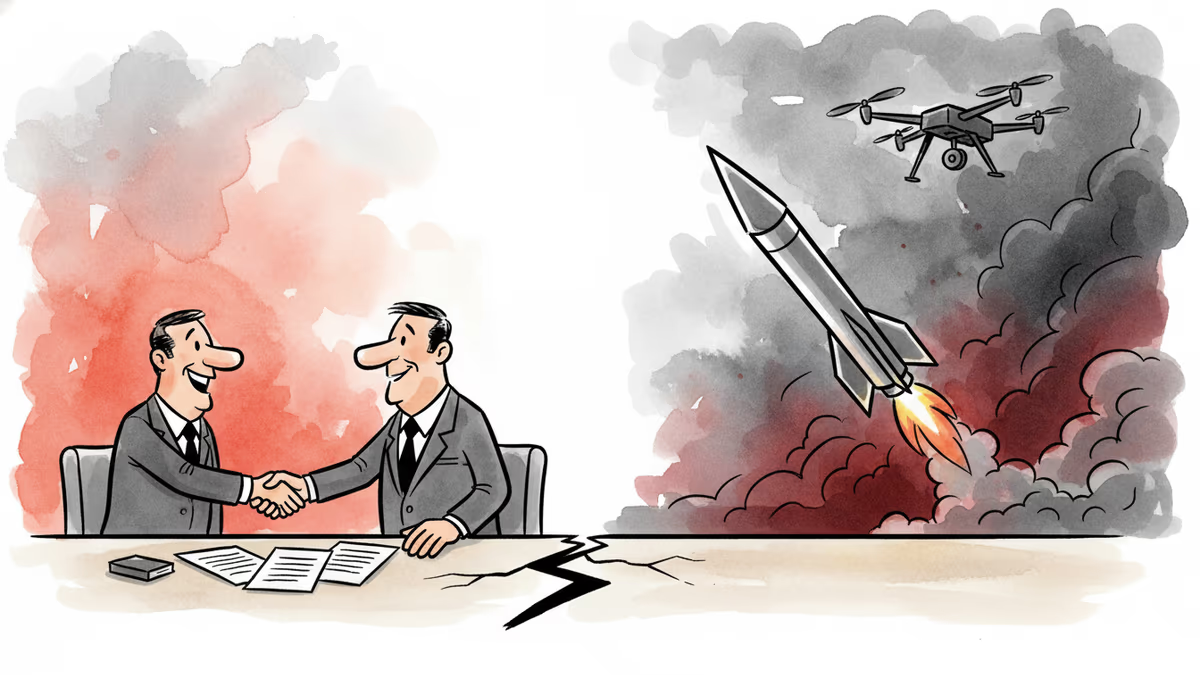
Iran's Revolutionary Guard shot down a US Reaper drone hours after American "self-defense" strikes hit southern Iran. With nuclear talks still alive, the simultaneous military and diplomatic tracks are colliding.

Trump says a US-Iran nuclear deal is 'largely negotiated.' Iran calls it a 'Persian-style peace.' Both sides claim victory. Here's what's actually at stake.
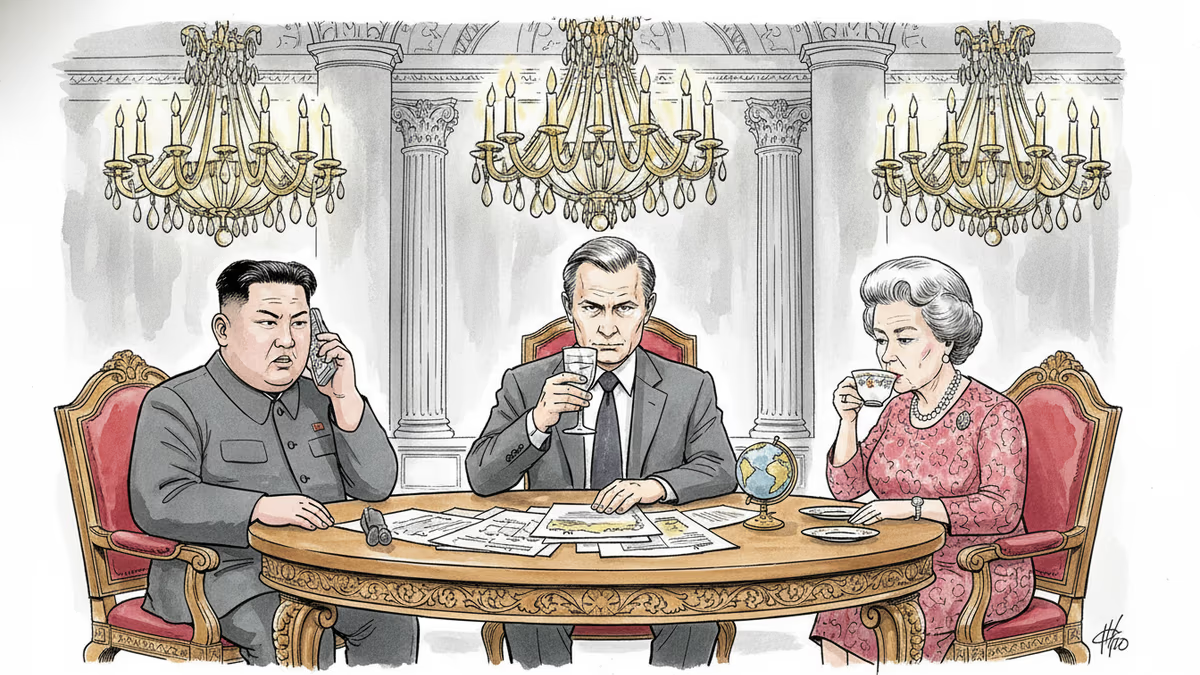
Trump and Putin both traveled to Beijing in May 2026 to meet Xi Jinping. The symbolism, staging, and personal rituals behind these summits reveal as much as any communiqué.
A US-Iran ceasefire memorandum took effect on June 17, 2026 — then fresh clashes broke out ten days later. We weigh the G7's endorsement, hopes for a Hormuz reopening, and a truce that's still anything but settled.
Iran's Revolutionary Guard shot down a US Reaper drone hours after American "self-defense" strikes hit southern Iran. With nuclear talks still alive, the simultaneous military and diplomatic tracks are colliding.
Trump says a US-Iran nuclear deal is 'largely negotiated.' Iran calls it a 'Persian-style peace.' Both sides claim victory. Here's what's actually at stake.
Trump and Putin both traveled to Beijing in May 2026 to meet Xi Jinping. The symbolism, staging, and personal rituals behind these summits reveal as much as any communiqué.
Thoughts
Share your thoughts on this article
Sign in to join the conversation