
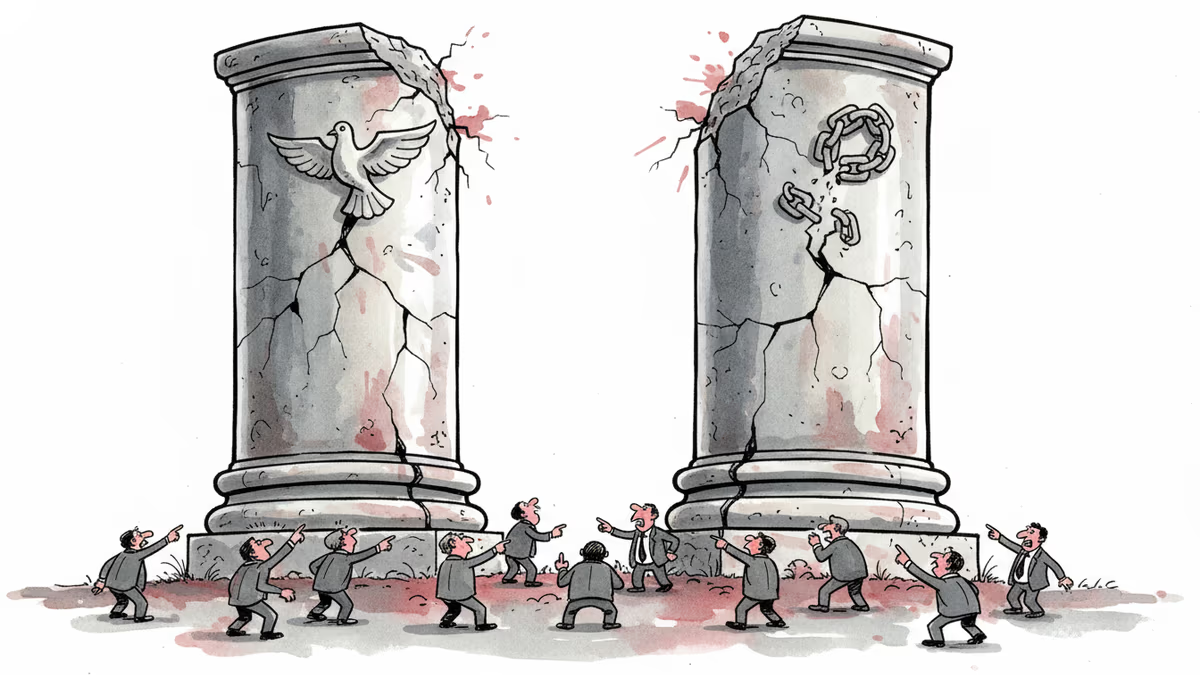
The Two Promises That Kept the World from War—Are Breaking
For 80 years, two convictions held global catastrophe at bay: no wars of aggression, no empire. Both are eroding simultaneously. What happened to the peace the UN was built to protect?
A hundred million dead. That's what it took to produce two simple convictions: that wars of conquest are intolerable, and that empires must end. For 80 years, those convictions—not NATO, not American military supremacy—were the actual load-bearing walls of global peace. Right now, both are cracking at once.
What the "Long Peace" Was Really Built On
Thant Myint-U, a Senior Fellow at the United Nations Foundation and grandson of former UN Secretary-General U Thant, argues in Foreign Affairs that the standard diagnosis of today's crisis is wrong. Most analysts blame the collapse of the so-called liberal international order—the post-Cold War arrangement underwritten by American power. Washington's retreat from NATO, the WTO, and multilateral institutions is real. But Thant Myint-U insists this conflates two very different things.
The liberal international order didn't create the long peace. In important ways, it actually undermined it—by centering global stability on American primacy rather than the moral convictions that originally animated the UN Charter. The real catastrophe isn't institutional. It's a collapse of collective memory and political imagination.
The evidence is hard to dismiss. Russia invaded Ukraine. The United States and Israel launched a war against Iran. Nuclear arsenals are expanding. Strategic arms control agreements have lapsed. Nuclear facilities have come under direct military attack. And in Ukraine, Palestine, Sudan, and Iran, UN peacemaking is, in his words, "missing in action."
When the UN Actually Worked

The UN wasn't always this absent. In 1956, Swedish Secretary-General Dag Hammarskjöld deployed the UN's first peacekeeping force to Egypt practically overnight during the Suez Crisis—giving France, Israel, and the United Kingdom a face-saving exit from an invasion that had already become a political disaster. In 1958, a UN observer mission in Lebanon helped create the conditions for an American military withdrawal. The secretary-general had no army. What he had was the moral authority of a genuinely impartial mediator, and—crucially—a world that still believed wars of aggression were wrong.
At the same moment, newly independent states from Asia and Africa were flooding into the UN General Assembly, many of them fresh from decades-long independence struggles. They read the UN Charter's language of sovereign equality and human dignity with a fervor its Western authors hadn't anticipated. In 1960, the Afro-Asian bloc pushed through the landmark Declaration on the Granting of Independence to Colonial Countries and Peoples, placing the UN unambiguously against empire. Their argument went further than flag-swapping: real sovereignty meant freedom from political interference and economic domination. A world of genuine equals, they argued, was the only stable foundation for lasting peace.
Thant Myint-U's point is that none of this worked because the institutions were perfect—they weren't. It worked because the convictions animating those institutions were politically alive, defended by states and peoples who had lived through what happens when they're abandoned.
The Diagnosis Nobody Wants to Hear
Here's where the argument gets genuinely uncomfortable. Thant Myint-U isn't calling for a new institutional architecture as the first step. He's explicitly skeptical that Security Council reform or structural fixes can precede the harder work. What's needed first, he argues, is the restoration of the twin convictions themselves—through political leaders willing to publicly champion them, a new UN secretary-general prepared to demonstrate them in action, and a global public willing to demand a world with neither war nor empire.
This matters for a specific reason. The world now emerging—where no single power can organize international politics around its own preferences—resembles the multipolar landscape of 1955 to 1990 far more than the American-dominated decades that followed. In that earlier era, it was precisely when warring parties approached exhaustion but couldn't find an exit that UN secretaries-general proved indispensable. The recent U.S.-Israeli war against Iran may be a preview of future conflicts where belligerents need exactly this kind of off-ramp—one that doesn't just stop the shooting but reinforces the taboo against aggression and the principle that the age of empire cannot return.
Skeptics will note that the UN's record is deeply uneven, that the Security Council veto has paralyzed collective action repeatedly, and that powerful states have always bent the rules when their interests demanded it. These are fair objections. But they don't quite meet Thant Myint-U's argument, which isn't that the UN was ever sufficient—only that it was sometimes necessary, and that the conditions which made it useful can be rebuilt.
This content is AI-generated based on source articles. While we strive for accuracy, errors may occur. We recommend verifying with the original source.
Related Articles

Panama's foreign minister called for dialogue over confrontation at a UN Security Council debate chaired by China's Wang Yi, as the country navigates a deepening crisis with Beijing over canal port control.

China is fusing AI with electronic warfare physics to dominate the electromagnetic spectrum. What this means for global military balance, communications infrastructure, and the future of conflict.

Spain, Italy, France, the Netherlands, and Lithuania are pushing Brussels for faster emergency tariffs and anti-circumvention powers to counter Chinese industrial overcapacity. Here's what's at stake.

Trump says a US-Iran nuclear deal is 'largely negotiated.' Iran calls it a 'Persian-style peace.' Both sides claim victory. Here's what's actually at stake.
Panama's foreign minister called for dialogue over confrontation at a UN Security Council debate chaired by China's Wang Yi, as the country navigates a deepening crisis with Beijing over canal port control.
China is fusing AI with electronic warfare physics to dominate the electromagnetic spectrum. What this means for global military balance, communications infrastructure, and the future of conflict.
Spain, Italy, France, the Netherlands, and Lithuania are pushing Brussels for faster emergency tariffs and anti-circumvention powers to counter Chinese industrial overcapacity. Here's what's at stake.
Trump says a US-Iran nuclear deal is 'largely negotiated.' Iran calls it a 'Persian-style peace.' Both sides claim victory. Here's what's actually at stake.
Thoughts
Share your thoughts on this article
Sign in to join the conversation