
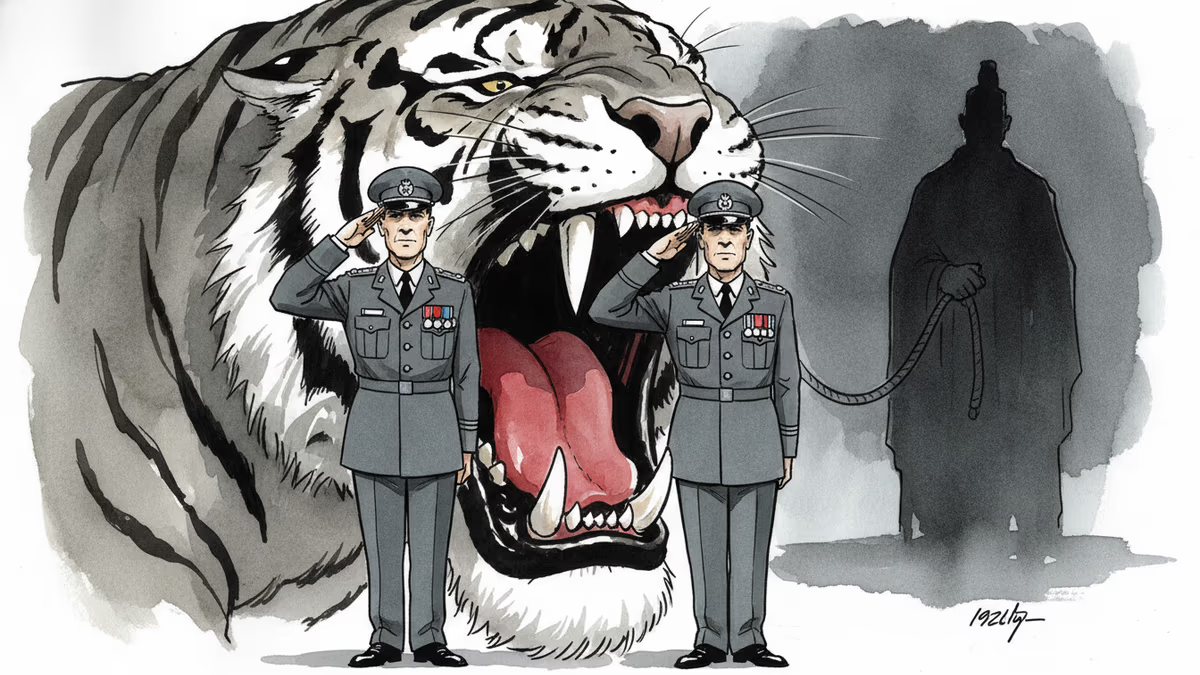
The Tiger's Court: China Sentences Two Defense Ministers to Death
China has handed suspended death sentences to former defense ministers Wei Fenghe and Li Shangfu. The ruling signals Xi Jinping's tightening grip on the PLA ahead of the 2027 Party Congress.
Two men who once commanded China's nuclear arsenal and weapons procurement are now waiting out their days in a military prison — sentenced to die, then not die, then live forever behind bars.
On May 7, China officially announced that Wei Fenghe and Li Shangfu — the 12th and 13th defense ministers of the People's Republic — had been sentenced to death with a two-year reprieve, with all personal assets confiscated. Wei was convicted of accepting bribes; Li of both taking and giving them. Neither is expected to be executed. Under Chinese law, the reprieve almost certainly converts to life imprisonment, provided no further violations occur during the two-year window.
But the message wasn't really about these two men. It was addressed to everyone still wearing a uniform.
What a Suspended Death Sentence Actually Means
In China's legal system, a suspended death sentence occupies a precise psychological space. It is more severe than life imprisonment — carrying the weight of a death warrant — but less destabilizing than an actual execution. For the Communist Party's anti-corruption machinery, it is a precision instrument: maximum deterrence, minimum blowback.
The last confirmed case of a senior PLA officer receiving this sentence was Gu Junshan, former deputy director of the General Logistics Department, whose corruption reportedly totaled over 600 million yuan (approximately $98 million). Gu reportedly cooperated with investigators, naming colleagues to avoid outright execution. His cooperation triggered a cascade: former CMC Vice Chairmen Guo Boxiong and Xu Caihou fell next. Xu died before sentencing; Guo received life imprisonment, as did former PLA Chief of Staff Fang Fenghui in 2017.
Notably, those earlier cases ended at life sentences — not suspended death. The escalation to a heavier penalty for Wei and Li suggests the scale of their alleged corruption exceeded even Gu's, likely implicating the operational readiness of the Rocket Force and Equipment Development Department they each led.
Three Reasons Xi Chose This Sentence
China's military courts are not independent. High-profile sentencing requires the explicit approval of the CMC chairman — Xi Jinping himself. So why a suspended death sentence rather than life imprisonment?

The calculus appears to have three parts.
The first is deterrence. A suspended death sentence sends a categorically different signal than life imprisonment. It tells every officer still on active duty that the floor of consequences has dropped. The second is stability. Actual executions of former defense ministers would risk demoralizing the officer corps and creating dangerous uncertainty within the institution Xi needs to control. The suspended sentence threads that needle: severe enough to inspire compliance through fear, contained enough to avoid institutional rupture.
The third is timing. The 21st Party Congress is scheduled for 2027, at which Xi is expected to extend his tenure for another five years. Ahead of that consolidation, demonstrating unambiguous dominance over the military is not optional — it is foundational. The sentencing of two former defense ministers, announced publicly and without ambiguity, is a message broadcast across every barracks in China.
Both Wei and Li reportedly resisted cooperating with investigators initially before eventually providing information on former colleagues. That cooperation likely saved them from execution but will draw additional officers into the investigation. Four current or former CMC members — Miao Hua, He Weidong, Zhang Youxia, and Liu Zhenli — remain under scrutiny. Their fates now look considerably darker.
The Capability Question Nobody in Beijing Wants to Ask
There is a harder problem underneath the political spectacle.
The Rocket Force manages China's nuclear and conventional missile arsenal. The Equipment Development Department oversees weapons procurement and advanced military technology. Both organizations had their top leadership removed on corruption charges. The question that follows — how deeply did that corruption compromise actual military readiness? — is one that Xi's government has every incentive to suppress and every reason to fear.
Historically, purge-driven militaries face a structural dilemma. Fear-based compliance produces visible loyalty but suppresses the independent judgment, tactical creativity, and honest upward reporting that effective fighting forces depend on. The Soviet Red Army after Stalin's 1937 purges performed disastrously in Finland within two years. Saddam Hussein's officer corps, hollowed out by political loyalty requirements, collapsed in weeks in 2003.
Xi may be building a more obedient PLA. Whether obedience and battlefield effectiveness move in the same direction is a question that will only be answered under conditions nobody should want to test.
For now, the climate inside the PLA is one of pervasive anxiety. Senior officers are watching two of their predecessors sentenced to a fate worse, psychologically, than simple imprisonment — and waiting to see whose name appears next. The ancient Chinese saying has never felt more apt: accompanying an emperor is like accompanying a tiger.
This content is AI-generated based on source articles. While we strive for accuracy, errors may occur. We recommend verifying with the original source.
Related Articles
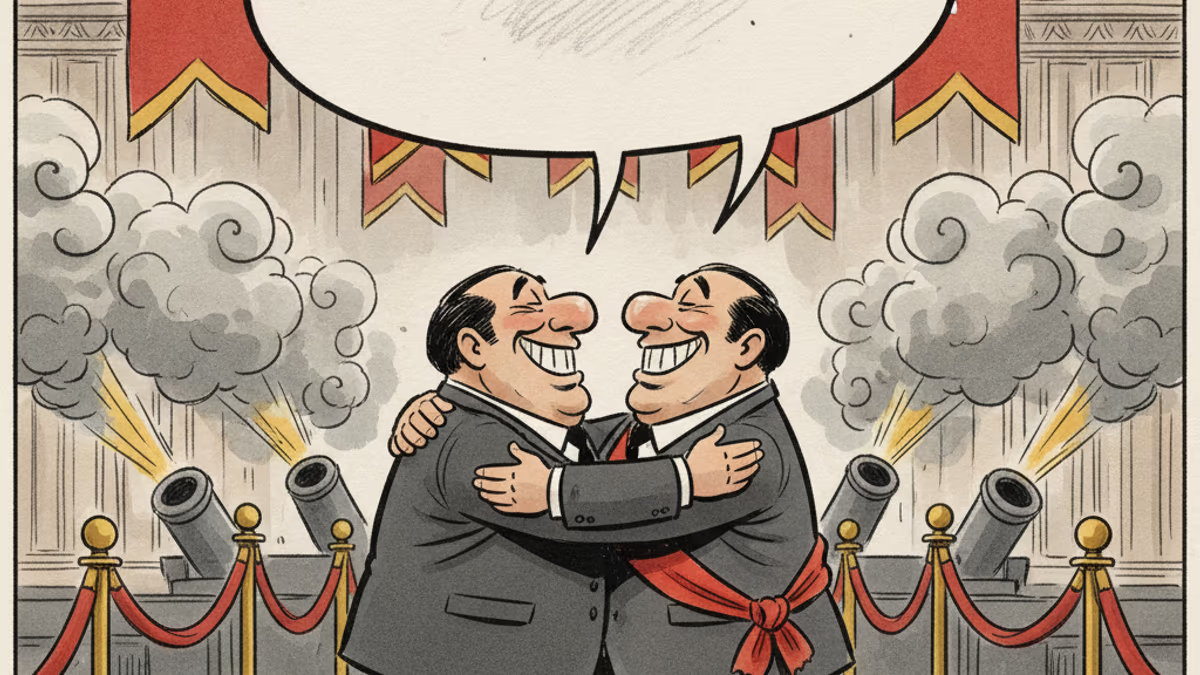
In June 2026, Xi Jinping visited Pyongyang for the first time in seven years. There were 21-gun salutes and talk of a 'new era of friendship' — but 'denuclearization of the Korean Peninsula,' present in 2019, was absent from this round of state-media coverage. A symbolic overreach, or a real upgrade?

Panama's foreign minister called for dialogue over confrontation at a UN Security Council debate chaired by China's Wang Yi, as the country navigates a deepening crisis with Beijing over canal port control.
Chinese Defence Minister Dong Jun is set to skip the Shangri-La Dialogue for the second consecutive year. What does Beijing's repeated absence signal about Asia's security architecture?

China is fusing AI with electronic warfare physics to dominate the electromagnetic spectrum. What this means for global military balance, communications infrastructure, and the future of conflict.
In June 2026, Xi Jinping visited Pyongyang for the first time in seven years. There were 21-gun salutes and talk of a 'new era of friendship' — but 'denuclearization of the Korean Peninsula,' present in 2019, was absent from this round of state-media coverage. A symbolic overreach, or a real upgrade?
Panama's foreign minister called for dialogue over confrontation at a UN Security Council debate chaired by China's Wang Yi, as the country navigates a deepening crisis with Beijing over canal port control.
Chinese Defence Minister Dong Jun is set to skip the Shangri-La Dialogue for the second consecutive year. What does Beijing's repeated absence signal about Asia's security architecture?
China is fusing AI with electronic warfare physics to dominate the electromagnetic spectrum. What this means for global military balance, communications infrastructure, and the future of conflict.
Thoughts
Share your thoughts on this article
Sign in to join the conversation