
Putin Says the War Is 'Coming to an End' — But on Whose Terms?
Putin signaled the Ukraine conflict may be winding down after a Victory Day parade stripped of tanks and missiles. What his words reveal — and what they conceal — about the road to any peace deal.
When the man who started a war tells you it's almost over, the first question isn't whether to celebrate — it's whether to believe him.
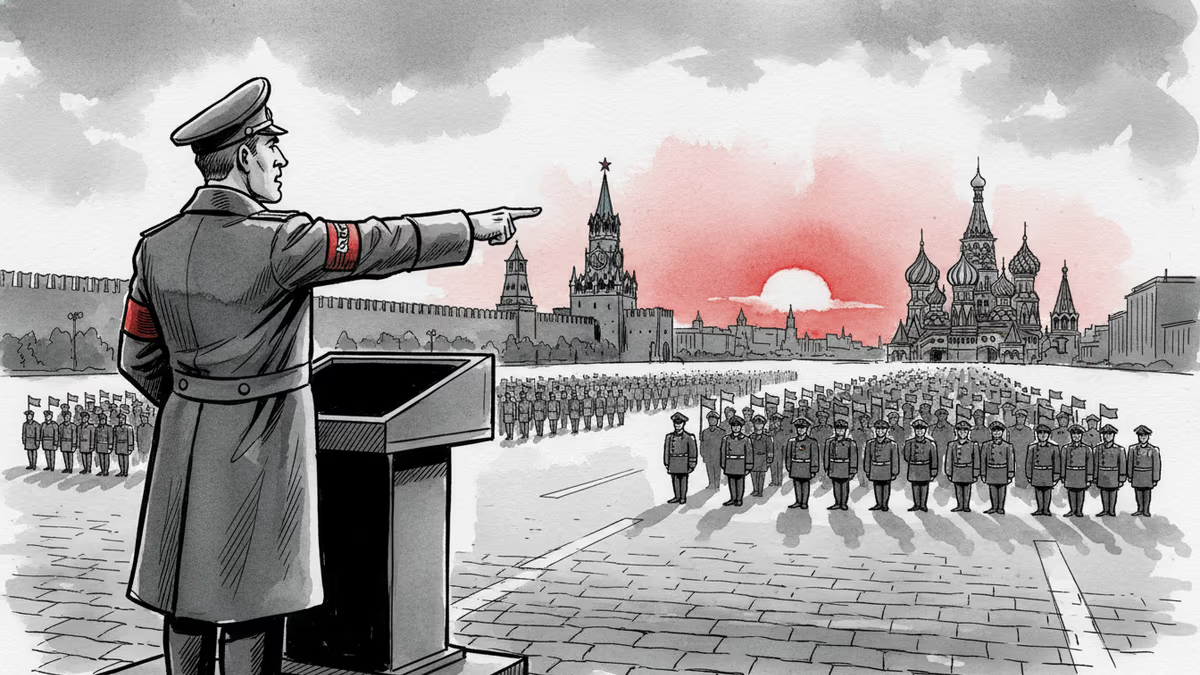
On May 9, 2026, Vladimir Putin stood before reporters in Moscow hours after a Victory Day parade that looked nothing like its predecessors. For the first time in nearly two decades, Russia's annual showcase of military hardware — tanks, intercontinental missiles, the full arsenal of symbolic intimidation — was absent from Red Square. Russian authorities had quietly cancelled the display, fearing Ukraine might use the occasion to launch drone strikes on the capital. A last-minute three-day ceasefire brokered by Donald Trump reduced that risk enough for the parade to proceed, but the optics were impossible to ignore.
Then came the statement. Asked about the conflict in Ukraine — which the Kremlin still officially calls a "special military operation" — Putin said: "I think that the matter is coming to an end, but it is a serious matter."
Four words. Enormous implications. Almost no specifics.
A Parade That Told Its Own Story
The Victory Day parade has long served as Russia's most visible annual assertion of military power. Its disappearance this year wasn't just a logistical decision — it was a signal, whether Putin intended it or not. The fact that a single Ukrainian drone could theoretically threaten Red Square says something about how the war has reshaped the calculus of Russian power projection.
Earlier the same morning, Putin's Victory Day speech struck a very different tone. Russia was fighting a "just" war, he declared. Ukraine was an "aggressive force" armed and supported by "the whole bloc of NATO." The West had "fuelled a confrontation with Russia that continues to this day." This was the language of a leader doubling down, not winding down.
And yet, hours later: "coming to an end."
Two messages, same day, same man. That tension is worth sitting with.

What Putin's Conditions Actually Reveal
Putin's remarks weren't just a vague signal — they came packaged with conditions that reveal quite a lot about Russia's negotiating posture.
On meeting Volodymyr Zelensky directly, Putin was precise: he'd only show up to sign a final peace treaty, not to negotiate one. "A meeting in a third country is also possible, but only once final agreements have been reached," he said. Translation: Russia won't sit across a table from Ukraine to work things out — it expects to arrive at the finish line and sign. That's not a negotiating position; it's a demand for capitulation dressed in diplomatic language.
More telling still was his choice of preferred interlocutor with the West: Gerhard Schröder, the former German chancellor who has maintained a close personal friendship with Putin and has worked for Russian state energy firms. Schröder is one of the most controversial figures in European politics precisely because of those ties. Naming him as a preferred negotiating partner isn't a good-faith gesture toward Europe — it's a deliberate provocation, and possibly an attempt to drive a wedge between EU member states at a moment when European Council President António Costa has already floated the idea of direct EU-Russia talks.
Meanwhile, the 1,000-prisoner-for-1,000-prisoner swap agreed under the US-brokered ceasefire hit an immediate snag: Putin said Russia had heard nothing from Ukraine about actually carrying it out. A ceasefire that exists on paper but stalls on its first practical test is a familiar pattern in this conflict.
Three Ways to Read "Coming to an End"
Putin's statement is genuinely ambiguous, and that ambiguity is probably deliberate. There are at least three coherent interpretations.
The first is that Russia is genuinely looking for an exit. The full-scale invasion began in February 2022 — more than four years ago. The front lines have been largely frozen. Western sanctions, while imperfect, have accumulated. The Trump administration has shown an appetite for deal-making that previous US governments did not. Under this reading, Putin is preparing his domestic audience for a negotiated settlement by framing it as a Russian-led conclusion.
The second is that this is positioning, not signaling. By declaring the war "coming to an end," Putin shapes the narrative: Russia is in control of the timeline, not reacting to military pressure or diplomatic demands. It's a way of entering any future negotiation from a posture of strength — or at least the appearance of one.
The third is that the statement is aimed less at Ukraine than at Europe and the United States. With transatlantic unity under strain and European leaders quietly exploring independent diplomatic channels, a well-timed signal from Moscow can accelerate those fractures. If EU members start moving at different speeds toward engagement with Russia, Ukraine's negotiating position weakens — without Russia having to concede anything.
These readings aren't mutually exclusive. Real diplomacy rarely is.
This content is AI-generated based on source articles. While we strive for accuracy, errors may occur. We recommend verifying with the original source.
Related Articles

Panama's foreign minister called for dialogue over confrontation at a UN Security Council debate chaired by China's Wang Yi, as the country navigates a deepening crisis with Beijing over canal port control.
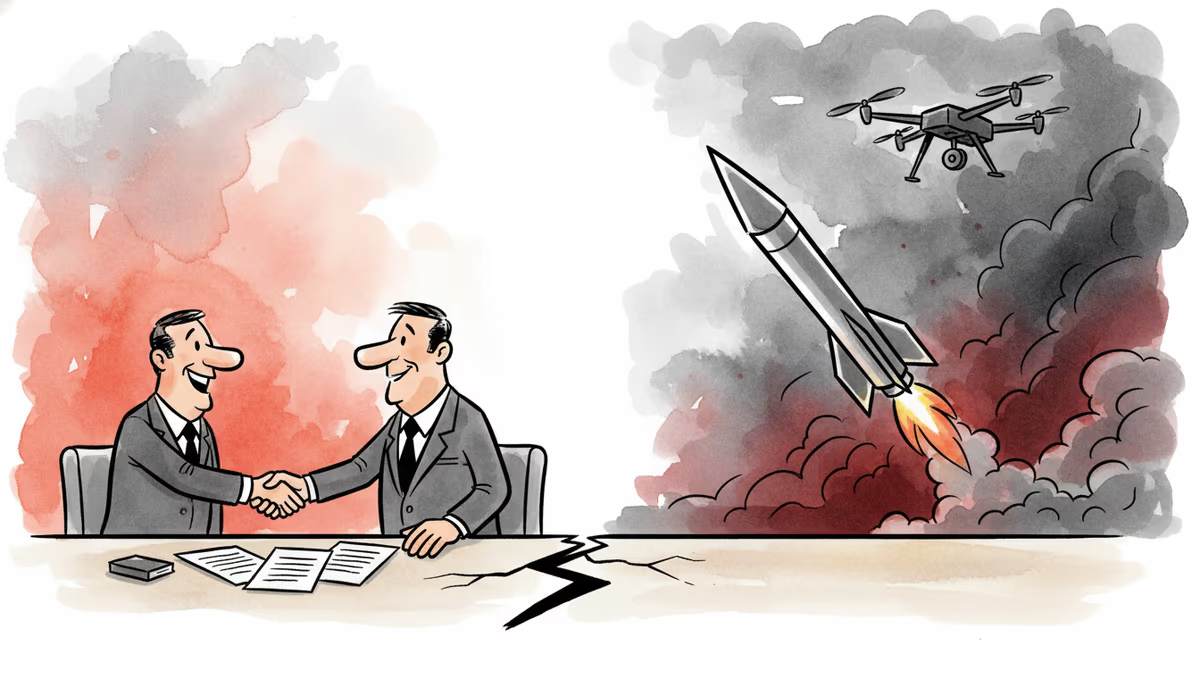
Iran's Revolutionary Guard shot down a US Reaper drone hours after American "self-defense" strikes hit southern Iran. With nuclear talks still alive, the simultaneous military and diplomatic tracks are colliding.

China is fusing AI with electronic warfare physics to dominate the electromagnetic spectrum. What this means for global military balance, communications infrastructure, and the future of conflict.

Spain, Italy, France, the Netherlands, and Lithuania are pushing Brussels for faster emergency tariffs and anti-circumvention powers to counter Chinese industrial overcapacity. Here's what's at stake.
Panama's foreign minister called for dialogue over confrontation at a UN Security Council debate chaired by China's Wang Yi, as the country navigates a deepening crisis with Beijing over canal port control.
Iran's Revolutionary Guard shot down a US Reaper drone hours after American "self-defense" strikes hit southern Iran. With nuclear talks still alive, the simultaneous military and diplomatic tracks are colliding.
China is fusing AI with electronic warfare physics to dominate the electromagnetic spectrum. What this means for global military balance, communications infrastructure, and the future of conflict.
Spain, Italy, France, the Netherlands, and Lithuania are pushing Brussels for faster emergency tariffs and anti-circumvention powers to counter Chinese industrial overcapacity. Here's what's at stake.
Thoughts
Share your thoughts on this article
Sign in to join the conversation