
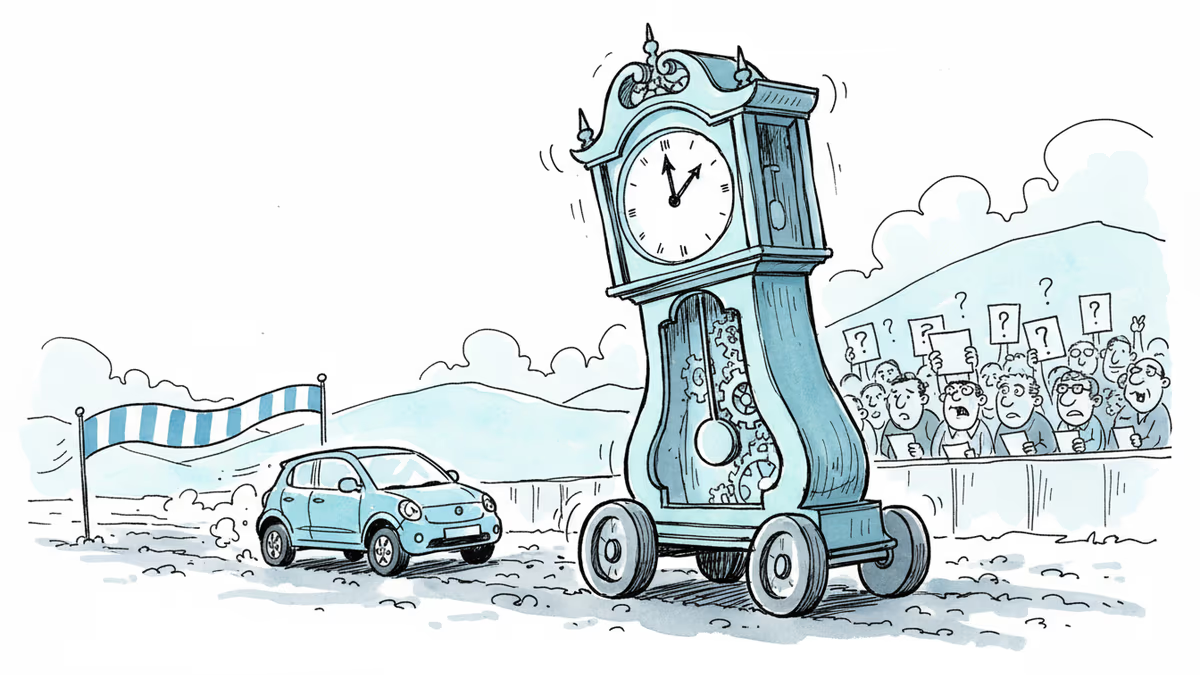
Rivian's R2 Has Six Months to Prove Everyone Wrong
Rivian's R2 SUV launches in June with a target of 20,000–25,000 units by year-end. If it hits even the low end, it would outsell every EV under $60K except the Tesla Model Y. Here's what's really at stake.
Six Months. 20,000 Cars. One Shot.
Rivian starts producing its R2 SUV in June. By December 31, it needs to sell between 20,000 and 25,000 of them. That's not a marketing stretch goal—it's the company's own public projection. Do the math: that's roughly 100 to 140 cars per day, every day, for six months, from a brand that most Americans still can't quite place.
Here's the number that puts it in perspective. According to sales data analyzed by TechCrunch senior reporter Sean O'Kane, if Rivian hits even the bottom of that range, the R2 would outsell every comparable EV priced at or under $60,000 in the U.S.—except the Tesla Model Y. Not a bad benchmark to chase. Not an easy one either.
Why R2, Why Now
Rivian arrived in 2021 with a splash—a successful IPO, Amazon delivery vans, and premium trucks and SUVs priced between $70,000 and $100,000. The problem: that's a thin slice of the market. Three years later, the stock had shed more than 80% of its peak value, and the company was burning cash faster than it was building brand loyalty.
The R2 is Rivian's pivot to volume. Price it under $60,000, make it accessible, and chase the mainstream buyer who wants an EV but can't justify a six-figure truck. Volkswagen's $5 billion investment and technology partnership gave the company the runway to actually attempt this. The Normal, Illinois factory is being retooled to support the new line.
But there's a gap between interest and purchase. When Rivian first teased the R2, pre-registrations ran into the tens of thousands. Converting that waitlist into actual sales is a different game. It requires financing options, test-drive access, dealer-equivalent service infrastructure, and word-of-mouth from real owners. Rivian has none of the traditional dealership network that legacy automakers rely on. That's either a liability or an opportunity, depending on how creatively they move.

The Bigger Week in Mobility
The R2 wasn't the only story. The week was dense with signals about where the broader industry is heading.
Wayve, the U.K.-based autonomous driving startup, closed a $1.2 billion raise—potentially $1.5 billion if it unlocks a milestone-based tranche from Uber. The company is now valued at $8.6 billion. What makes Wayve interesting isn't the money—it's the model. Rather than operating its own robotaxi fleet, Wayve licenses its software to automakers and fleet operators. Its end-to-end neural network approach requires no HD maps, learns from data alone, and works across hardware platforms. Backers include Mercedes-Benz, Nissan, and Stellantis—which tells you something about how nervous traditional automakers are about being left behind on software.
BYD dropped a headline-grabbing battery claim: 10% to 70% charge in five minutes. The caveat, buried in the fine print, is that it requires a dedicated high-power charger that doesn't yet exist at scale. Fast charging is a genuine competitive advantage—but only when the infrastructure catches up.
And then there was Waymo. A video surfaced showing one of its Austin robotaxis blocking an ambulance responding to a mass shooting. An officer moved the vehicle using established protocol, and Waymo declined to comment at the time. It's the latest in a series of first-responder incidents involving autonomous vehicles, and it lands at a particularly sensitive moment: the NHTSA convened an AV safety forum this week, pulling in the CEOs of Aurora, Waymo, and Zoox to discuss exactly these kinds of edge cases.
Three Stakeholders, Three Very Different Views
For EV buyers, the R2 represents something genuinely new: a purpose-built, reasonably priced electric SUV from a brand with a cult following, not a legacy automaker trying to catch up. The question is whether Rivian's charging network and service coverage can match the convenience that Tesla owners take for granted.
For investors, the calculus is trickier. Rivian needs the R2 to work—not just sell modestly, but sell at scale and at margin. The Volkswagen partnership buys time, but not indefinitely. Meanwhile, Wayve's raise signals that the market still has appetite for autonomous driving bets, even as Waymo incidents keep reminding everyone how hard the last mile of this problem actually is.
For legacy automakers, the week was a quiet alarm bell. Wayve's software-licensing model means even well-capitalized OEMs are outsourcing their AV brains to startups. BYD is redefining charging expectations. And Rivian is about to compete directly in the segment—under $60,000—where Hyundai, Kia, GM, and Ford have been trying to build EV volume.
Authors
Related Articles
Waymo's new Ojai robotaxi isn't just a vehicle upgrade. It's the company's most serious attempt yet at cracking the cost problem that has kept autonomous vehicles from scaling. Here's what's really at stake.
Mercedes-AMG's new GT 4-door coupe packs three YASA axial flux motors producing 1,153 hp and 1,475 lb-ft of torque. Here's what it means for the EV performance race—and who actually wins.
Auto China 2026 set records with 1,451 vehicles and 181 world premieres. But the real story isn't the size—it's how Chinese automakers stopped competing on price and started competing on brains.
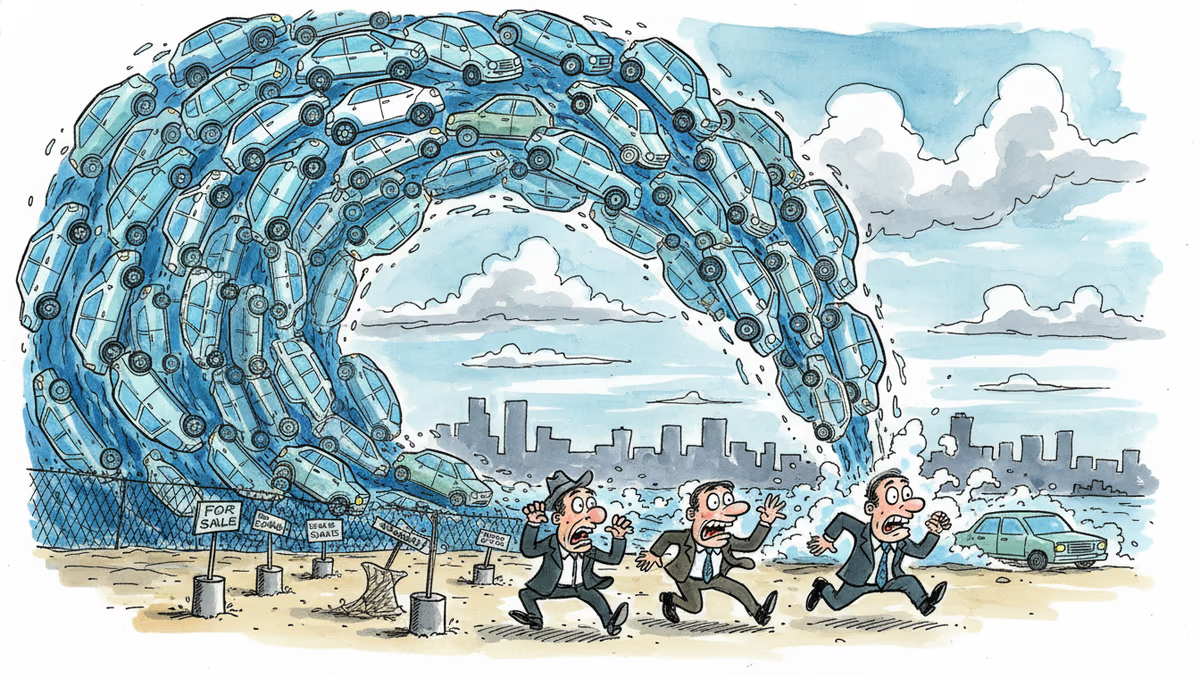
Expiring leases will flood the US used car market with over a million electric vehicles by 2028. Could this do what subsidies couldn't — make EVs genuinely affordable?
Waymo's new Ojai robotaxi isn't just a vehicle upgrade. It's the company's most serious attempt yet at cracking the cost problem that has kept autonomous vehicles from scaling. Here's what's really at stake.
Mercedes-AMG's new GT 4-door coupe packs three YASA axial flux motors producing 1,153 hp and 1,475 lb-ft of torque. Here's what it means for the EV performance race—and who actually wins.
Auto China 2026 set records with 1,451 vehicles and 181 world premieres. But the real story isn't the size—it's how Chinese automakers stopped competing on price and started competing on brains.
Expiring leases will flood the US used car market with over a million electric vehicles by 2028. Could this do what subsidies couldn't — make EVs genuinely affordable?
Thoughts
Share your thoughts on this article
Sign in to join the conversation