
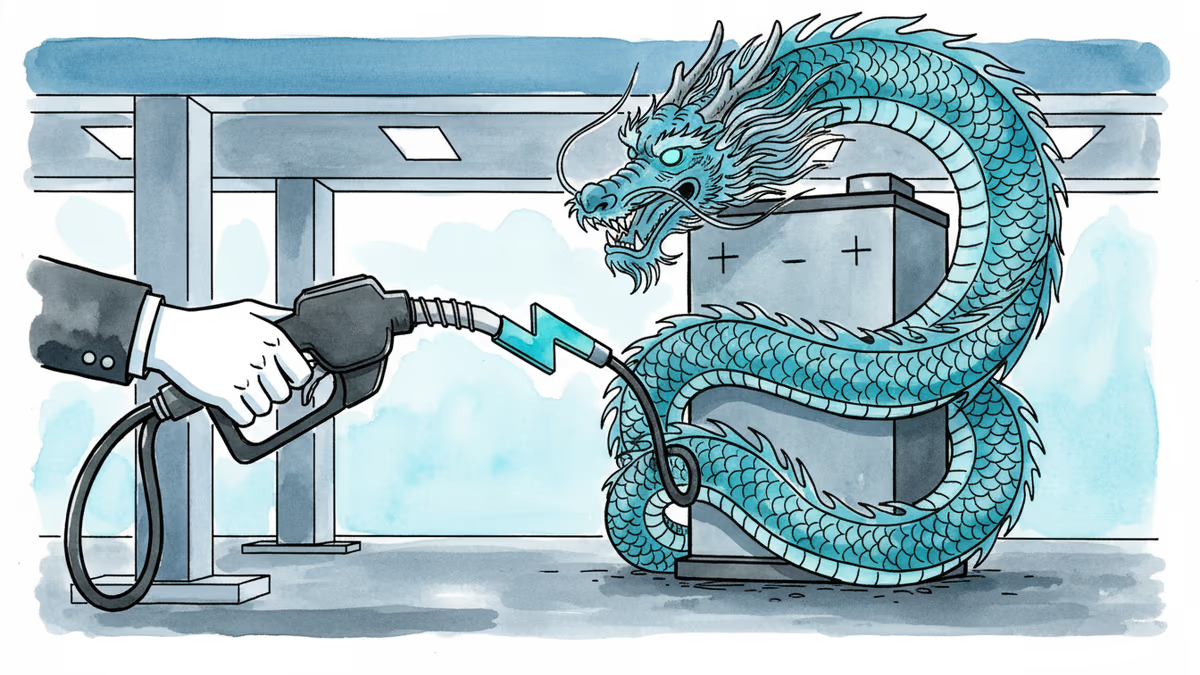
4-Minute Charge: China Just Rewrote the EV Rulebook
CATL's third-gen Shenxing LFP battery claims charging speeds nearly 5x faster than Hyundai or Porsche's best 800V systems. Here's what that really means.
Filling a tank of gas takes about four minutes. Charging a Porsche Taycan from 10 to 80 percent takes eighteen. That gap — those fourteen minutes — has been one of the most stubborn psychological barriers standing between EVs and true mass adoption. This week, CATL claims it has closed it.
At a tech showcase in China, the world's largest battery manufacturer unveiled the third-generation Shenxing battery, an advanced lithium iron phosphate (LFP) cell that the company says charges at nearly five times the speed of today's leading 800V NMC systems. Do the math: we're talking roughly 4 minutes for a 10-to-80% charge. If that number holds up in the real world, it's not a spec bump — it's a category shift.
What CATL Actually Announced
The Shenxing 3.0 is CATL's direct response to BYD's recently announced Blade Battery 2.0. Both companies are zeroing in on the same two pain points: charging speed and safety. The LFP chemistry they're both using is already well-regarded for thermal stability — it's far less prone to thermal runaway than the nickel-manganese-cobalt (NMC) cells that dominate premium EVs from Hyundai, Porsche, and others. The historic knock against LFP has been lower energy density and slower charging. Shenxing 3.0 is a direct assault on that second weakness.
For context, Hyundai's Ioniq 6 and Porsche's Taycan — both running sophisticated 800V architectures — can charge from 10 to 80% in as little as 18 minutes, which the industry has celebrated as a benchmark. CATL's claim would put the Shenxing 3.0 in a different league entirely.
The announcement also arrives as a counterpoint to BYD's recent momentum. China's two battery titans are effectively in a public spec war, and consumers — and automakers — stand to benefit.
Why This Matters Beyond the Numbers
Charging anxiety is real and well-documented. Surveys consistently show it as a top reason consumers hesitate to switch to EVs, even among those who find the vehicles otherwise appealing. A 4-minute charge doesn't just reduce inconvenience — it removes the entire mental framework of "planning around the battery." You stop at a charging station the way you stop at a gas station: briefly, without thinking much about it.
But the implications run deeper than consumer psychology. The premium EV market has been built, in part, on the argument that NMC batteries justify their higher cost through superior performance. Samsung SDI, LG Energy Solution, and SK On have invested heavily in NMC and next-generation solid-state technology. If LFP — cheaper, cobalt-free, and now apparently fast-charging — can match NMC on the one dimension that matters most to buyers, the value proposition of the premium chemistry starts to erode.

This is the quiet competitive threat that Western and Korean battery makers have been watching with growing unease.
The Skeptic's Corner
Not everyone is ready to rewrite the playbook just yet, and for good reason.
Battery specs announced at a company-run showcase in China are not the same as independently verified performance in a production vehicle. Charging speed in a controlled demo environment can differ significantly from real-world conditions — cold weather, battery state of health over time, and the thermal management system all play roles. CATL has not yet disclosed which automakers will use the Shenxing 3.0 or when it will reach production vehicles.
There's also the infrastructure question. Achieving 4-minute charging requires charging stations capable of delivering enormous amounts of power in a very short time. Most public fast chargers today operate at 50–150kW. The hardware to support Shenxing 3.0-level speeds doesn't yet exist at scale outside of China. A battery that can theoretically charge in 4 minutes is only as useful as the charger it's plugged into.
Still, CATL's track record earns it the benefit of the doubt. The first-generation Shenxing battery, announced in 2023, delivered on most of its headline promises. The company has a pattern of aggressive claims followed by credible execution.
Three Stakeholders, Three Different Reactions
For EV buyers, this is the most promising development in years — if it lands. The charging experience is the one area where EVs still feel like a compromise. Eliminating that compromise changes the calculus for millions of fence-sitters.
For Western and Korean automakers, the pressure is mounting. Hyundai, GM, Ford, and Volkswagen have all made 800V fast-charging a centerpiece of their EV marketing. If a Chinese-made LFP cell undercuts that advantage on speed while also being cheaper and safer, the competitive differentiation argument gets harder to make.
For investors and policymakers, the announcement is another data point in a broader pattern: China's EV ecosystem — from raw materials to cells to finished vehicles — is moving faster than most Western forecasts predicted five years ago. The policy response in the US and EU, including tariffs and domestic battery incentives, reflects this anxiety. But tariffs slow adoption; they don't accelerate domestic innovation.
Authors
Related Articles
Waymo's new Ojai robotaxi isn't just a vehicle upgrade. It's the company's most serious attempt yet at cracking the cost problem that has kept autonomous vehicles from scaling. Here's what's really at stake.
Mercedes-AMG's new GT 4-door coupe packs three YASA axial flux motors producing 1,153 hp and 1,475 lb-ft of torque. Here's what it means for the EV performance race—and who actually wins.
Auto China 2026 set records with 1,451 vehicles and 181 world premieres. But the real story isn't the size—it's how Chinese automakers stopped competing on price and started competing on brains.
Moonshot AI raised $2B at a $20B valuation. Its Kimi models rank second on OpenRouter. What China's open-weight AI surge means for the global LLM market.
Waymo's new Ojai robotaxi isn't just a vehicle upgrade. It's the company's most serious attempt yet at cracking the cost problem that has kept autonomous vehicles from scaling. Here's what's really at stake.
Mercedes-AMG's new GT 4-door coupe packs three YASA axial flux motors producing 1,153 hp and 1,475 lb-ft of torque. Here's what it means for the EV performance race—and who actually wins.
Auto China 2026 set records with 1,451 vehicles and 181 world premieres. But the real story isn't the size—it's how Chinese automakers stopped competing on price and started competing on brains.
Moonshot AI raised $2B at a $20B valuation. Its Kimi models rank second on OpenRouter. What China's open-weight AI surge means for the global LLM market.
Thoughts
Share your thoughts on this article
Sign in to join the conversation