
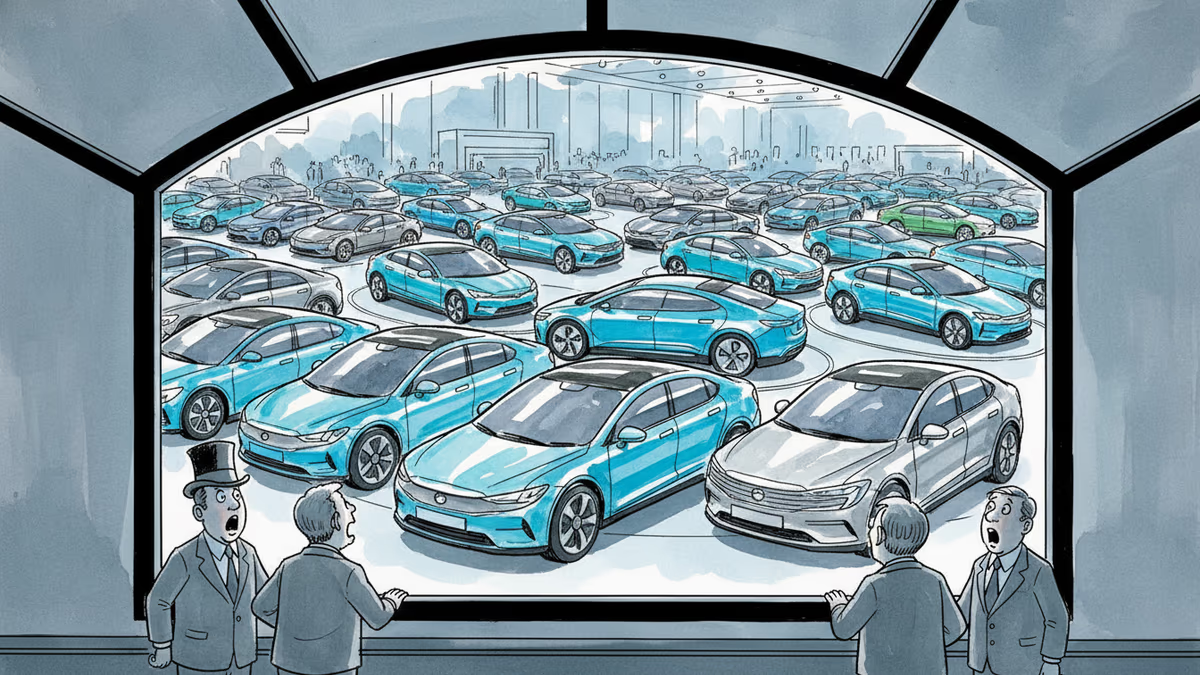
The World's Biggest Auto Show Is Now in Beijing
Auto China 2026 set records with 1,451 vehicles and 181 world premieres. But the real story isn't the size—it's how Chinese automakers stopped competing on price and started competing on brains.
The Scoreboard Has Changed
While motor shows in Frankfurt, Detroit, and Paris have been shrinking—some canceling entirely—the 2026 Beijing International Automotive Exhibition just became the largest auto show in recorded history. 1,451 vehicles on display. 181 world premieres. Record exhibition floor space.
But the size of the show is almost beside the point. What happened inside those halls signals something more consequential: the "cheap Chinese cars vs. premium European cars" narrative is collapsing, and it's collapsing fast.
For years, Chinese automakers competed primarily on price. That era is over. At Auto China 2026, lidar sensors—the laser-based technology that enables advanced driver assistance—are now appearing in EVs priced under 100,000 yuan (roughly $14,500). Drive-by-wire systems, which replace a century-old mechanical steering column and hydraulic brake lines with electronic signals, are hitting both flagship and mid-range models almost simultaneously. AI-native vehicle design, where the large language model comes first and the car is built around it, is no longer a concept—it's on the showroom floor.
When the Supplier Becomes the Platform
The most structurally significant vehicle at the show may not be the flashiest. XPeng's GX wasn't designed as a regular car with autonomous driving bolted on. It was engineered from the ground up with Level 4 autonomy as the architectural premise—sensors, compute infrastructure, and AI models first, chassis second.
The GX carries up to four proprietary AI chips delivering 3,000 TOPS of total computing power. For context, a single Nvidia Orin chip—the benchmark in most Western autonomous driving programs—delivers 254 TOPS. That's roughly 12 times the compute, in a production SUV priced at 399,800 yuan ($58,000).
Here's the detail that reframes the competitive landscape: Volkswagen has adopted XPeng's AI chip and driver-assistance technology for its own EVs sold in China. Europe's largest automaker is now sourcing its autonomous driving brains from a Chinese startup that didn't exist fifteen years ago. XPeng has quietly become a platform provider.
SAIC Motor's Roewe brand went a step further with the Jiayue 07, a vehicle designed around ByteDance's Doubao Da Model 2.0—an LLM developed by the company behind TikTok. Multiple Chinese manufacturers simultaneously treating AI as the foundational design constraint, not a feature to be added later, is a meaningful inflection point.

The Technology Trickle-Down That Took Months, Not Years
In traditional automotive development, premium technology follows a predictable path: it debuts in a flagship model at a high price, then gradually migrates downmarket over five to eight years as manufacturing costs fall. That cycle appears to be breaking in China.
Li Auto's L9 Livis claims a world first: full drive-by-wire integration—steer-by-wire, electromechanical brakes, four-wheel steering—with zero mechanical or hydraulic connections. The engineering case is compelling: electronic brakes respond faster than hydraulic ones, and removing mechanical linkages simplifies the hardware foundation for future autonomous systems. Price: 559,800 yuan ($82,300).
That same technology stack appears in IM Motors' LS8—a subsidiary of SAIC—at a starting price of 249,800 yuan ($36,700). Less than six months separates a "world first" flagship from a mid-market implementation at half the price. For European automakers whose profitability model depends on harvesting premium margins from high-value technology before it commoditizes, this compression is a direct threat to the business model, not just the product.
Geely took the logical endpoint of autonomous vehicle design to its conclusion with the EVA Cab: no steering wheel, no pedals, four seats arranged face-to-face. It's positioned as China's first purpose-built robotaxi, with 3,000+ TOPS of onboard compute and planned commercial deployment through Geely's ride-hailing service, CaoCao Mobility, in 2027.
Foreign Brands Adapt—By Going Local
The response from foreign automakers at the show reveals a strategic convergence that would have seemed unlikely five years ago.
Hyundai unveiled the Ioniq V in Beijing and announced it will operate Ioniq as a standalone brand in China. The car's supplier list: CATL batteries, Momenta driver-assistance systems, Qualcomm chips, and LLMs from both ByteDance and Baidu. That list is nearly identical to what Volkswagen, Audi, and GM's Cadillac are using in their China-market vehicles. The technological substrate for competing in China is standardizing around a common set of domestic suppliers.
Toyota debuted the bZ7—a China-specific EV sedan larger than a Tesla Model S—at 169,800 yuan ($25,000), with a launch offer of 147,800 yuan ($21,700). It reportedly collected 3,100 orders within one hour of going on sale in March. The powertrain and smart cockpit OS come from Huawei. The driver-assistance system is from Momenta. Smart home integration runs on Xiaomi systems. Japan's largest automaker has effectively handed its China EV stack to Chinese technology companies.
Volkswagen reversed course on its pure-EV commitment with the ID. Era 9X, a range-extended EV developed with joint venture partner SAIC. The practical logic is hard to argue: China's charging infrastructure remains uneven between coastal cities and inland regions, and a vehicle that can travel over 990 miles on combined electric and engine-generated power addresses a real consumer concern. Starting price: approximately 310,000 yuan ($45,500).
Among Japanese manufacturers, Nissan stood out as the only major player to debut a globally significant new model—the Terrano PHEV Concept—for the first time in the world at Beijing, rather than at a home-market show. CEO Ivan Espinosa confirmed a production version within a year, with global export plans.
This content is AI-generated based on source articles. While we strive for accuracy, errors may occur. We recommend verifying with the original source.
Related Articles
Waymo's new Ojai robotaxi isn't just a vehicle upgrade. It's the company's most serious attempt yet at cracking the cost problem that has kept autonomous vehicles from scaling. Here's what's really at stake.
Mercedes-AMG's new GT 4-door coupe packs three YASA axial flux motors producing 1,153 hp and 1,475 lb-ft of torque. Here's what it means for the EV performance race—and who actually wins.

Expiring leases will flood the US used car market with over a million electric vehicles by 2028. Could this do what subsidies couldn't — make EVs genuinely affordable?
Elon Musk confirmed on Tesla's Q1 2026 earnings call that Hardware 3 vehicles will never receive unsupervised Full Self-Driving — locking out millions who paid for the feature.
Waymo's new Ojai robotaxi isn't just a vehicle upgrade. It's the company's most serious attempt yet at cracking the cost problem that has kept autonomous vehicles from scaling. Here's what's really at stake.
Mercedes-AMG's new GT 4-door coupe packs three YASA axial flux motors producing 1,153 hp and 1,475 lb-ft of torque. Here's what it means for the EV performance race—and who actually wins.
Expiring leases will flood the US used car market with over a million electric vehicles by 2028. Could this do what subsidies couldn't — make EVs genuinely affordable?
Elon Musk confirmed on Tesla's Q1 2026 earnings call that Hardware 3 vehicles will never receive unsupervised Full Self-Driving — locking out millions who paid for the feature.
Thoughts
Share your thoughts on this article
Sign in to join the conversation