
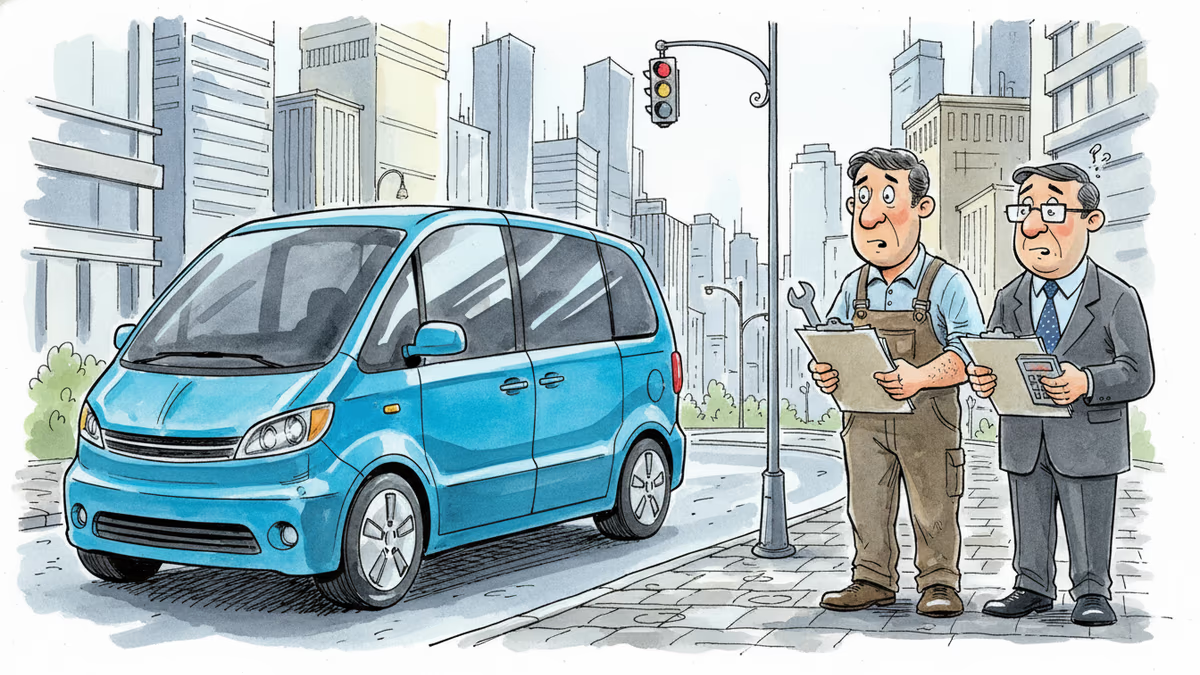
Waymo's Minivan Bet Is Really About Unit Economics
Waymo's new Ojai robotaxi isn't just a vehicle upgrade. It's the company's most serious attempt yet at cracking the cost problem that has kept autonomous vehicles from scaling. Here's what's really at stake.
500,000 Rides a Week, Still No Profit
Waymo has given more autonomous rides than any company on earth. More than 500,000 paid robotaxi trips every week. Over a decade of public road testing. Backing from one of the most cash-rich parent companies in the world. And yet the fundamental problem remains unsolved: each car costs too much to build, operate, and fix.
Roughly 97% of Waymo's current fleet is the Jaguar I-Pace — a capable electric vehicle, but one never designed for the punishment of commercial taxi service. It's hard to clean. It's expensive to repair. The step-in height makes boarding awkward. Most critically, it wasn't built for volume. Waymo's total fleet sits at around 3,700 vehicles. New York City alone runs more than 13,000 yellow cabs. At that scale, Waymo isn't a taxi company. It's a very expensive pilot program.
The Ojai is Waymo's answer to that math problem.
What the Ojai Actually Is
The vehicle rolling out now in Los Angeles, Phoenix, and San Francisco is a modified minivan built by Zeekr, the electric vehicle brand owned by China's Geely Holdings. It was designed in Sweden, built on Zeekr's SEA-M platform — an architecture explicitly developed for "future mobility products" like robotaxis and logistics vehicles, not consumer cars.
The exterior is a calm shade of blue. The interior is engineered for throughput. Flat floor. Low step-in height. Gondola-style doors on both sides. Three large adaptive touchscreens for riders to control music, climate, and route. Charging ports, grab bars, braille labels, and an interior designed to be wiped down quickly between rides. Faster charging and higher battery capacity round out the operational improvements.
Layered on top is Waymo's sixth-generation autonomy system: 13 cameras, 4 lidar sensors, 6 radar units, and external audio receivers. The critical detail here isn't the sensor count — it's that this hardware stack is modular. The same system can be fitted to different vehicle platforms. Waymo has already announced two: the Zeekr minivan and the Hyundai Ioniq 5. That modularity is the entire strategic point.

Stripped-down Zeekr vehicles are shipped to Waymo's Arizona facility, where they're outfitted with the full autonomy package. The company says it's now scaling toward tens of thousands of units annually.
The Timing Is Complicated
The Ojai launch lands during a rough patch for Waymo. The company recently suspended freeway robotaxi service across Los Angeles, Miami, Phoenix, and San Francisco to address how its vehicles handle construction zones. Services in Atlanta and San Antonio were paused separately to deal with flooding scenarios. The message embedded in those pauses is uncomfortable: autonomous vehicles, even the most mature ones, still struggle with conditions that human drivers navigate every day.
Launching a new vehicle into that context is a calculated risk. The Ojai signals commercial ambition and cost discipline. It does not resolve the underlying question of whether the technology is ready for the full complexity of urban driving at scale.
There's also a geopolitical dimension worth sitting with. Waymo's newest vehicle runs on a Chinese-built platform, from a brand owned by Geely — the same company that owns Volvo and a stake in Mercedes-Benz. The autonomy stack is American. The chassis is Chinese. That arrangement made clean business sense in 2021 when the partnership was formed. In 2026, with US-China trade tensions running at a sustained high, the durability of that supply chain is a legitimate open question that neither company has addressed publicly.
Three Ways to Read This Launch
For riders, the near-term change is incremental. Free rides in a more comfortable vehicle, in cities where Waymo already operates. No new market access, no price disruption yet.
For the autonomous vehicle industry, the Ojai represents something more significant: the first serious attempt to separate the autonomy software stack from the vehicle platform at commercial scale. If Waymo can run the same sixth-gen system on a Zeekr minivan today and a Hyundai Ioniq 5 tomorrow, the business model starts to look less like a car company and more like an operating system licensor. That's a fundamentally different competitive position.
For investors and competitors, the annual production target of tens of thousands of units is the number to watch. Tesla has been promising a robotaxi fleet for years. Cruise stumbled badly after a pedestrian incident in 2023 and has been rebuilding slowly. Waymo is the only player with a functioning commercial service at meaningful scale — but "meaningful" is still a long way from "profitable."
This content is AI-generated based on source articles. While we strive for accuracy, errors may occur. We recommend verifying with the original source.
Related Articles
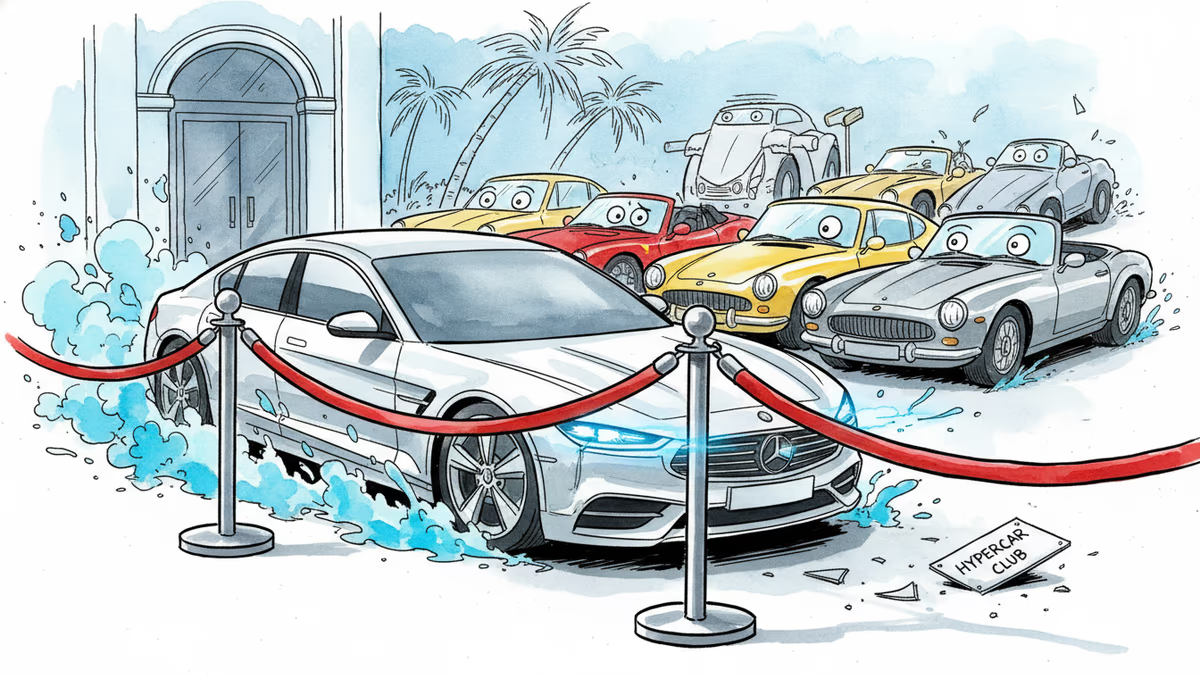
Mercedes-AMG's new GT 4-door coupe packs three YASA axial flux motors producing 1,153 hp and 1,475 lb-ft of torque. Here's what it means for the EV performance race—and who actually wins.
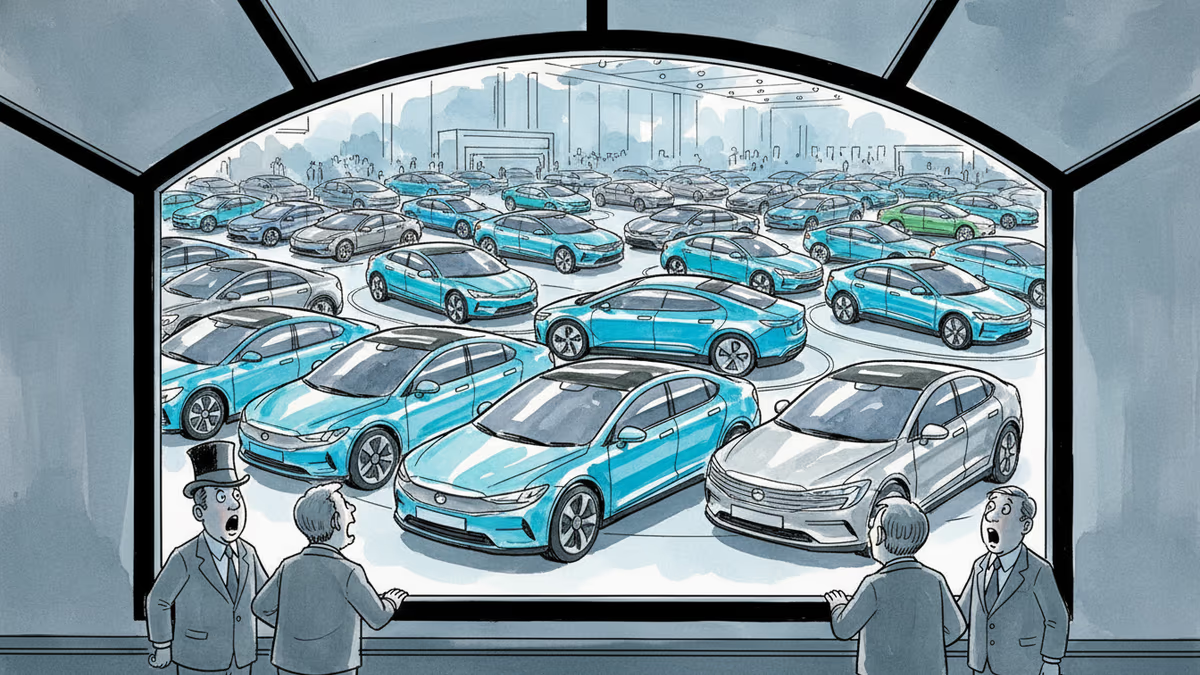
Auto China 2026 set records with 1,451 vehicles and 181 world premieres. But the real story isn't the size—it's how Chinese automakers stopped competing on price and started competing on brains.

Expiring leases will flood the US used car market with over a million electric vehicles by 2028. Could this do what subsidies couldn't — make EVs genuinely affordable?
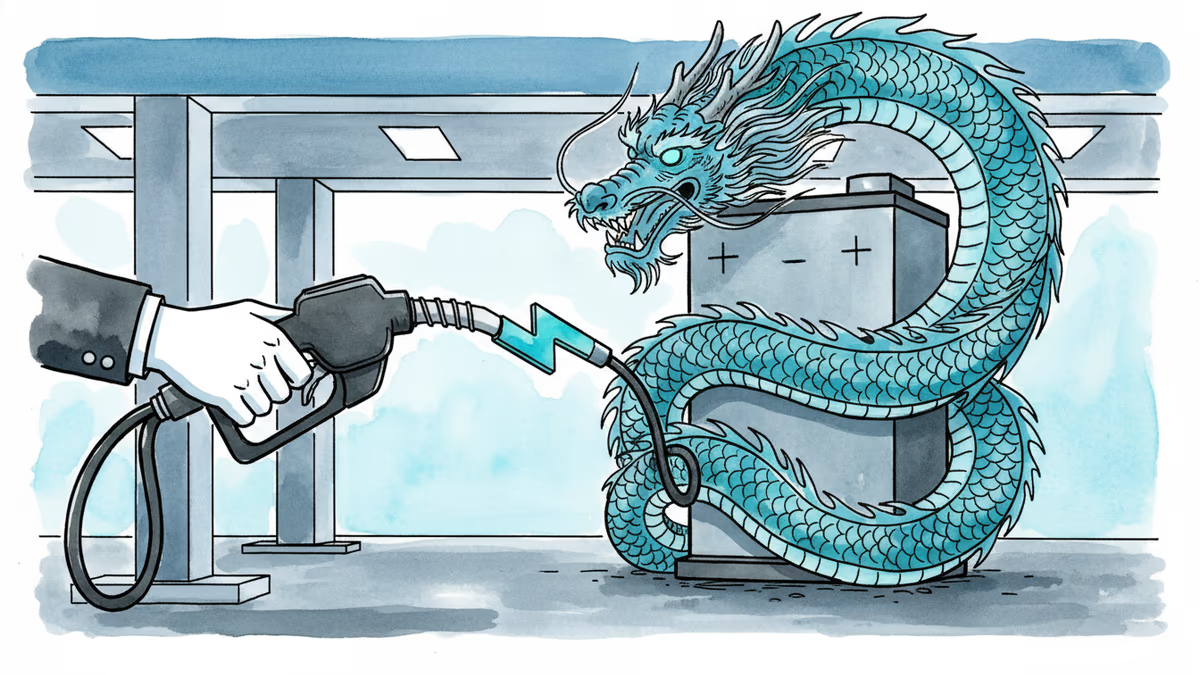
CATL's third-gen Shenxing LFP battery claims charging speeds nearly 5x faster than Hyundai or Porsche's best 800V systems. Here's what that really means.
Mercedes-AMG's new GT 4-door coupe packs three YASA axial flux motors producing 1,153 hp and 1,475 lb-ft of torque. Here's what it means for the EV performance race—and who actually wins.
Auto China 2026 set records with 1,451 vehicles and 181 world premieres. But the real story isn't the size—it's how Chinese automakers stopped competing on price and started competing on brains.
Expiring leases will flood the US used car market with over a million electric vehicles by 2028. Could this do what subsidies couldn't — make EVs genuinely affordable?
CATL's third-gen Shenxing LFP battery claims charging speeds nearly 5x faster than Hyundai or Porsche's best 800V systems. Here's what that really means.
Thoughts
Share your thoughts on this article
Sign in to join the conversation