
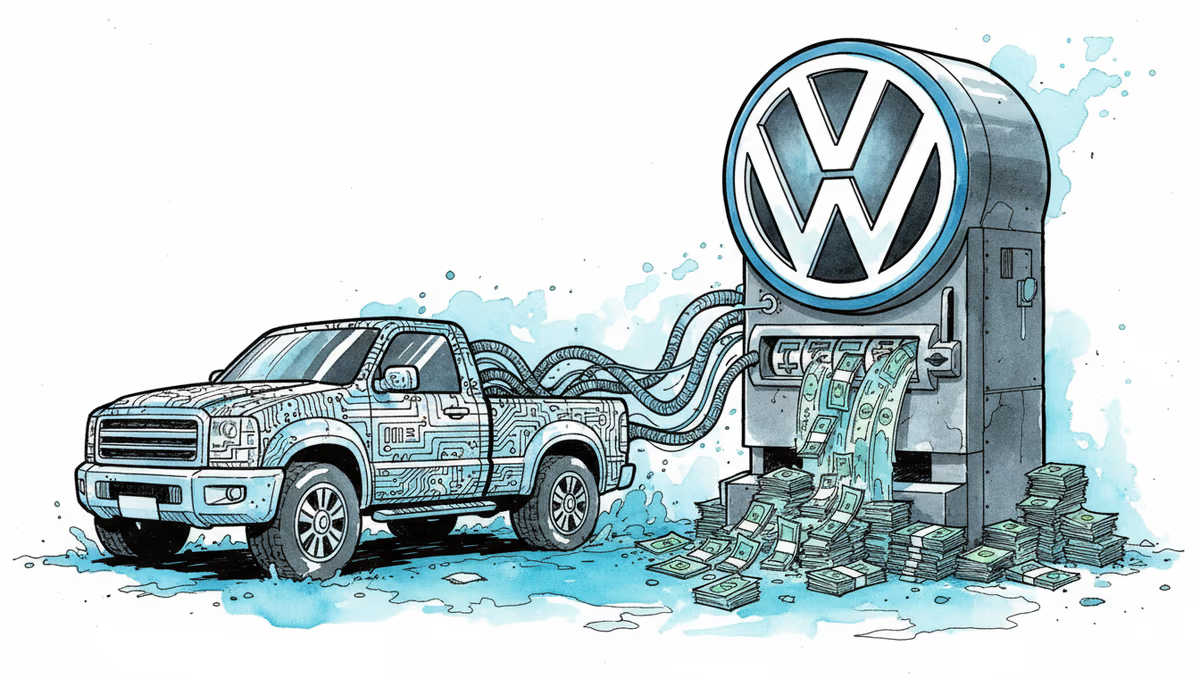
When Software Saves the Hardware Company
Rivian's 2025 revenue grew 8% despite falling vehicle sales, thanks to a $1.55B software windfall from Volkswagen. Is this the new playbook for struggling EV makers?
$5.38 billion in total revenue. 15% drop in automotive sales. Threefold growth in software income. For Rivian, 2025 wasn't just another year—it was proof that sometimes the best way to sell cars is to stop relying on selling cars.
The electric truck maker's latest earnings reveal a company in transformation. While vehicle deliveries stumbled and automotive revenue fell to $3.8 billion, software and services revenue exploded to $1.55 billion, largely thanks to its joint venture with Volkswagen Group. The German automaker didn't just write checks—it wrote Rivian's survival story.
The Volkswagen Lifeline
The numbers tell a stark tale of dependence. VW's$5.8 billion joint venture commitment isn't just partnership—it's life support. Rivian received $1 billion in 2025 alone, with another $2 billion expected in 2026. About $1 billion of that hinges on successful winter testing currently underway.
Under the deal, Rivian supplies VW with its electrical architecture and software stack—essentially selling the brain of its vehicles to a company that builds ten times more cars. For VW, it's a shortcut to competitive EV technology. For Rivian, it's the difference between innovation and insolvency.
But this financial oxygen comes with strings. Rivian must prove its technology works in VW's harsh European winter conditions. Fail that test, and $1 billion evaporates.
The R2 Gamble
Rivian's 2026 projections read like a company betting everything on one card: the R2 SUV. Expected to launch by June, this "cheaper to build" vehicle represents Rivian's attempt to escape the death spiral of losing money on every car sold.

The math is brutal but improving. Cost of goods sold dropped to $92,000 per unit in Q4 2025, down $4,000 from the previous quarter. Still, when your vehicles cost more to build than many people's annual salaries, profitability feels distant.
Rivian expects to deliver between 62,000 and 67,000 vehicles in 2026—potentially a 59% jump from 2025's 42,247 deliveries. That's ambitious for a company that's struggled with production consistency and faces intensifying competition from Tesla, traditional automakers, and Chinese EV makers.
The Amazon Anchor
While VW provides the cash, Amazon remains Rivian's most visible customer through the electric delivery van program. New variants planned for 2026—including all-wheel-drive and larger battery options—suggest Amazon's logistics demands are evolving.
CEO RJ Scaringe emphasized working "really closely with Amazon in defining the requirements," language that sounds more like a supplier relationship than the strategic partnership once envisioned. For Rivian, Amazon's steady orders provide predictable revenue, but they also highlight the company's struggle to diversify beyond its original backer.
The Software Pivot Question
Rivian's software success raises uncomfortable questions about its identity. Is it an EV manufacturer that happens to license technology, or a software company that happens to build trucks? The threefold growth in software revenue suggests the market values Rivian's code more than its manufacturing capabilities.
This pivot isn't unique. Traditional automakers increasingly view software as their future profit center, while pure-play EV companies like Rivian discover that hardware alone won't sustain them. The irony is palpable: companies that entered the market to revolutionize transportation now find salvation in selling the very technology that was supposed to differentiate them.
Rivian's 2025 results illuminate a harsh reality: building electric vehicles profitably remains extraordinarily difficult, even for companies with innovative technology and strong backing. The company's software windfall from VW might represent the future of EV startups—not as independent manufacturers, but as technology suppliers to larger players with manufacturing scale.
As the EV market matures and competition intensifies, how many startups will follow Rivian's path of selling their technological souls to survive? And if the most innovative companies become mere suppliers to traditional automakers, who will drive the next wave of transportation innovation?
Authors
Related Articles
Waymo's new Ojai robotaxi isn't just a vehicle upgrade. It's the company's most serious attempt yet at cracking the cost problem that has kept autonomous vehicles from scaling. Here's what's really at stake.
The Ferrari Luce is finally here — 1,000 hp, a 122 kWh battery, and an interior designed by the team behind the iPhone. But the real story is what Ferrari risked to build it.
Mercedes-AMG's new GT 4-door coupe packs three YASA axial flux motors producing 1,153 hp and 1,475 lb-ft of torque. Here's what it means for the EV performance race—and who actually wins.
Auto China 2026 set records with 1,451 vehicles and 181 world premieres. But the real story isn't the size—it's how Chinese automakers stopped competing on price and started competing on brains.
Waymo's new Ojai robotaxi isn't just a vehicle upgrade. It's the company's most serious attempt yet at cracking the cost problem that has kept autonomous vehicles from scaling. Here's what's really at stake.
The Ferrari Luce is finally here — 1,000 hp, a 122 kWh battery, and an interior designed by the team behind the iPhone. But the real story is what Ferrari risked to build it.
Mercedes-AMG's new GT 4-door coupe packs three YASA axial flux motors producing 1,153 hp and 1,475 lb-ft of torque. Here's what it means for the EV performance race—and who actually wins.
Auto China 2026 set records with 1,451 vehicles and 181 world premieres. But the real story isn't the size—it's how Chinese automakers stopped competing on price and started competing on brains.
Thoughts
Share your thoughts on this article
Sign in to join the conversation