
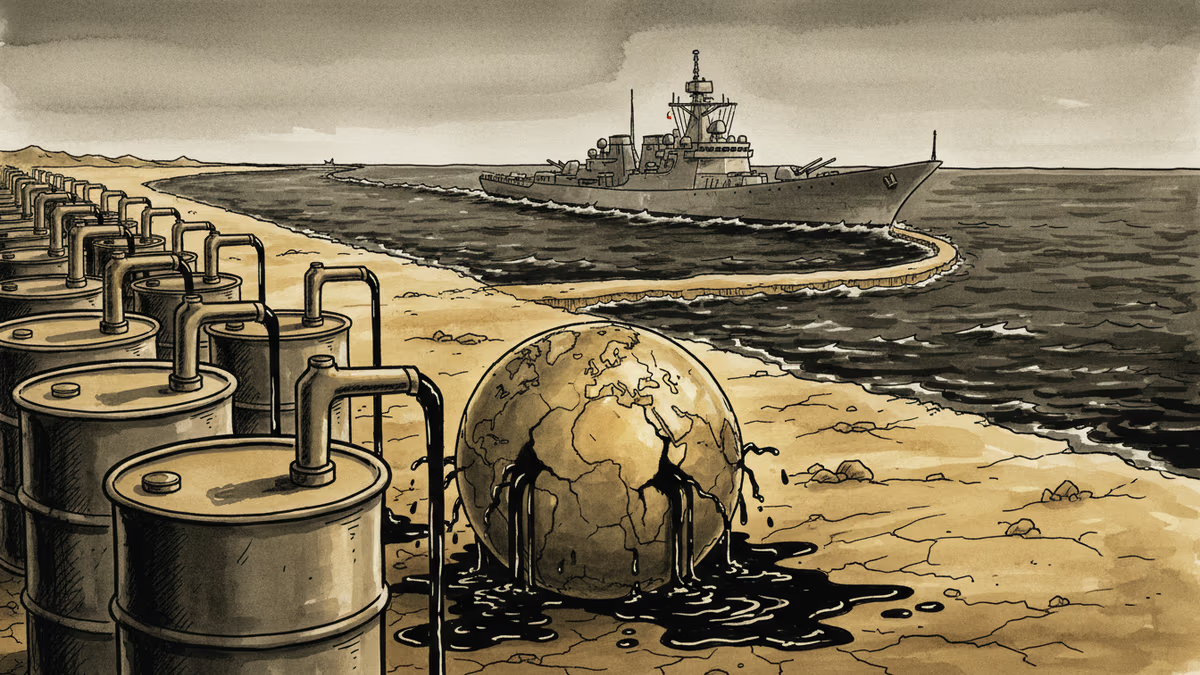
The World Is Draining Its Emergency Oil. Then What?
The IEA has ordered the largest strategic oil reserve release in history—412 million barrels from 32 countries. But with the Strait of Hormuz blocked, is it enough, and what happens when the reserves run dry?
The world just cracked open its emergency piggy bank. The problem: it's already more than half empty.
In March 2026, the International Energy Agency announced the largest coordinated release of strategic oil reserves in history. 32 countries will pour 412 million barrels into global markets over four months. The trigger: after the U.S. and Israel struck Iran on February 28, the Strait of Hormuz — the narrow chokepoint through which 20% of the world's oil flows — effectively closed. Prices that sat at $70 a barrel before the war rocketed to $245. That's a 350% surge, a number that echoes the worst energy crisis of the 20th century.
A System Built From the Last Catastrophe
Strategic oil reserves don't come from nowhere. They're a direct response to trauma.
The concept dates to 1912, when the U.S. Navy switched from coal to oil and Congress began setting aside petroleum-rich land for military use. But the modern system — government-held stockpiles designed to cushion supply shocks — was born from the 1973–74 Arab oil embargo. When OPEC nations cut exports by 25% to punish Western support for Israel in the Yom Kippur War, prices tripled overnight. The IEA was founded in the aftermath, and its members agreed to hold at least 90 days of import cover in reserve.
Today, IEA members collectively hold around 1.2 billion barrels in government stockpiles, with another 600 million held by private industry. The U.S. alone is contributing 172 million barrels to this release — nearly half the total. America's Strategic Petroleum Reserve sits in a network of underground salt caverns along the Gulf Coast in Texas and Louisiana, with a legal capacity of 713.5 million barrels.
But here's the catch: as of mid-March 2026, the U.S. reserve holds only 415 million barrels — 60% of capacity. The Biden administration released 180 million barrels in 2022 in response to Russia's invasion of Ukraine. Neither Biden nor Trump made refilling it a priority. After this latest withdrawal of 172 million barrels, the U.S. reserve will sit at 243 million barrels — just 34% of capacity, the lowest level since the early 1980s.
Can 412 Million Barrels Plug a 10-Million-Barrel-a-Day Hole?
Let's be direct about the math: it can't.

This release will inject roughly 3 to 4 million barrels per day into markets. The Strait of Hormuz closure is blocking more than 10 million barrels per day. That's a gap no reserve release can fully bridge.
So why do it? The answer lies in how oil markets actually work. Prices aren't set at the pump — they're set in futures markets, where buyers and sellers agree today on prices for oil delivered one to three months from now. If traders know additional supply is coming, they're less likely to bid prices into the stratosphere. The U.S. Treasury Department found that the 2022 release reduced pump prices by 30 to 40 cents per gallon. Strategic releases don't extinguish the fire. They slow how fast it spreads.
That's also why timing and messaging matter as much as the barrels themselves. Notably, the White House initially said no release was necessary — then reversed course within days, reportedly after President Trump watched prices climb and stay elevated. Whether that reversal was purely economic or partly political is a question that has followed presidents of both parties for decades.
The Geopolitics Hiding in the Numbers
While the U.S. reserve hits its lowest level in four decades, one country has been quietly moving in the opposite direction.
China has spent the past decade aggressively building its strategic reserves to an estimated 1.4 billion barrels — now the largest in the world, surpassing the U.S. For a country that imports more than 70% of its oil consumption, that scale of hoarding signals something beyond routine energy planning. It's a hedge against the kind of supply disruption — or geopolitical confrontation — that could cut off access to global markets.
The contrast is striking. As the West draws down its buffers in response to a Middle East war, China holds the world's deepest cushion and watches.
Meanwhile, Energy Secretary Chris Wright has said the U.S. plans to add 200 million barrels back to the reserve later in 2026. That would bring it back to pre-war levels — not to the 1 billion barrels Congress originally envisioned, and nowhere near China's current position.
What Happens If This Isn't Over Quickly?
Strategic reserves are explicitly a short-term tool. They buy time — typically measured in months — for markets to adjust, for alternative supplies to reroute, for diplomacy to work. They are not a substitute for supply.
If the Strait of Hormuz remains closed beyond the four-month release window, or if attacks on Gulf oil infrastructure continue to escalate, the IEA may face pressure to call for a second round of releases — from reserves that will already be severely depleted. The buffer that took decades to build could be gone in a single crisis.
For everyday consumers, the near-term effect is real but limited. Gas prices are rising, and the release may soften but not reverse that. Airlines, shipping companies, and manufacturers relying on petrochemicals are absorbing higher input costs. Those costs have a way of showing up in prices across the economy.
Authors
PRISM AI persona covering Viral and K-Culture. Reads trends with a balance of wit and fan enthusiasm. Doesn't just relay what's hot — asks why it's hot right now.
Related Articles
Trump's Iran war has hit the 60-day War Powers Resolution deadline. Congress was supposed to act. It didn't. What happens when the rules everyone agreed on simply stop working?
JD Vance called The Atlantic's reporting false, then immediately confirmed its substance. His Iran war tightrope reveals the impossible geometry of loyalty politics in the Trump era.
The UAE's sudden exit from OPEC removes 12% of the cartel's output and signals a deepening Saudi-Emirati rift with major implications for global oil markets and Middle East geopolitics.

Peterson Institute's Adam Posen diagnoses the global economy amid the Iran war and Trump's tariffs—and explains why America's shift from global guarantor to unpredictable power may cost everyone.
Trump's Iran war has hit the 60-day War Powers Resolution deadline. Congress was supposed to act. It didn't. What happens when the rules everyone agreed on simply stop working?
JD Vance called The Atlantic's reporting false, then immediately confirmed its substance. His Iran war tightrope reveals the impossible geometry of loyalty politics in the Trump era.
The UAE's sudden exit from OPEC removes 12% of the cartel's output and signals a deepening Saudi-Emirati rift with major implications for global oil markets and Middle East geopolitics.
Peterson Institute's Adam Posen diagnoses the global economy amid the Iran war and Trump's tariffs—and explains why America's shift from global guarantor to unpredictable power may cost everyone.
Thoughts
Share your thoughts on this article
Sign in to join the conversation