
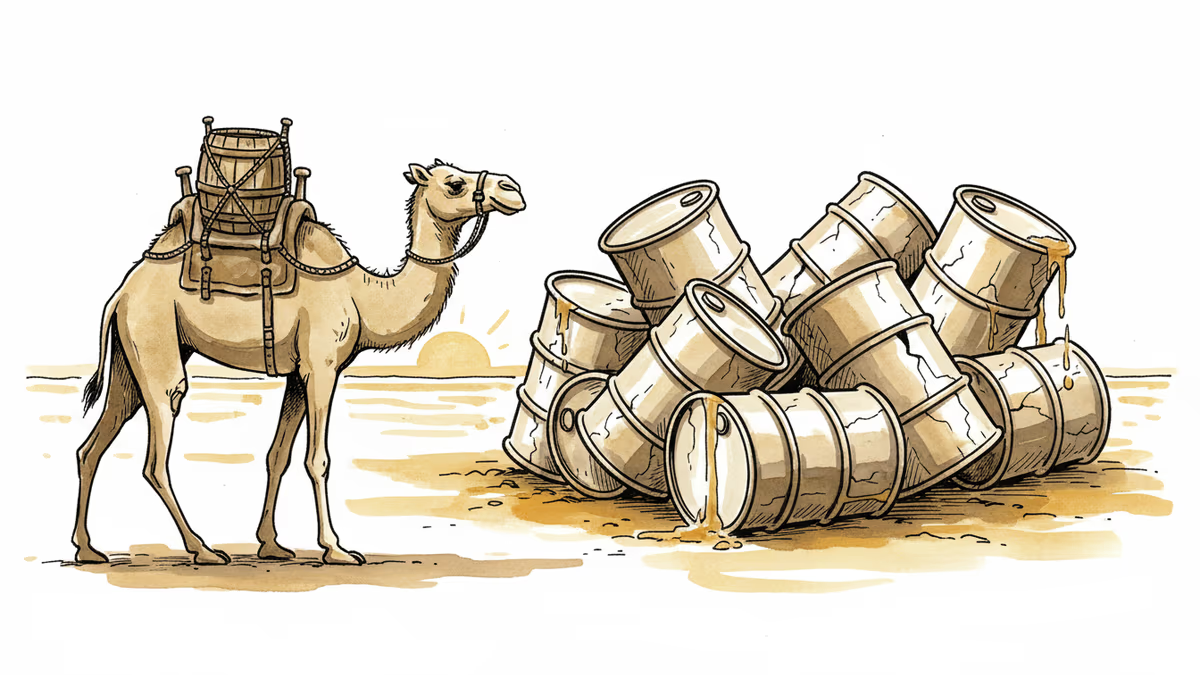
UAE Quits OPEC: The Gulf's Quiet Divorce
The UAE's sudden exit from OPEC removes 12% of the cartel's output and signals a deepening Saudi-Emirati rift with major implications for global oil markets and Middle East geopolitics.
Sixty years of membership. Three days' notice.
On April 28, 2026, the United Arab Emirates announced it would exit both OPEC and OPEC+ effective May 1 — stripping the cartel of its third- and fourth-largest oil producer in a single move. The departure affects roughly 12% of OPEC's total output, dwarfing the exits of Qatar in 2019 and Angola in 2024. Nothing quite like this has happened in the cartel's history.
To anyone watching Gulf politics closely, though, this wasn't a surprise. It was an inevitability.
A Breakup Years in the Making
The cracks first showed publicly in November 2020, when disagreements between Abu Dhabi and Riyadh over production quotas nearly derailed an OPEC+ summit. They widened again in July 2021. In both cases, the argument was the same: Saudi Arabia wanted to keep output low and prices high; the UAE wanted to pump more.
The reason for that divergence is structural, not personal. Saudi Arabia depends on elevated oil revenues to fund its sprawling Vision 2030 transformation — a multi-trillion-dollar bet on reinventing the kingdom's economy. High oil prices aren't a preference for Riyadh; they're a fiscal necessity.
The UAE's calculus is different. Abu Dhabi's economy is more diversified, less tethered to crude revenues, and — crucially — its leadership has made a strategic decision to monetize its reserves now, before the global energy transition erodes their value. The emirate has invested heavily to expand production capacity from 3.4 million barrels per day to a target of 5 million barrels per day by 2027. OPEC quotas were a ceiling it no longer wanted.
The logic is blunt: if the world is eventually going to stop buying oil, you'd rather sell your reserves than watch them become stranded assets.
War, Realignment, and a Calculated Exit
The geopolitical backdrop makes the timing sharper. In December 2025, competing Saudi and Emirati visions for Yemen's future threatened to reignite conflict in the war-torn country — a rare and open rupture between two Gulf states that had long projected unity. Then, on February 28, 2026, U.S. and Israeli military operations against Iran began, temporarily papering over the Saudi-Emirati rift under the banner of shared threat.

But the underlying split didn't disappear. It adapted.
Emirati officials have reportedly taken careful note of which partners showed up during the Iran crisis — and which didn't. The UAE's pivot is unmistakably toward Washington and, increasingly, toward Israel. Leaving a Saudi-dominated organization fits neatly into that reorientation. Some analysts suggest the UAE may also reconsider its roles in the Arab League, the Organisation of Islamic Cooperation, and potentially even the Gulf Cooperation Council.
And there's a practical upside: once the Strait of Hormuz fully reopens after the Iran conflict, Abu Dhabi — no longer bound by OPEC production ceilings — can increase output as aggressively as it wants.
What This Means for Oil Markets
The immediate market question is whether UAE production will actually surge, and how quickly. Abu Dhabi National Oil Company (ADNOC) has the infrastructure investment in place, but ramping up to 5 million barrels per day takes time even without quota constraints. In the short term, the symbolic signal may matter more than the barrels.
For OPEC itself, the damage is twofold. First, the raw math: losing 12% of output weakens the cartel's ability to move prices through coordinated cuts. Second, and perhaps more damaging, the UAE was one of the few genuine swing producers in the group — a member capable of rapidly adjusting output in response to market conditions. That flexibility is now gone.
Russia, already under economic strain from the Ukraine war, faces the prospect of a weakened OPEC+ unable to defend price floors. Saudi Arabia must now decide whether to compensate by cutting deeper itself — further straining its own budget — or accept lower prices and a diminished cartel.
For energy-importing nations — Europe, Japan, South Korea, India — UAE production growth could exert modest downward pressure on prices. But Middle East instability remains a risk premium that won't vanish with a membership card.
Stakeholders See Very Different Pictures
From Riyadh's perspective, this is a body blow. The Saudis built OPEC+ into a vehicle for coordinating with Russia and stabilizing markets after the 2014-2016 price crash. Losing the UAE — a fellow Gulf Arab state, a supposed partner — undermines both the mechanics and the optics of that project.
From Washington's perspective, the picture looks different. A UAE more tightly aligned with U.S. interests, less constrained by multilateral oil politics, and openly distancing itself from Russian-Saudi energy coordination is broadly welcome. The Biden-era discomfort with OPEC+ price management hasn't entirely faded from institutional memory.
For international investors, the UAE's move introduces uncertainty but also opportunity. ADNOC's expansion plans could attract significant capital. But if the Saudi-Emirati rivalry deepens into broader Gulf instability, the risk calculus shifts.
And for the global energy transition community, there's an uncomfortable irony: the UAE is accelerating fossil fuel production precisely because it believes the energy transition is coming. It's a race to extract value before the window closes — a reminder that decarbonization timelines are as much about financial strategy as environmental commitment.
This content is AI-generated based on source articles. While we strive for accuracy, errors may occur. We recommend verifying with the original source.
Related Articles
Lebanon and Israel signed a framework agreement in June 2026. Hezbollah rejected it. Israel kept fighting. History suggests this moment is real—and fragile.
Trump says he wants to 'take' Cuba. But this desire isn't new—it stretches back to Thomas Jefferson. Why this centuries-old obsession is coming to a head right now.
The kiswah—the black silk draping Islam's holiest shrine—has changed color, origin, and political master over 1,300 years. Its history is a map of Islamic power itself.
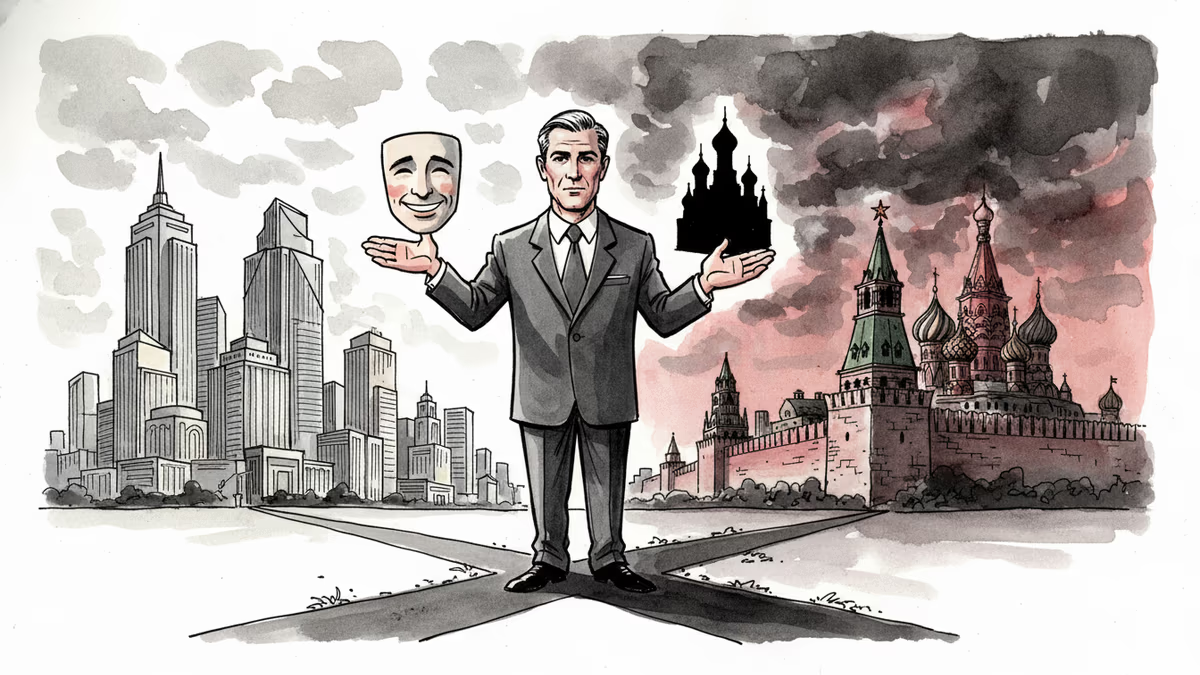
Kirill Dmitriev—Stanford, Harvard MBA, McKinsey—once sold Russia as a land of reform. Now he's selling out Ukraine's sovereignty in Mar-a-Lago backrooms. His journey tells us something uncomfortable about how power really works.
Lebanon and Israel signed a framework agreement in June 2026. Hezbollah rejected it. Israel kept fighting. History suggests this moment is real—and fragile.
Trump says he wants to 'take' Cuba. But this desire isn't new—it stretches back to Thomas Jefferson. Why this centuries-old obsession is coming to a head right now.
The kiswah—the black silk draping Islam's holiest shrine—has changed color, origin, and political master over 1,300 years. Its history is a map of Islamic power itself.
Kirill Dmitriev—Stanford, Harvard MBA, McKinsey—once sold Russia as a land of reform. Now he's selling out Ukraine's sovereignty in Mar-a-Lago backrooms. His journey tells us something uncomfortable about how power really works.
Thoughts
Share your thoughts on this article
Sign in to join the conversation