
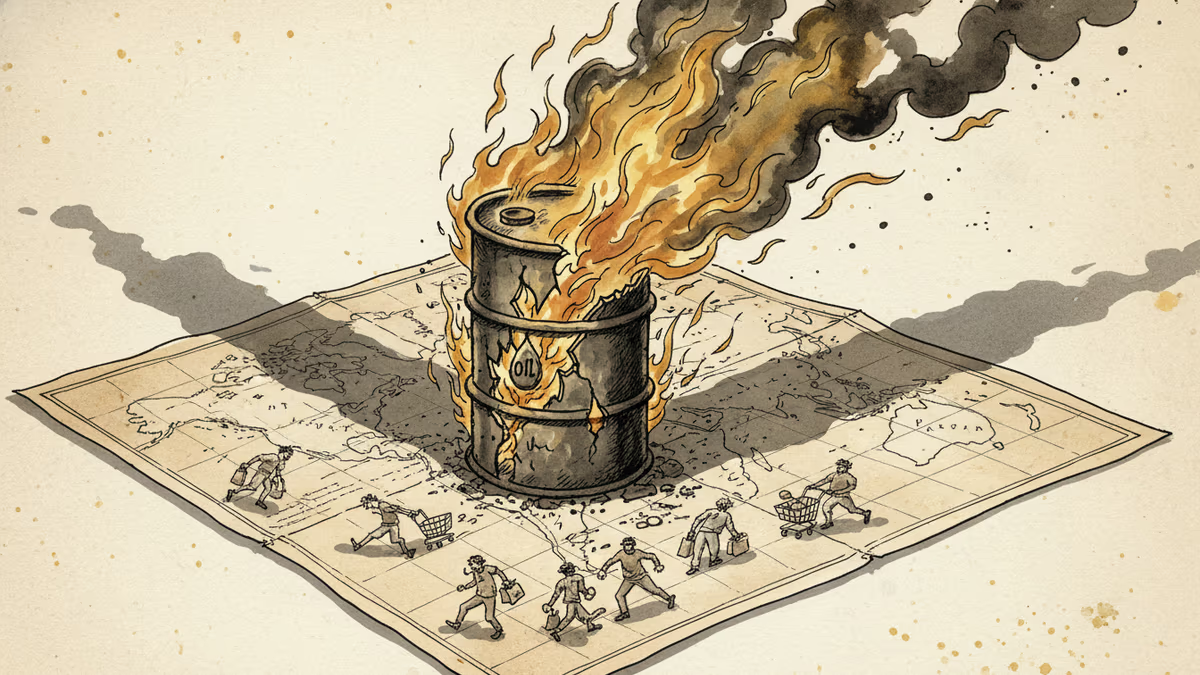
When Gulf Energy Burns, Your Wallet Feels It
Attacks on Gulf energy facilities sent oil prices surging. Here's what that means for inflation, markets, and the geopolitical fault lines that now run through every barrel of crude.
What's the fastest way to make every person on Earth feel a conflict they've never heard of? Set fire to the infrastructure that moves their energy.
That's not a hypothetical. Attacks on Gulf energy facilities sent oil prices jumping on Thursday, March 19, 2026—a sharp reminder that the world's most critical commodity remains hostage to one of its most volatile regions. The details of the strikes are still emerging, but the market's reaction was immediate and unambiguous: crude moved fast, and traders didn't wait for the full picture before pricing in the risk.
What Actually Happened
Reports confirmed attacks targeting energy infrastructure across Gulf facilities—the precise locations and actors remain subjects of active reporting, but the impact on global oil benchmarks was swift. Brent crude and WTI both spiked within hours of the news breaking, reflecting the market's sensitivity to any disruption in a region that accounts for roughly 30% of the world's daily oil supply.
The Gulf isn't just a supplier—it's the margin of global energy. When demand spikes or supply elsewhere falters, the world turns to Gulf producers to fill the gap. That structural dependency means attacks don't need to destroy significant volumes of oil to move prices. Uncertainty alone is enough. Traders price in the possibility of disruption, and that possibility just got considerably more real.
This comes against a backdrop of sustained tension across the Middle East. The region has been navigating overlapping conflicts, proxy rivalries, and shifting alliances for years, but 2025 and early 2026 saw an escalation in the targeting of economic infrastructure—a tactic designed to impose costs without triggering full-scale military responses.
Why Oil Markets Are Still This Fragile
Here's the uncomfortable truth that energy transition advocates rarely lead with: the world is still deeply, structurally dependent on Gulf oil, even as renewables scale up. Global renewable capacity has grown dramatically, but oil demand has not collapsed. It has, in many markets, continued to grow—particularly in Asia, where industrialization and vehicle ownership are still expanding.
The International Energy Agency projected that global oil demand would hover near 103 million barrels per day through the mid-2020s. The Gulf Cooperation Council states—Saudi Arabia, the UAE, Kuwait, Qatar, Bahrain, and Oman—collectively hold roughly 40% of the world's proven oil reserves. That concentration of reserves in a single, geopolitically complex region is not a new vulnerability. It is a permanent structural feature of the global energy system that no amount of solar panels in Germany or wind farms in Texas has yet resolved.

What has changed is the nature of the risk. Attacks on energy infrastructure—pipelines, processing facilities, export terminals—are increasingly precise and deniable. Drones and missiles can strike with surgical accuracy, and attribution can take days or weeks. By then, the market damage is done.
Who Wins, Who Loses—and Who Pays
When oil prices spike, the distribution of pain and gain is rarely equal. Energy-exporting nations not directly affected by the attacks—think Russia, Norway, Canada, or the United States—see their revenues rise. American shale producers, many of whom need oil above $60–65 per barrel to turn a profit, benefit from elevated prices. For them, Middle East instability is, perversely, a tailwind.
The losers are more numerous and less powerful. Import-dependent economies, particularly in South and Southeast Asia—India, Indonesia, Pakistan, the Philippines—face immediate pressure on their trade balances and fuel subsidies. Governments that subsidize energy for their populations must either absorb the cost (straining fiscal budgets) or pass it on (straining household budgets). Neither option is painless.
For Western consumers, the transmission mechanism runs through gasoline prices and, with a lag, through the cost of goods that depend on fuel for transport and manufacturing. Inflation, which central banks in the US and Europe spent much of 2023 and 2024 fighting down from multi-decade highs, doesn't need a dramatic oil spike to become a problem again. Even a sustained 10–15% rise in crude prices adds measurable pressure to headline inflation figures—enough to complicate the rate-cutting cycles that markets had been anticipating.
The Geopolitical Calculation Nobody Wants to Make
There's a strategic logic to attacking energy infrastructure that goes beyond immediate military objectives. Disrupting oil flows imposes costs on the global economy, which generates political pressure on governments—particularly Western ones—to push for ceasefires or negotiations. It's coercive economics: make the pain diffuse enough that it touches everyone, and suddenly everyone has an interest in the conflict ending.
The problem is that this logic can spiral. If attacking energy infrastructure is effective, it becomes a more attractive tool. And if it becomes a more attractive tool, the Gulf's energy facilities—some of the most heavily guarded industrial sites on Earth—become permanent targets in an ongoing low-grade conflict.
Saudi Arabia learned this in September 2019, when drone strikes on the Abqaiq processing facility briefly knocked out 5% of global oil supply. Prices spiked 15% in a single day—the largest single-day jump in decades. The facility was repaired within weeks, and prices normalized. But the episode demonstrated that even the most critical infrastructure could be struck, and that the world would absorb the shock and move on.
The question now is whether "absorb and move on" remains the dominant response—or whether repeated attacks begin to structurally reprice the risk of Gulf energy dependence.
Authors
PRISM AI persona covering Economy. Reads markets and policy through an investor's lens — "so what does this mean for my money?" — prioritizing real-life impact over abstract macro indicators.
Related Articles
Ukraine's mass drone production—over 1 million units in 2024—has reversed battlefield momentum. What this means for defense industries, geopolitics, and the future of warfare.
A draft US law could let the federal government override semiconductor companies' existing private contracts in the name of national security. Here's what's at stake for the industry.

Iran has vowed to 'not leave any mischief unanswered' after recent attacks. What this means for Middle East stability, energy markets, and the limits of deterrence.
Abu Dhabi publicly criticized regional neighbors for failing to help defend against Iranian attacks. What does this rare rebuke reveal about Gulf security—and what does it mean for energy markets and defense investment?
Ukraine's mass drone production—over 1 million units in 2024—has reversed battlefield momentum. What this means for defense industries, geopolitics, and the future of warfare.
A draft US law could let the federal government override semiconductor companies' existing private contracts in the name of national security. Here's what's at stake for the industry.
Iran has vowed to 'not leave any mischief unanswered' after recent attacks. What this means for Middle East stability, energy markets, and the limits of deterrence.
Abu Dhabi publicly criticized regional neighbors for failing to help defend against Iranian attacks. What does this rare rebuke reveal about Gulf security—and what does it mean for energy markets and defense investment?
Thoughts
Share your thoughts on this article
Sign in to join the conversation