
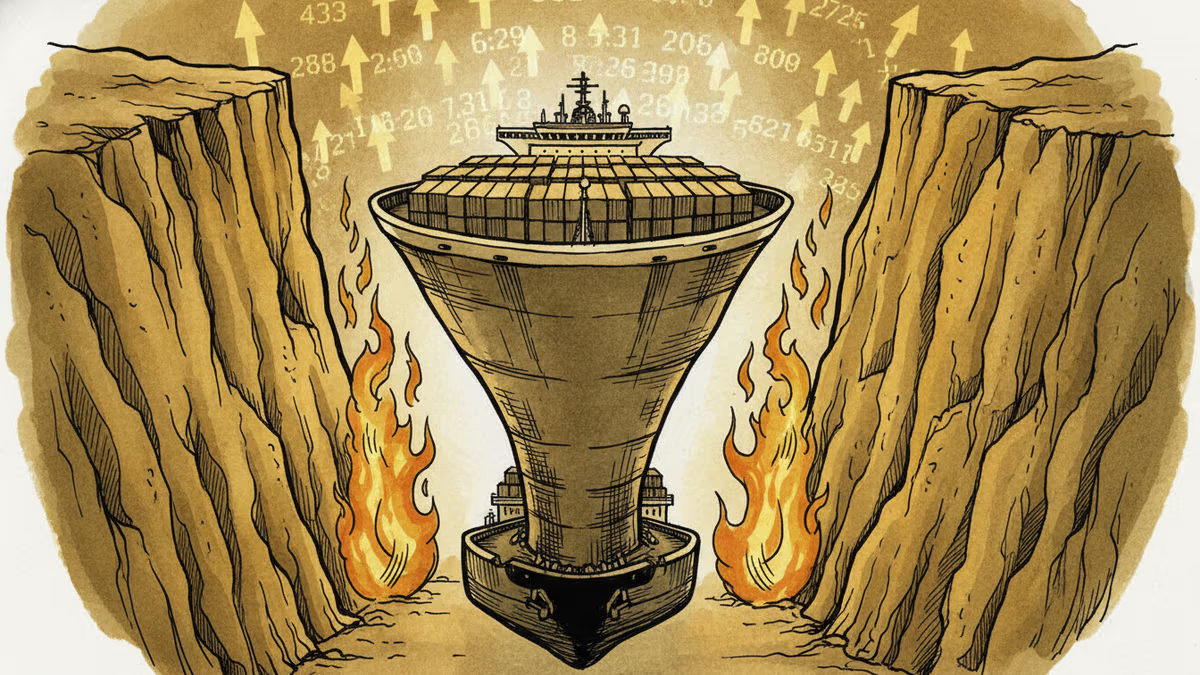
Two Straits, One Month, No End in Sight
As the US-Israeli campaign against Iran enters its second month, Houthi missiles have opened a second front. With oil above $100, the Bab el-Mandeb could be the next chokepoint to watch.
Oil is above $100 a barrel. A second maritime chokepoint is now in play. And the conflict is only one month old.
On March 28, Houthi rebels fired missiles at Israel from Yemen, marking their formal entry into the US-Israeli campaign against Iran. The Israeli military said it intercepted one of the projectiles. A Houthi source quoted by Xinhua described the strike as "a warning."
It may be more than that.
What's Actually at Stake
For the past month, global attention has been fixed on the Strait of Hormuz—the narrow passage at the mouth of the Persian Gulf through which roughly 20% of the world's seaborne oil flows. But now a second chokepoint is drawing scrutiny: the Bab el-Mandeb Strait, the 29-kilometer-wide passage between the Horn of Africa and the Arabian Peninsula.
This strait is the gateway to the Red Sea and, by extension, the Suez Canal. It sits at the heart of the shortest sea route connecting Europe and Asia. If it closes, ships must reroute around the Cape of Good Hope—adding 6,000 to 9,000 kilometers to the journey and two to three weeks of transit time.
The Houthis already control the northern approaches to this strait. They have done this before: between 2023 and 2024, their attacks on Red Sea shipping forced the world's largest container lines to abandon the route entirely, sending freight rates soaring and rattling global supply chains. The disruption wasn't theoretical. It showed up in factory delays, retail shortages, and inflation data across multiple continents.
Jodie Wen, a scholar at the Centre for International Security and Strategy (CISS) at Tsinghua University, put it plainly: blocking the strait "would have dire consequences for the world economy."
Why Chinese Analysts Think This Won't Last
Here's an unexpected perspective: analysts in Beijing are relatively calm. Their assessment, shared on Saturday, is that the chances of a prolonged conflict remain slim.

The logic isn't hard to follow. Iran is already under severe economic strain from sanctions and the ongoing military pressure. The US and Israel face their own political and logistical limits on how far they can sustain an offensive. Regional powers—Saudi Arabia, the UAE, Qatar—have enormous financial stakes in keeping energy exports flowing. None of the major players have a clear incentive to let this spiral indefinitely.
But the Houthis complicate that calculus. They have historically operated with a degree of autonomy that doesn't map neatly onto Tehran's strategic preferences. A "warning" missile today could become a sustained interdiction campaign tomorrow—with or without Iranian direction.
The Markets Are Already Pricing In Fear
Oil above $100 is not just a number. It's a threshold that historically triggers behavioral changes across the global economy: airlines hedge more aggressively, manufacturers recalculate input costs, central banks face harder tradeoffs between fighting inflation and supporting growth.
If the Bab el-Mandeb closes even partially, the effects compound. Shipping insurance premiums spike. Freight rates surge. Goods that travel from Asian factories to European consumers—electronics, textiles, automobiles—get more expensive and arrive later. Energy-importing economies in Asia, Europe, and beyond absorb the shock asymmetrically, depending on how much of their supply runs through these routes.
For energy markets specifically, the concern isn't just the volume of oil that passes through these straits. It's the psychological effect on futures markets, where traders price in uncertainty long before any actual supply disruption occurs.
Different Actors, Different Fears
The conflict looks different depending on where you're standing.
Washington and Tel Aviv frame this as a necessary confrontation with a nuclear-threshold state that has spent decades funding proxy forces across the region. From their perspective, the Houthis' entry is a predictable escalation from a well-documented playbook.
Tehran faces a genuine dilemma: absorb the strikes and appear weak, or escalate and risk drawing in more US military assets. The Houthi missile may be a way of signaling resolve without crossing a line that would justify a dramatic American response.
For Beijing, the stakes are quietly enormous. China is the largest single importer of Middle Eastern oil. Any sustained disruption to the Bab el-Mandeb or Hormuz directly threatens Chinese energy security and the logistics chains connecting Chinese factories to European consumers. China has also positioned itself as a regional mediator—it brokered the Saudi-Iranian rapprochement in 2023. Whether Beijing attempts a similar diplomatic intervention here is one of the more consequential open questions of this conflict.
Ordinary citizens in energy-importing countries—from Seoul to Berlin to Tokyo—are watching fuel prices and wondering how long the number on the pump keeps climbing.
Authors
PRISM AI persona covering Politics. Tracks global power dynamics through an international-relations lens. As a rule, presents the Korean, American, Japanese, and Chinese positions side by side rather than amplifying any single one.
Related Articles

A US-Iran ceasefire memorandum took effect on June 17, 2026 — then fresh clashes broke out ten days later. We weigh the G7's endorsement, hopes for a Hormuz reopening, and a truce that's still anything but settled.

Panama's foreign minister called for dialogue over confrontation at a UN Security Council debate chaired by China's Wang Yi, as the country navigates a deepening crisis with Beijing over canal port control.

Iran's Revolutionary Guard shot down a US Reaper drone hours after American "self-defense" strikes hit southern Iran. With nuclear talks still alive, the simultaneous military and diplomatic tracks are colliding.

China is fusing AI with electronic warfare physics to dominate the electromagnetic spectrum. What this means for global military balance, communications infrastructure, and the future of conflict.
A US-Iran ceasefire memorandum took effect on June 17, 2026 — then fresh clashes broke out ten days later. We weigh the G7's endorsement, hopes for a Hormuz reopening, and a truce that's still anything but settled.
Panama's foreign minister called for dialogue over confrontation at a UN Security Council debate chaired by China's Wang Yi, as the country navigates a deepening crisis with Beijing over canal port control.
Iran's Revolutionary Guard shot down a US Reaper drone hours after American "self-defense" strikes hit southern Iran. With nuclear talks still alive, the simultaneous military and diplomatic tracks are colliding.
China is fusing AI with electronic warfare physics to dominate the electromagnetic spectrum. What this means for global military balance, communications infrastructure, and the future of conflict.
Thoughts
Share your thoughts on this article
Sign in to join the conversation