
Beijing's Month: Trump, Putin, and Sharif All Come Calling
Trump just left Beijing after the first US presidential visit in nine years. Putin arrives Wednesday. Pakistan's PM follows. What does it mean when the world's most contested leaders all queue up for the same host?
In the span of a single month, the leaders of Washington, Moscow, and Islamabad will all have passed through Beijing. That has never happened before.
Donald Trump wrapped up a three-day visit to China on Friday — the first trip by a sitting US president in nine years. The visit, originally scheduled for March, had been postponed due to the Iran war. Barely hours after Air Force One departed, Hong Kong's South China Morning Post reported exclusively that Vladimir Putin would arrive in Beijing on Wednesday for a one-day visit. Shehbaz Sharif, Pakistan's Prime Minister, is also scheduled for a three-day stay. By the time May is out, Xi Jinping will have hosted the leaders of America, Russia, and Pakistan — three countries that are, in various configurations, rivals, partners, and clients — all within the same calendar month.
Why Beijing, Why Now
Taken individually, each visit has its own logic. Trump's trip was framed around trade and tariff negotiations — a continuation of the economic friction that has defined US-China relations for the better part of a decade. Putin's visit extends the deepening alignment between Moscow and Beijing that accelerated after the Ukraine invasion. Sharif's agenda centers on China-Pakistan Economic Corridor (CPEC) investment and regional security, particularly as tensions with India remain elevated.
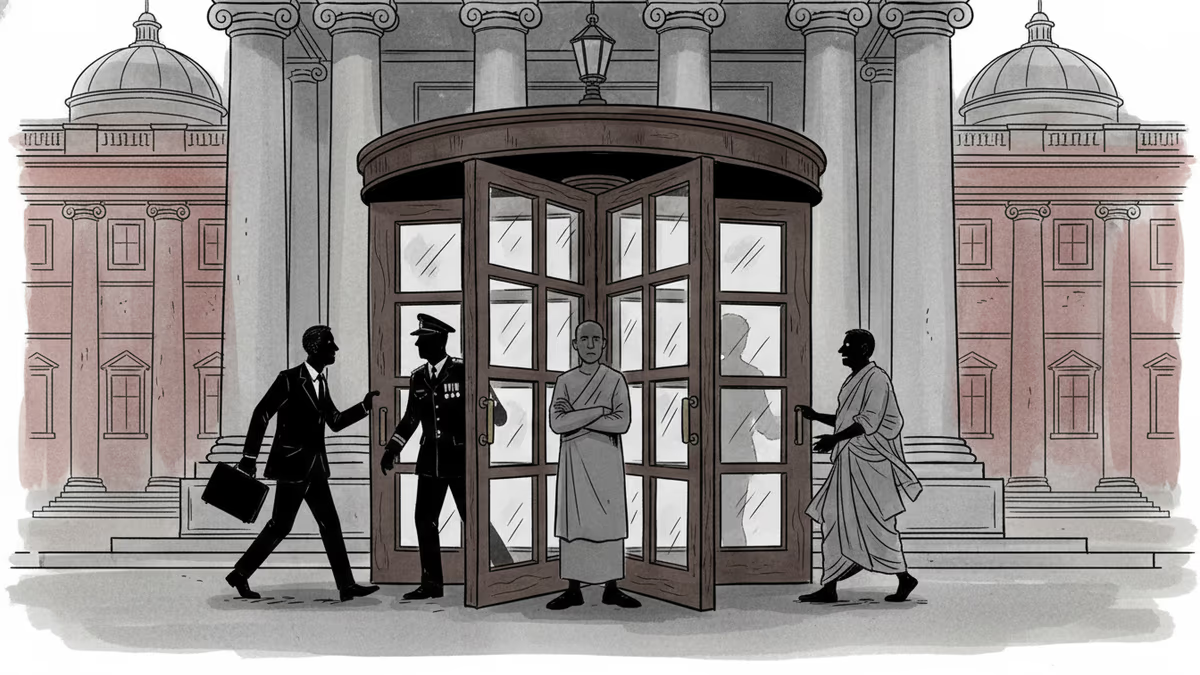
But zoom out, and the pattern becomes harder to dismiss as coincidence. Beijing is positioning itself as the indispensable interlocutor of a fractured world. The message isn't in any single bilateral communiqué — it's in the optics of the sequence itself. When the leader of the world's largest economy, the leader of its most sanctioned major power, and the leader of a nuclear-armed South Asian state all make the same pilgrimage within weeks of each other, the host country doesn't need to say anything. The calendar does the talking.
The timing matters for another reason: the world is simultaneously mid-crisis on multiple fronts. The Iran war has reshuffled Middle Eastern alignments. The Ukraine conflict grinds on. US-China trade tensions have calcified into a tariff structure that neither side has fully dismantled. In that environment, Beijing is presenting itself not as a superpower in the traditional sense, but as something arguably more valuable — a country that will talk to everyone.
What Each Side Is Getting

For Trump, the visit is partly a domestic political product. A presidential trip to Beijing — the first in nearly a decade — is a tangible foreign policy achievement, regardless of what was actually agreed. But American hawks will be watching closely for signs that Trump gave away too much. The full contents of any joint statement have yet to be disclosed, and until they are, suspicion will linger on both sides of the US political spectrum.
For Putin, arriving in the same city that Trump just left is a statement in itself. Russia has spent three years under Western sanctions, and every high-profile diplomatic engagement — especially one that follows a US presidential visit — serves as a rebuttal to the narrative of isolation. The China-Russia relationship has grown considerably more transactional since 2022, with Beijing providing economic lifelines while carefully avoiding direct military support. This visit will test whether that arrangement is deepening or plateauing.
For Sharif, the calculus is the most precarious. Pakistan needs Chinese investment and diplomatic backing, but the terms of CPEC have generated serious domestic debate about debt dependency. Sharif arrives needing to demonstrate tangible wins — new commitments, renegotiated terms, or security guarantees — without appearing to trade sovereignty for them.
The Hub Paradox
China's diplomatic positioning this month reflects a broader strategic ambition: to occupy the center of a multipolar order rather than lead a bloc within it. During the Cold War, the world divided into two camps. After 1991, American unipolarity defined the architecture. What Beijing is now constructing looks like neither — a country that trades with everyone, mediates selectively, and avoids the kind of formal alliance commitments that would force it to choose sides in a crisis.
This is a genuinely novel posture, and it comes with genuine tensions. Washington has not dropped its suspicion that Beijing is quietly sustaining Moscow's war economy. Whether Trump raised this directly with Xi — and what response he received — remains unknown. India is watching the Sharif visit with acute anxiety, reading every CPEC expansion as a strategic encirclement. And smaller nations in the Global South, while drawn to Beijing's non-judgmental engagement, are increasingly aware that Chinese infrastructure investment comes with its own forms of leverage.
The question of whether Beijing is a neutral hub or a self-interested operator managing multiple relationships simultaneously is not merely academic. It will determine how the next major international crisis — whatever shape it takes — gets resolved, and who ends up on which side of it.
This content is AI-generated based on source articles. While we strive for accuracy, errors may occur. We recommend verifying with the original source.
Related Articles
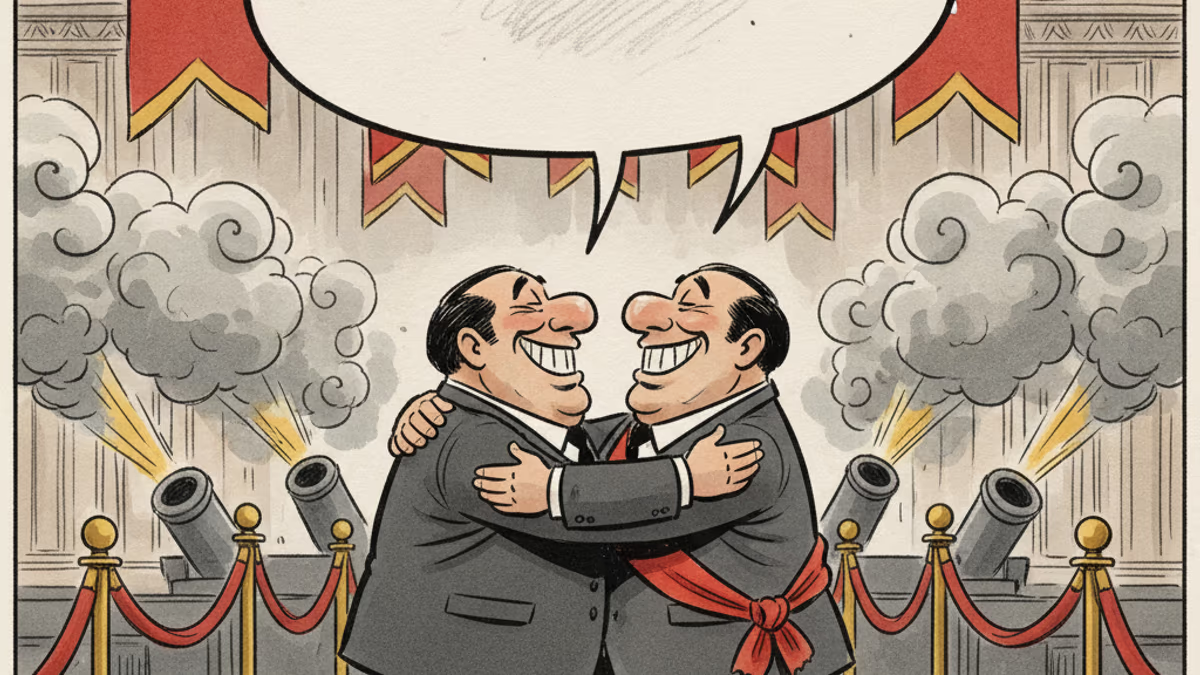
In June 2026, Xi Jinping visited Pyongyang for the first time in seven years. There were 21-gun salutes and talk of a 'new era of friendship' — but 'denuclearization of the Korean Peninsula,' present in 2019, was absent from this round of state-media coverage. A symbolic overreach, or a real upgrade?

Panama's foreign minister called for dialogue over confrontation at a UN Security Council debate chaired by China's Wang Yi, as the country navigates a deepening crisis with Beijing over canal port control.

Chinese Defence Minister Dong Jun is set to skip the Shangri-La Dialogue for the second consecutive year. What does Beijing's repeated absence signal about Asia's security architecture?

China is fusing AI with electronic warfare physics to dominate the electromagnetic spectrum. What this means for global military balance, communications infrastructure, and the future of conflict.
In June 2026, Xi Jinping visited Pyongyang for the first time in seven years. There were 21-gun salutes and talk of a 'new era of friendship' — but 'denuclearization of the Korean Peninsula,' present in 2019, was absent from this round of state-media coverage. A symbolic overreach, or a real upgrade?
Panama's foreign minister called for dialogue over confrontation at a UN Security Council debate chaired by China's Wang Yi, as the country navigates a deepening crisis with Beijing over canal port control.
Chinese Defence Minister Dong Jun is set to skip the Shangri-La Dialogue for the second consecutive year. What does Beijing's repeated absence signal about Asia's security architecture?
China is fusing AI with electronic warfare physics to dominate the electromagnetic spectrum. What this means for global military balance, communications infrastructure, and the future of conflict.
Thoughts
Share your thoughts on this article
Sign in to join the conversation