
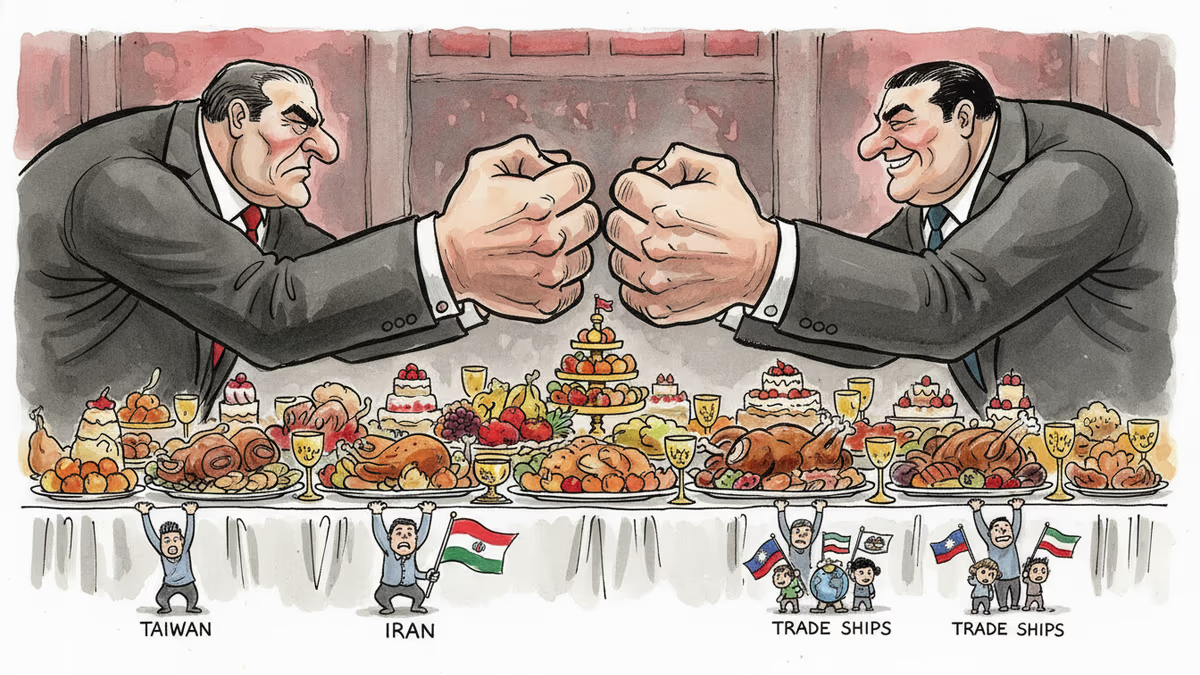
Smiles in Beijing — But Who Blinked First?
Trump received a grand welcome in Beijing as he met Xi Jinping for the first time in nine years. Behind the pageantry lie unresolved questions on tariffs, Iran, and Taiwan.
In 2016, Donald Trump told a campaign rally that China was "raping" the United States. On Thursday, standing beside Xi Jinping at the Temple of Heaven, he called his host "a great leader" and said China was beautiful.
Nine years is a long time. So is a 100%-plus tariff war.
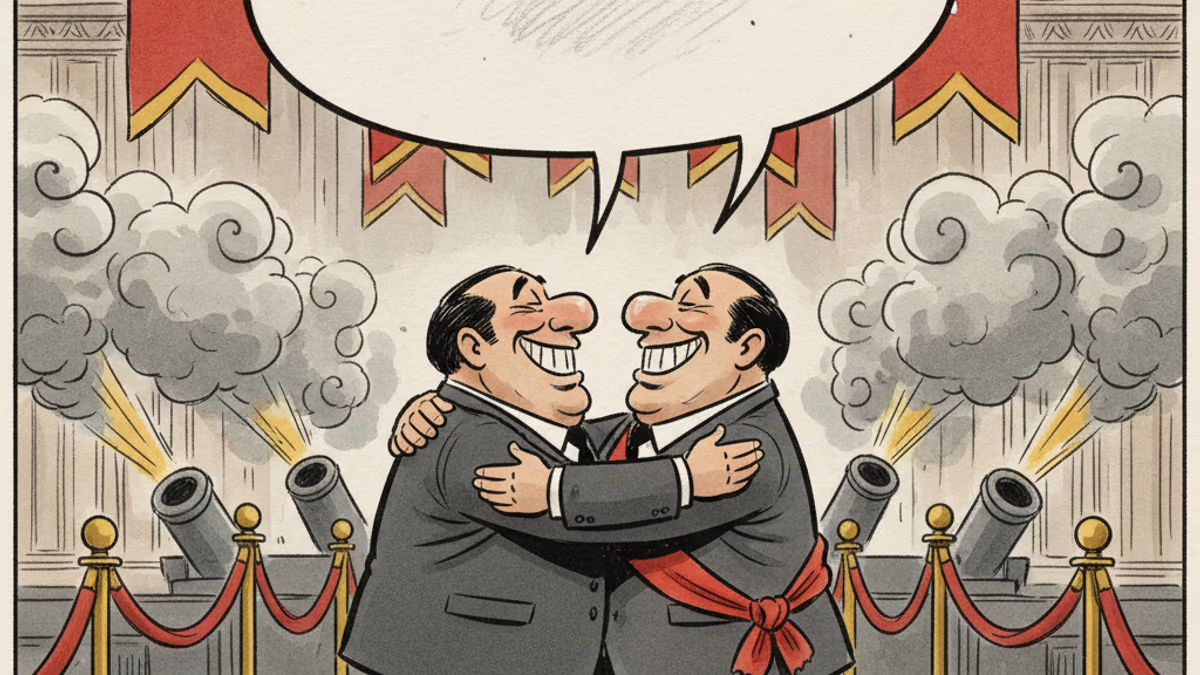
Trump arrived in Beijing for his first visit since his first term, greeted by a military honor guard, a gun salute, schoolchildren waving Chinese and American flags, and a band playing the Star-Spangled Banner outside the Great Hall of the People. He patted Xi's arm. He called the talks "cherished." At the evening banquet, he invited Xi to the White House in September.
Xi, for his part, offered a toast: "The great rejuvenation of the Chinese nation and Make America great again can go hand in hand."
But behind the choreography, three deeply thorny issues remain unresolved — and the details released so far are thin.
What Beijing Put on the Table — and What It Didn't
The guest list alone told a story. Elon Musk, Tim Cook, and Jensen Huang of Nvidia were among the 30 American CEOs who flew to Beijing with Trump. China's state media made sure the images were broadcast widely. This was not just a diplomatic reception — it was a demonstration.
And China had reason to feel confident hosting it. The country now manufactures roughly one-third of all goods produced globally. It processes over 90% of the world's rare earth minerals. It produces somewhere between 60 and 80% of all solar panels, wind turbines, and electric vehicles. When Trump imposed tariffs exceeding 100% last year, Beijing retaliated in kind and restricted rare earth exports. Washington came back to the table. Tariffs were lowered.
"I hesitate to put too much on this specific summit," said John Delury, a senior fellow at the Asia Society's Centre on US-China Relations, "but the inexorable rise of China to a place where it is legitimately rivalling the US — that is now happening before our eyes. Beijing is now the second world capital."

Xi has spent recent months cultivating exactly that image: a steady, reliable partner at a moment when the United States under Trump has rattled allies and upended global trade rules. Leaders from Canada, the UK, and Germany have all made their way to Beijing. The welcome for Trump, then, was also a message to everyone watching — that China's door is open, and that deals get done here.
Three Problems, No Answers Yet
The White House readout from the first day of talks was notable for what it left out.
On trade, the statement said the two sides "discussed ways to enhance economic cooperation," including expanding US firms' access to Chinese markets and Chinese investment in American industries. No numbers, no timeline, no mechanism. Xi's mention of expanding agricultural trade was widely read as a signal that China may resume large purchases of American soybeans, beef, and Boeing aircraft — but nothing was confirmed.
On Iran, the situation is more urgent. The blocked Strait of Hormuz has rattled global energy markets, and Trump needs Beijing's help to pressure Tehran toward the negotiating table. China is Iran's largest trading partner, and the relationship runs deep. Secretary of State Marco Rubio said before the trip that the US hopes to "convince them to play a more active role." The joint statement confirmed that both sides agreed Iran must never have a nuclear weapon and that the Strait must remain open. What China gets in return for any active mediation was not disclosed.
On Taiwan, the silence was loudest. Chinese state media reported that Xi warned Trump the Taiwan issue could bring the two countries into conflict. When reporters asked both leaders at the Temple of Heaven whether they had discussed Taiwan, neither responded. Officials in Taipei are watching closely. Trump is legally bound to provide Taiwan with defensive arms, but the degree of US commitment — and whether it might be quietly traded for progress elsewhere — is exactly what Taipei fears being negotiated away.
Why Both Sides Need This to Work
The striking thing about this summit is that both leaders arrived needing something.
Trump's approval ratings are falling. The Iran crisis has rattled markets and exposed the limits of unilateral American pressure. A foreign policy win — a deal, a photo, a narrative of strength — matters heading into the domestic political calendar. The delegation of tech and business CEOs was not incidental; it was the story Trump wants to tell: that he opened China's market for American companies.
Xi, meanwhile, is managing a domestic economy under real stress. Youth unemployment is high. The real estate sector remains fragile. Local government debt is at dangerous levels. A stable trade relationship with the United States is not a luxury — it is an economic necessity. China may not want a world centered on Washington, but it cannot afford a prolonged rupture with its largest export market.
That shared vulnerability may be the most durable foundation for whatever comes next. The two leaders agreed to frame their relationship as "constructive, strategic, and stable" for the next three years — a framing that signals intent, if not yet substance.
Friday's second round of talks may yield more concrete details. Or it may not.
This content is AI-generated based on source articles. While we strive for accuracy, errors may occur. We recommend verifying with the original source.
Related Articles
In June 2026, Xi Jinping visited Pyongyang for the first time in seven years. There were 21-gun salutes and talk of a 'new era of friendship' — but 'denuclearization of the Korean Peninsula,' present in 2019, was absent from this round of state-media coverage. A symbolic overreach, or a real upgrade?

Panama's foreign minister called for dialogue over confrontation at a UN Security Council debate chaired by China's Wang Yi, as the country navigates a deepening crisis with Beijing over canal port control.

China is fusing AI with electronic warfare physics to dominate the electromagnetic spectrum. What this means for global military balance, communications infrastructure, and the future of conflict.

Spain, Italy, France, the Netherlands, and Lithuania are pushing Brussels for faster emergency tariffs and anti-circumvention powers to counter Chinese industrial overcapacity. Here's what's at stake.
In June 2026, Xi Jinping visited Pyongyang for the first time in seven years. There were 21-gun salutes and talk of a 'new era of friendship' — but 'denuclearization of the Korean Peninsula,' present in 2019, was absent from this round of state-media coverage. A symbolic overreach, or a real upgrade?
Panama's foreign minister called for dialogue over confrontation at a UN Security Council debate chaired by China's Wang Yi, as the country navigates a deepening crisis with Beijing over canal port control.
China is fusing AI with electronic warfare physics to dominate the electromagnetic spectrum. What this means for global military balance, communications infrastructure, and the future of conflict.
Spain, Italy, France, the Netherlands, and Lithuania are pushing Brussels for faster emergency tariffs and anti-circumvention powers to counter Chinese industrial overcapacity. Here's what's at stake.
Thoughts
Share your thoughts on this article
Sign in to join the conversation