
China's Rare Earth Reach Now Extends Beyond Its Borders
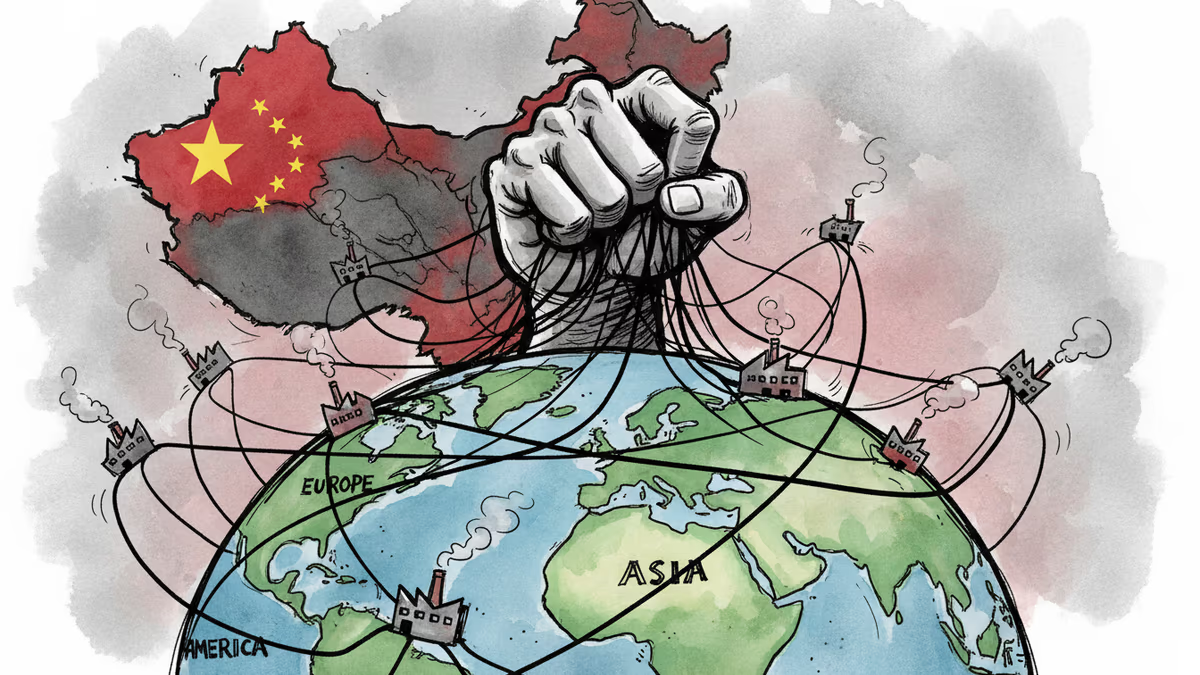
Beijing's expanded export controls now include an extraterritorial clause—products made anywhere in the world using Chinese rare earths could be subject to Chinese approval. The rules of global supply chains just changed.
What if the factory is in Germany, the buyer is in Japan, but China still holds the veto?
That's no longer a hypothetical. Last October, as a room full of European officials and Asia-watchers gathered at a conference centre in The Hague for a symposium on China relations, news broke mid-session: Beijing had expanded its export controls on rare earths and critical minerals—and this time, added a clause that stopped many in the room cold.
The new rules carry an extraterritorial dimension. China can now restrict not only direct exports of rare earths, but also the sale of products manufactured in third countries if those products contain Chinese-origin rare earth content or controlled inputs. In other words, a wind turbine assembled in Denmark, an EV motor built in South Korea, or a guided missile component produced in the United States—if any of them contain materials that trace back to Chinese mines or refineries, Beijing now claims the right to approve or deny their onward sale.
The conference room, by several accounts, went quiet.
The Weapon That Was Always There
To understand why this matters, start with the numbers. China controls roughly 60% of global rare earth mining and an estimated 85–90% of refining capacity. These aren't obscure industrial inputs. Neodymium, dysprosium, terbium—the names are unfamiliar, but without them there are no EV motors, no wind turbine generators, no precision-guided munitions, no advanced semiconductors. Rare earths are the hidden skeleton of the modern economy.
For years, analysts warned that this concentration was a vulnerability waiting to be exploited. China gave a preview in 2010, when it restricted rare earth exports to Japan during a territorial dispute over the Senkaku/Diaoyu islands. The world noted it, diversification efforts sputtered, and by the mid-2010s supply chains had quietly re-centred on China anyway—because Chinese rare earths were simply cheaper and more reliably available than alternatives.
What's different now is the architecture of the control. The extraterritorial clause transforms rare earth leverage from a bilateral tool into a multilateral chokehold. It's not just about what China sells to whom. It's about what the world can make and trade with what China has already sold.
A Symmetrical Response to Washington

The timing is not coincidental. Washington has spent the better part of four years building an elaborate export control regime around semiconductors, chipmaking equipment, and AI hardware—designed to slow China's technological ascent. The Commerce Department's Entity List, the Foreign Direct Product Rule, the CHIPS Act restrictions: all of them use American technological dominance as a lever.
Beijing's expanded rare earth controls are, in structural terms, the mirror image. Where Washington controls the flow of advanced technology downstream, Beijing is asserting control over raw material inputs upstream. Two chokepoints, two supply chains, two sets of rules—and every country in between is being asked, implicitly or explicitly, to choose which rules it lives by.
The Foreign Direct Product Rule, which the US uses to restrict foreign-made goods that incorporate American technology, is widely seen as the template China is now adapting. That's a significant shift. For decades, the architecture of global trade rules was largely written in Washington, Geneva, and Brussels. The extraterritorial rare earth clause is Beijing writing its own chapter.
The Gap Between Policy and Reality
The US, EU, Japan, and Australia have all announced initiatives to diversify rare earth supply chains. The Inflation Reduction Act, the EU Critical Raw Materials Act, bilateral agreements with Canada and Greenland—the policy intent is clear. New mining projects are underway in Australia, Canada, and parts of Africa.
But the gap between intent and capability remains vast. Building a mine, processing facility, and refining capacity from scratch takes upward of a decade and billions in capital investment. Environmental permitting, community opposition, and thin profit margins at current prices make many projects economically fragile. China built its rare earth dominance over 30+ years of deliberate industrial policy, state subsidies, and tolerance for environmental costs that Western democracies cannot easily replicate.
Some analysts argue China is unlikely to enforce the extraterritorial clause aggressively—rare earth exports generate significant foreign exchange, and a hard cutoff would accelerate exactly the diversification Beijing wants to prevent. But a weapon doesn't need to be fired to change behaviour. The clause's existence alone reshapes how companies design supply chains, how governments negotiate trade deals, and how investors price geopolitical risk.
Who Feels It First
The industries most exposed are precisely those that sit at the centre of the green and digital transitions: EV manufacturers, renewable energy developers, defence contractors, and consumer electronics producers. Tesla, Volkswagen, Siemens Energy, Lockheed Martin—their supply chain teams are now mapping rare earth content in ways they never had to before.
For smaller economies deeply integrated into global manufacturing—South Korea, Taiwan, the Netherlands—the extraterritorial clause creates a compliance headache with no clean solution. They can't easily source outside China in the short term, but sourcing from China now comes with a new layer of political exposure.
Europe's position is particularly awkward. The EU needs rare earths to hit its climate targets, has staked its industrial future on EVs and offshore wind, and is simultaneously trying to reduce strategic dependence on China. The Hague conference, meant to discuss how Europe engages with Beijing, found itself suddenly confronting a much sharper question: what leverage does Europe actually have?
This content is AI-generated based on source articles. While we strive for accuracy, errors may occur. We recommend verifying with the original source.
Related Articles

Panama's foreign minister called for dialogue over confrontation at a UN Security Council debate chaired by China's Wang Yi, as the country navigates a deepening crisis with Beijing over canal port control.

Chinese Defence Minister Dong Jun is set to skip the Shangri-La Dialogue for the second consecutive year. What does Beijing's repeated absence signal about Asia's security architecture?

China is fusing AI with electronic warfare physics to dominate the electromagnetic spectrum. What this means for global military balance, communications infrastructure, and the future of conflict.

Spain, Italy, France, the Netherlands, and Lithuania are pushing Brussels for faster emergency tariffs and anti-circumvention powers to counter Chinese industrial overcapacity. Here's what's at stake.
Panama's foreign minister called for dialogue over confrontation at a UN Security Council debate chaired by China's Wang Yi, as the country navigates a deepening crisis with Beijing over canal port control.
Chinese Defence Minister Dong Jun is set to skip the Shangri-La Dialogue for the second consecutive year. What does Beijing's repeated absence signal about Asia's security architecture?
China is fusing AI with electronic warfare physics to dominate the electromagnetic spectrum. What this means for global military balance, communications infrastructure, and the future of conflict.
Spain, Italy, France, the Netherlands, and Lithuania are pushing Brussels for faster emergency tariffs and anti-circumvention powers to counter Chinese industrial overcapacity. Here's what's at stake.
Thoughts
Share your thoughts on this article
Sign in to join the conversation