
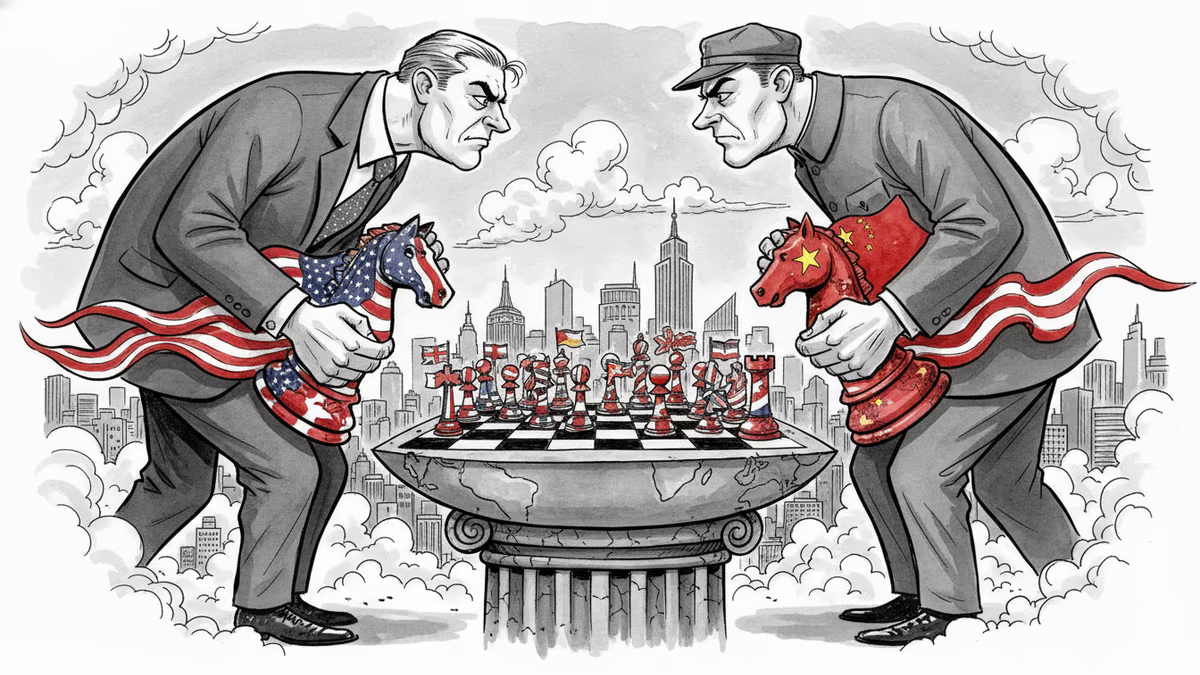
The Beijing Summit: Three Bets That Could Reshape the World
Trump and Xi meet in Beijing with trade, Taiwan, and AI on the table. What each side wants — and what they're willing to give up — could define superpower relations for years.
Security around Tiananmen Square has been tightened for days. Rumours of a parade. Whispers of a spectacle. China is preparing a show — and the audience of one is Donald Trump.
The US president's visit to Beijing this week is the first by an American head of state since Trump's own trip in 2017. The itinerary — talks, a state banquet, a visit to the Temple of Heaven where emperors once prayed for good harvests — is dense with symbolism. But beneath the ceremony, three high-stakes negotiations are underway, each with consequences that will ripple well beyond the two countries at the table.
The Iran Card: Beijing's Most Valuable Chip
For much of his second term, Trump's foreign policy attention has been consumed by the US-Israel war against Iran, military operations in the Western Hemisphere, and domestic politics. China, for once, was not the top priority. That changes this week.
The Iran war, now in its third month, has disrupted global oil flows through the Strait of Hormuz and sent energy costs surging. For Chinese manufacturers reliant on petrochemicals — textiles, plastics, packaging — production costs have climbed as much as 20%. China's lead in renewables and electric vehicles provides some insulation, but an export-dependent economy running at slower growth can't absorb the shock indefinitely.
So Beijing has been quietly positioning itself as a peacemaker. Alongside Pakistan, it presented a five-point ceasefire plan in March. Chinese officials have been nudging Tehran toward the negotiating table. Last week, Iranian Foreign Minister Abbas Araghchi made a conspicuous visit to Beijing — a public display of the leverage China holds in the Middle East.
Washington noticed. Secretary of State Marco Rubio said he hoped China would tell Iran "what it needs to be told." Ali Wyne, Senior Adviser at the International Crisis Group, put it plainly: "If we're going to bring Iran back to the negotiating table in an enduring way, the United States recognises that China is going to play some role."
The calculus is straightforward: China wants the war to end, and the US needs China's help to end it. But Beijing won't move for free. The question hanging over every meeting room in the Zhongnanhai compound is: what does Washington offer in return?
Taiwan: The Weight of a Single Word
The Trump administration has sent contradictory signals on Taiwan with remarkable consistency. In December, it approved an $11 billion arms package for Taipei — infuriating Beijing. Then Trump publicly mused that Taiwan "doesn't give us anything" and questioned US willingness to defend it. He imposed a 15% tariff on Taiwanese goods and accused the island of "stealing" semiconductor manufacturing from America.
China has responded in the only language it consistently uses: military pressure. Warplanes and naval vessels circle Taiwan almost daily. And heading into the summit, Foreign Minister Wang Yi called on the US to make "the right choices."

Analysts believe Beijing may push for a subtle but significant language shift. The current US position is that it "does not support" Taiwan independence. China reportedly wants that upgraded to the US "opposes" Taiwan independence — a small textual change with enormous diplomatic weight, as it would imply active resistance rather than passive non-endorsement.
John Delury, a senior fellow at the Asia Society's Centre on US-China Relations, is sceptical it will stick even if Trump agrees. "Even if Trump says something that looks like some capitulation on Taiwan, the Chinese know better than to put much stock in it," he says. "He can reverse it with a Truth Social post a week later."
That uncertainty cuts both ways. It gives Trump flexibility. It also means Beijing can't bank on anything he says.
Trade and AI: The Structural Fight Beneath the Handshakes
The fact that CEOs from Nvidia, Apple, ExxonMobil, and Boeing are travelling with Trump signals that this summit is as much about commerce as diplomacy. Trump will push for expanded Chinese purchases of US agricultural products — politically important for farm states that voted for him. China will press the US to drop a recently launched trade probe into unfair business practices, which could give Trump the legal basis to reimpose triple-digit tariffs.
The broader trade relationship has cooled since Trump and Xi met in South Korea last October, and a February Supreme Court ruling limiting the president's unilateral tariff authority helped tamp down the most volatile impulses on the American side. But the structural tensions haven't gone anywhere.
The deeper contest is over technology. Washington has restricted exports of advanced semiconductors to China. American officials accuse Chinese firms like DeepSeek of stealing US AI research. Yingyi Ma of the Brookings Institution calls it plainly: "An opening chapter of an AI cold war is emerging."
China, for its part, is investing heavily in AI and humanoid robotics as part of Xi's vision of "new productive forces" — a state-directed bet that technological self-sufficiency will power the next phase of Chinese growth. The US views that same investment as a strategic threat. Neither side is wrong about what the other is doing.
Michael O'Hanlon of Brookings captures the bind facing US negotiators: "It could be tough for the US to give up investigations of all unfair Chinese trade practices given how widespread and distorting the latter still are."
What Each Side Needs to Walk Away With
Xi enters the summit with economic headwinds — slower growth, higher unemployment, a manufacturing sector squeezed by the Iran war — but with geopolitical leverage. China is now the leading trade partner for more than 120 countries. It holds cards on Iran. And it has watched patiently as Trump's tariff volatility alienated US allies, leaving Beijing looking comparatively stable.
But Xi can't afford to look weak domestically, and he can't afford to let Trump leave feeling snubbed. Ryan Hass, Director of the John L. Thornton China Centre at Brookings, frames the fragility clearly: "So long as Trump concludes he was treated respectfully, the uneasy calm in the bilateral relationship will endure. If he leaves feeling disrespected or trifled with, he could have a change of heart."
Trump, meanwhile, wants wins he can sell at home: a trade deal, agricultural purchases, maybe a headline on Iran. Whether the substance matches the optics is a separate question.
This content is AI-generated based on source articles. While we strive for accuracy, errors may occur. We recommend verifying with the original source.
Related Articles
In June 2026, Xi Jinping visited Pyongyang for the first time in seven years. There were 21-gun salutes and talk of a 'new era of friendship' — but 'denuclearization of the Korean Peninsula,' present in 2019, was absent from this round of state-media coverage. A symbolic overreach, or a real upgrade?

Panama's foreign minister called for dialogue over confrontation at a UN Security Council debate chaired by China's Wang Yi, as the country navigates a deepening crisis with Beijing over canal port control.

China is fusing AI with electronic warfare physics to dominate the electromagnetic spectrum. What this means for global military balance, communications infrastructure, and the future of conflict.

Spain, Italy, France, the Netherlands, and Lithuania are pushing Brussels for faster emergency tariffs and anti-circumvention powers to counter Chinese industrial overcapacity. Here's what's at stake.
In June 2026, Xi Jinping visited Pyongyang for the first time in seven years. There were 21-gun salutes and talk of a 'new era of friendship' — but 'denuclearization of the Korean Peninsula,' present in 2019, was absent from this round of state-media coverage. A symbolic overreach, or a real upgrade?
Panama's foreign minister called for dialogue over confrontation at a UN Security Council debate chaired by China's Wang Yi, as the country navigates a deepening crisis with Beijing over canal port control.
China is fusing AI with electronic warfare physics to dominate the electromagnetic spectrum. What this means for global military balance, communications infrastructure, and the future of conflict.
Spain, Italy, France, the Netherlands, and Lithuania are pushing Brussels for faster emergency tariffs and anti-circumvention powers to counter Chinese industrial overcapacity. Here's what's at stake.
Thoughts
Share your thoughts on this article
Sign in to join the conversation