
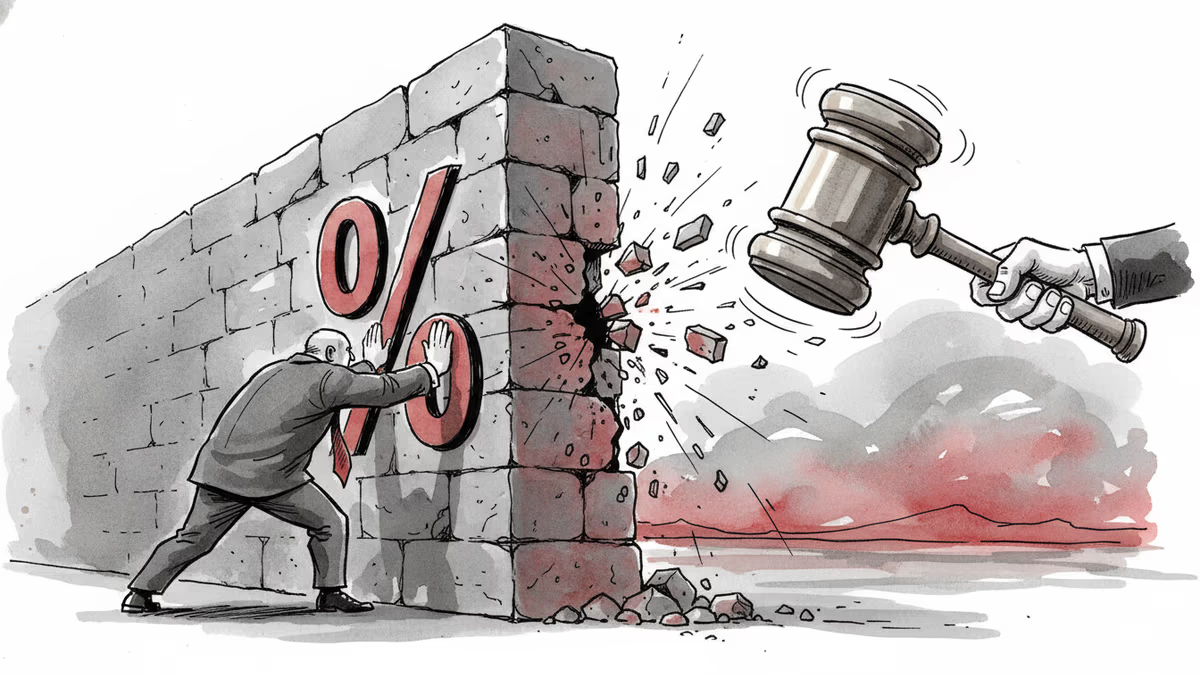
Trump's Tariffs Hit a Courtroom Wall — Then He Appealed
A federal court struck down Trump's sweeping 10% global tariff, ruling he overstepped his legal authority. His administration appealed within 24 hours. Here's what's really at stake.
The world's most powerful executive just lost in court. He filed the paperwork to fight back the next day.
What the Court Actually Said
On Thursday, the US Court of International Trade struck down President Trump's 10% blanket import tax on goods from nearly every country on earth — one of the broadest unilateral tariff actions in modern American history. The ruling was pointed: the administration had failed to meet the legal requirements of Section 122 of the Trade Act of 1974, the provision it had invoked to justify the sweeping levies.
Section 122 does grant the president emergency authority to impose tariffs, but it comes with strict conditions — including specific findings about the nature of the trade emergency and limits on how long such tariffs can last. The court found the administration hadn't cleared that bar. By Friday, Trump's legal team had filed an appeal, pushing the fight to a higher court and leaving billions of dollars in potential refunds hanging in legal limbo.
For importers who have already paid the tariff, that word — refunds — carries enormous weight. If the tariffs are ultimately invalidated, the US government could owe back payments running into the tens of billions of dollars. That's not a rounding error; it's a fiscal event.
How We Got Here
Trump returned to the White House in early 2025 with trade policy as a centerpiece of his economic agenda. Tariffs on Chinese goods climbed past 100% in some categories. A 10% baseline levy was applied to imports from allies and adversaries alike — the EU, Japan, South Korea, Vietnam, and dozens of others. The administration framed it as a correction of decades of unfair trade, a tool to shrink the US trade deficit and pull manufacturing back to American soil.
But the legal scaffolding was contested from the start. Can a president impose tariffs of this scale and universality without explicit congressional authorization? Trade associations and importers argued no, and filed suit. Thursday's ruling was the most significant judicial answer yet: not like this, not under this statute.

The administration's use of Section 122 was, in the view of legal scholars who had tracked the case, an unusually aggressive interpretation of executive trade authority. Other tariff actions — including those targeting China — have relied on different legal provisions, like Section 232 (national security) or Section 301 (unfair trade practices). Those remain in force for now and were not addressed by this ruling.
A Fight About More Than Tariffs
For the Trump administration, the appeal isn't just about defending one policy. It's about preserving the legal architecture of presidential power over economic policy. Lose this, and the broader project of using executive authority to reshape trade relationships — without waiting for a divided Congress to act — becomes legally fragile.
For US businesses, the uncertainty is its own kind of cost. Supply chains restructured around the assumption that tariffs would persist. Contracts were renegotiated. Some manufacturers accelerated plans to shift production. Now those decisions sit in a legal gray zone that could last months, or potentially years, as the case works its way through the Court of Appeals for the Federal Circuit and possibly to the Supreme Court.
For trading partners — the EU, South Korea, Japan, Canada — the ruling offers a moment of cautious relief, but not resolution. The tariffs remain in effect during the appeals process. No goods are moving more cheaply today than they were Wednesday. The legal challenge to the tariffs' validity doesn't automatically translate into policy change at the border.
And for American consumers, the picture is similarly complicated. The 10% levy functioned as a broad-based tax on imported goods, affecting everything from electronics to clothing to food. Whether that cost gets reversed depends on a judicial timeline nobody can predict.
The Deeper Constitutional Tension
US trade law is a patchwork of statutes that grant the president wide but not unlimited authority. Congress delegated broad powers over tariffs to the executive branch through the 20th century — a delegation that critics argue has gone too far, and that courts have rarely been asked to police so directly.
This case is now forcing that question into the open: when a president uses emergency trade powers in a sustained, structural way rather than for a narrow, temporary purpose, does the legal basis hold? The Court of International Trade said no. The appeals court will have its say. And depending on that outcome, the Supreme Court may ultimately draw the line.
What makes this moment unusual isn't just the scale of the tariffs. It's that a federal court has intervened in an active, high-profile trade policy in real time — not years after the fact. That's a relatively rare event, and it signals that at least some judges are prepared to scrutinize executive trade authority more rigorously than in the past.
This content is AI-generated based on source articles. While we strive for accuracy, errors may occur. We recommend verifying with the original source.
Related Articles

Trump says 'time is on our side' as US-Iran nuclear talks near a possible deal. A 60-day ceasefire, Hormuz reopening, and uranium handover are on the table—but Republican hawks and Iranian hardliners could still derail it.
Trump and Putin both traveled to Beijing in May 2026 to meet Xi Jinping. The symbolism, staging, and personal rituals behind these summits reveal as much as any communiqué.
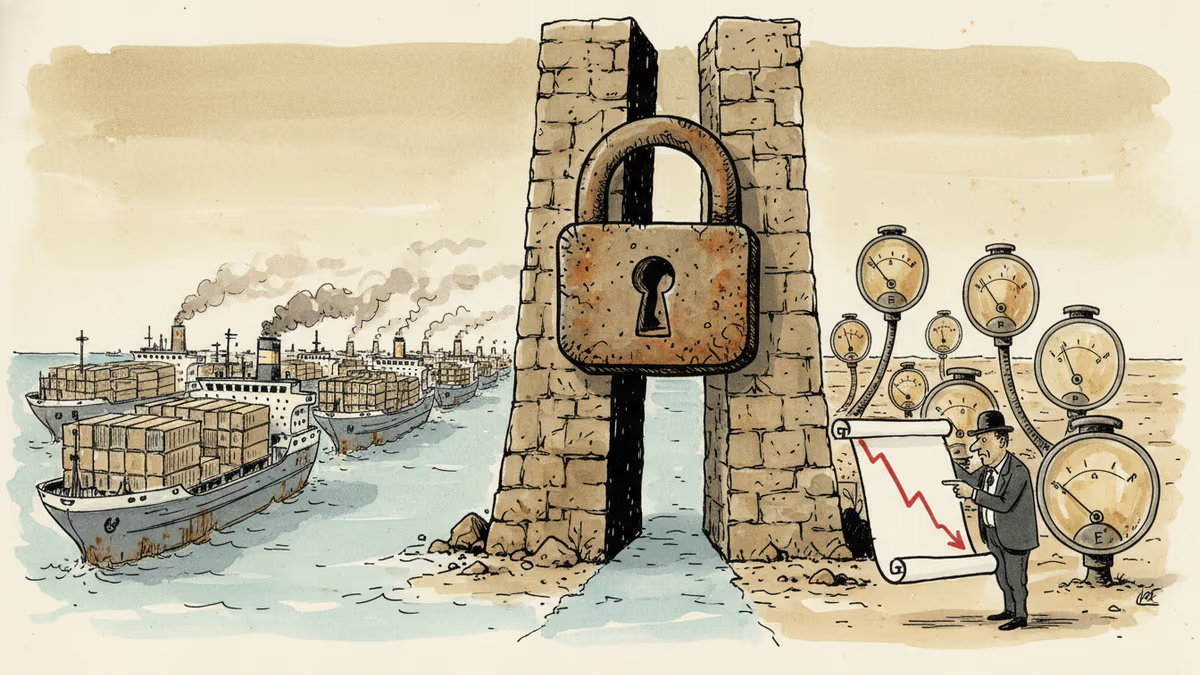
The UN has cut its 2026 global growth forecast to 2.5%, citing the Iran war's disruption of Hormuz shipping. Even after a ceasefire, only 10 ships a day pass where 130 once did.
Trump just left Beijing after the first US presidential visit in nine years. Putin arrives Wednesday. Pakistan's PM follows. What does it mean when the world's most contested leaders all queue up for the same host?
Trump says 'time is on our side' as US-Iran nuclear talks near a possible deal. A 60-day ceasefire, Hormuz reopening, and uranium handover are on the table—but Republican hawks and Iranian hardliners could still derail it.
Trump and Putin both traveled to Beijing in May 2026 to meet Xi Jinping. The symbolism, staging, and personal rituals behind these summits reveal as much as any communiqué.
The UN has cut its 2026 global growth forecast to 2.5%, citing the Iran war's disruption of Hormuz shipping. Even after a ceasefire, only 10 ships a day pass where 130 once did.
Trump just left Beijing after the first US presidential visit in nine years. Putin arrives Wednesday. Pakistan's PM follows. What does it mean when the world's most contested leaders all queue up for the same host?
Thoughts
Share your thoughts on this article
Sign in to join the conversation