
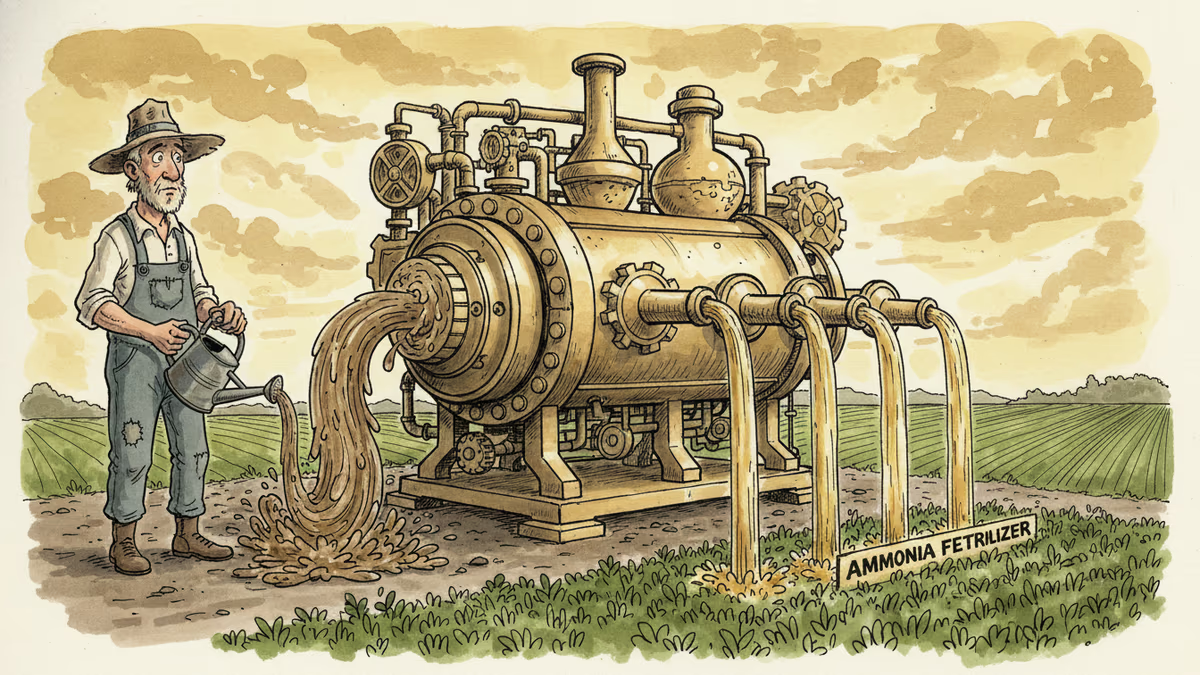
China Turns Polluted Water Into Fertilizer—3x Faster
Chinese researchers have developed a dual-atom catalyst that converts nitrate-polluted wastewater into ammonia at nearly triple the efficiency of conventional methods, with major implications for food security and green chemistry.
The same water that poisons a river could soon grow your food.
Researchers at the Fujian Institute of Research on the Structure of Matter, part of the Chinese Academy of Sciences, have developed a catalyst that pulls nitrate pollution straight out of agricultural and industrial wastewater and converts it into ammonia—the chemical backbone of urea fertilizer. The kicker: it does so at nearly three times the efficiency of conventional catalysts. Their findings were published on March 18 in the Journal of the American Chemical Society, earning the front cover.
It's a result that sits at the intersection of environmental remediation and food production—two of the most pressing challenges of the coming decades.
The Science: Two Atoms Are Better Than One
The breakthrough hinges on what chemists call a dual-atom catalyst, or DAC. The concept is elegant. Traditional single-atom catalysts rely on one metal atom to drive a chemical reaction. DACs place two metal atoms side by side, letting them collaborate on complex, multi-step reactions—like the conversion of nitrate into ammonia—that a lone atom handles far less efficiently.
The problem has always been building these pairs reliably. Without strong theoretical guidance, researchers were largely stuck guessing which metal combinations would bond well and perform. Han Lili and her team broke that bottleneck by training a deep-learning model to screen metal pairings and identify those with high bonding rates. Instead of trial and error, they used AI to do the heavy lifting upfront. The result was a catalyst with dramatically improved metal loading and selectivity.
The reaction itself—converting nitrate (NO₃⁻) to ammonia (NH₃)—is called electrochemical nitrate reduction. It runs at near-ambient conditions, meaning it doesn't require the extreme heat and pressure that define conventional ammonia production.

Why This Matters Beyond the Lab
To understand the significance, you have to understand what ammonia production currently looks like. The Haber-Bosch process, invented over a century ago, still accounts for more than 70% of global ammonia output. It's energy-intensive by design—combining nitrogen from the air with hydrogen under high pressure and temperature—and consumes roughly 1–2% of global energy supply annually. It also depends heavily on natural gas as a hydrogen feedstock, tying fertilizer prices directly to fossil fuel markets.
When Russia invaded Ukraine in 2022, global fertilizer prices spiked sharply. Countries that had built their food supply chains around affordable imported fertilizer felt the shock almost immediately. For China—the world's largest fertilizer consumer—the episode underscored a strategic vulnerability.
A technology that converts locally available wastewater pollution into ammonia, using less energy, addresses two problems at once: it reduces nitrate contamination in waterways and builds resilience into the fertilizer supply chain. That dual value is precisely why Chinese state-backed research institutions are investing heavily in this space.
The Gap Between Promise and Scale
Not everyone is ready to call this a near-term solution. There are real obstacles between a journal paper and a working industrial plant.
Real wastewater is messy. It contains sulfates, chlorides, heavy metals, and organic compounds that can degrade catalyst performance or poison it entirely. The lab results were achieved under controlled conditions; replicating that efficiency in the field is a different challenge. Catalyst durability over thousands of operating hours, and the economics of synthesizing DACs at industrial scale, remain open questions.
There's also the inertia of existing infrastructure. The Haber-Bosch process has decades of engineering refinement and trillions of dollars in sunk capital behind it. For a new technology to displace even a fraction of that, it needs to be not just cleaner but cost-competitive. That threshold is moving as carbon pricing spreads and environmental regulations tighten—but it hasn't arrived yet.
For investors in green chemistry and agricultural technology, the signal here is directional rather than immediate. DAC-based electrochemical synthesis is a field worth watching, but the timeline to commercial deployment is measured in years, not months.
This content is AI-generated based on source articles. While we strive for accuracy, errors may occur. We recommend verifying with the original source.
Related Articles

Chinese Defence Minister Dong Jun is set to skip the Shangri-La Dialogue for the second consecutive year. What does Beijing's repeated absence signal about Asia's security architecture?

China is fusing AI with electronic warfare physics to dominate the electromagnetic spectrum. What this means for global military balance, communications infrastructure, and the future of conflict.
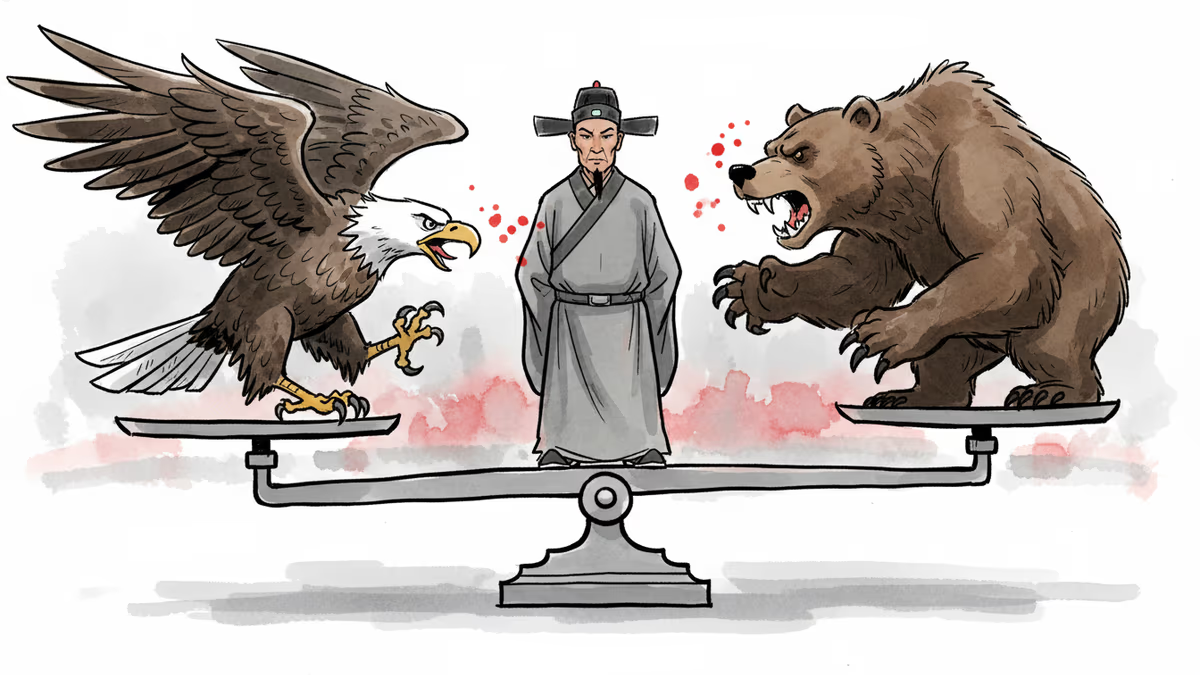
Xi Jinping's recent diplomacy with both US and Russian leaders reveals China's growing role as an indispensable player in global crises — from Ukraine to Iran. What does this mean for the international order?
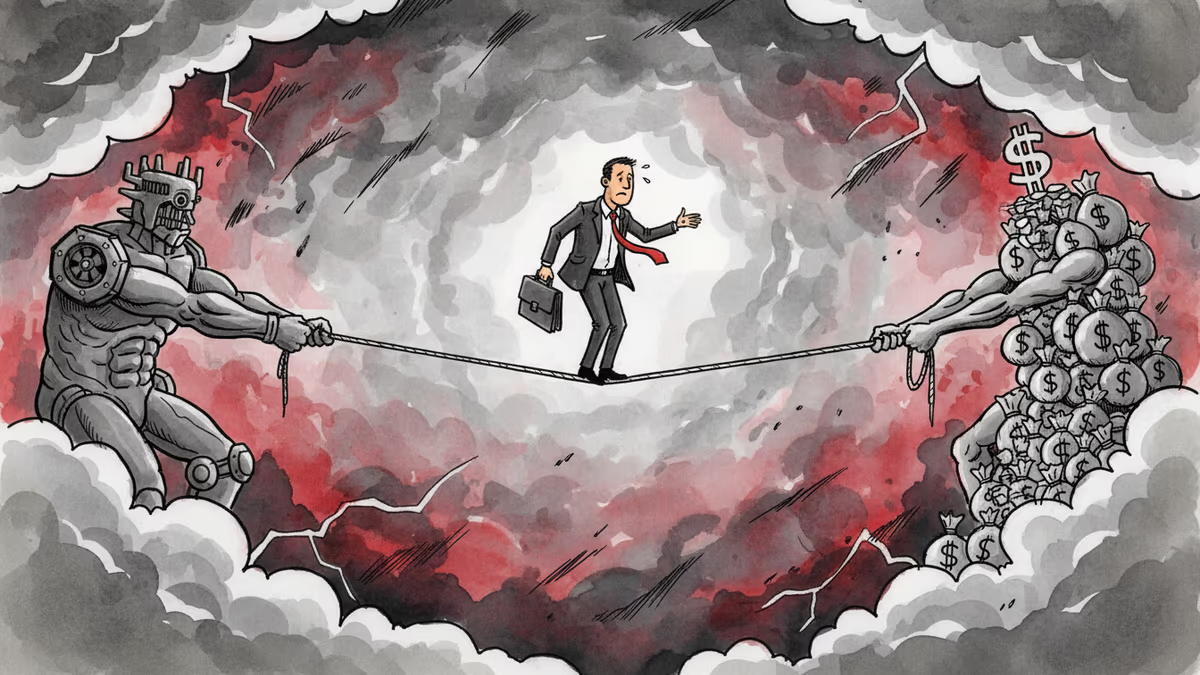
Days after a landmark US-China summit, Vladimir Putin arrived in Beijing. Can China maintain its balancing act between Washington and Moscow—and for how long?
Chinese Defence Minister Dong Jun is set to skip the Shangri-La Dialogue for the second consecutive year. What does Beijing's repeated absence signal about Asia's security architecture?
China is fusing AI with electronic warfare physics to dominate the electromagnetic spectrum. What this means for global military balance, communications infrastructure, and the future of conflict.
Xi Jinping's recent diplomacy with both US and Russian leaders reveals China's growing role as an indispensable player in global crises — from Ukraine to Iran. What does this mean for the international order?
Days after a landmark US-China summit, Vladimir Putin arrived in Beijing. Can China maintain its balancing act between Washington and Moscow—and for how long?
Thoughts
Share your thoughts on this article
Sign in to join the conversation