
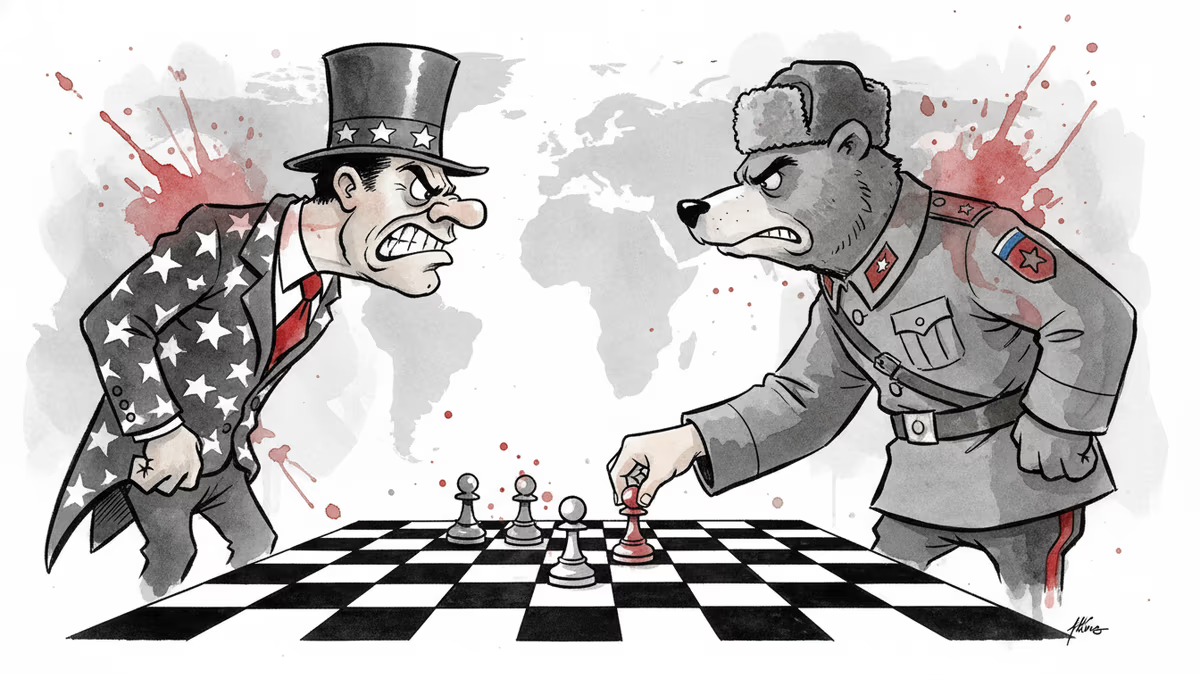
The Summit After the Summit: Who Gains When Xi Meets Both Trump and Putin?
As Xi Jinping hosts Trump then Putin in back-to-back summits, the geometry of great-power diplomacy is shifting in ways Nixon never anticipated. Here's what the numbers reveal.
Nixon flew to Beijing to isolate Moscow. Fifty years later, Beijing is hosting both Washington and Moscow — and it's not clear who's isolating whom.
Within days of his summit with Donald Trump on May 14–15, Xi Jinping is set to welcome Vladimir Putin to Beijing. The back-to-back scheduling is deliberate. The question analysts are asking isn't whether this constitutes triangular diplomacy — it clearly does. The question is who holds the leverage.
The Nixon Playbook, Revisited and Revised
In 1972, the logic was elegant: Washington and Beijing draw closer, Moscow feels the squeeze. The U.S. used China as a wedge against the Soviet Union, and it worked. Today's geometry is fundamentally different, and not just because the players have changed.
Trump is no stranger to triangular maneuvering. In April 2017, while hosting Xi at Mar-a-Lago, he announced that the U.S. had just bombed Russian-allied Syria. China subsequently abstained — rather than vetoing alongside Russia — on a UN resolution condemning Syria's chemical weapons use. Chinese analysts at the time suggested Trump was deliberately trying to drive a wedge between Beijing and Moscow, while also signaling distance from Putin to a domestic audience.
But that was a different era, and a different conflict. The wars now burning in Ukraine and Iran have reshuffled the cards in ways that make a clean Nixon-style play nearly impossible.
Where China and Russia's Interests Diverge
The Iran conflict is the clearest stress test of the Sino-Russian partnership — and it's revealing cracks.

Just ahead of the Trump-Xi summit, the U.S. Treasury sanctioned 12 Chinese companies: three for supplying satellite imagery to Iran to assist missile targeting, nine for involvement in Iranian oil shipments. Western media simultaneously reported Russia shipping upgraded Shahed drones back to Iran — an ironic loop, given Iran originally supplied Russia with the base model for use in Ukraine.
Both Beijing and Moscow have partnership agreements with Tehran, but neither has a formal military alliance. More importantly, their interests in the conflict's trajectory diverge sharply. China's economy has absorbed the Strait of Hormuz closure through oil reserves and a growing renewables sector — but a prolonged conflict means higher energy prices and supply disruptions for Gulf chemicals critical to fertilizer and semiconductor manufacturing. These are real economic risks for Beijing.
Russia, by contrast, benefits from elevated oil prices and has far less exposure to Gulf trade. Some Russian analysts even argue Moscow gains from sustained U.S. entanglement in the Middle East, provided it can position itself as a stabilizing broker.
For Xi, this divergence is a management problem. Last month, Foreign Minister Wang Yi called for "closer and stronger strategic coordination" within the partnership — diplomatic language that veteran observers read as an acknowledgment that coordination is, in fact, lacking. Wang used nearly identical phrasing immediately after Russia's full-scale invasion of Ukraine in 2022.
The Numbers That Don't Lie
Strip away the diplomatic rhetoric, and the economic data tells its own story.
In 2025, U.S.-China trade reached $414.7 billion — nearly double the $234 billion in Sino-Russian trade. Chinese students enrolled in American universities numbered 265,919 (declining, but still dominant); those choosing Russian universities totaled 56,000. Wu Dahui, deputy director of Tsinghua University's Russian Research Institute, recently invoked the image of 60,000-plus communication channels linking China and Russia "like blood vessels in one body." The metaphor is vivid. The economic reality is more prosaic.
On Ukraine, the numbers are damning in a different direction: China reportedly supplies approximately 90% of Russia's dual-use technology needs as of May 2026. In April 2026, the European Union imposed sanctions on Chinese entities for this trade for the first time. Ukraine, unsurprisingly, does not consider China a neutral mediator. Neither do most European capitals, where Chinese officials have echoed Russian framing about Moscow's "legitimate interests."
The Xi-Putin summit, their 40th-plus bilateral interaction, will almost certainly be framed as a demonstration of the partnership's depth and global stabilizing role. The Iran war gives both leaders convenient common ground — shared criticism of U.S. and Israeli military action — while allowing them to paper over their divergences on Iran's future, North Korea, and Gulf stability.
The China-U.S. summit, meanwhile, may produce tangible results on trade, investment, or critical minerals. But by the metrics of frequency, symbolic weight, and rhetorical ambition, the Xi-Putin meeting will be positioned as the more consequential relationship — at least in Beijing's telling.
This content is AI-generated based on source articles. While we strive for accuracy, errors may occur. We recommend verifying with the original source.
Related Articles
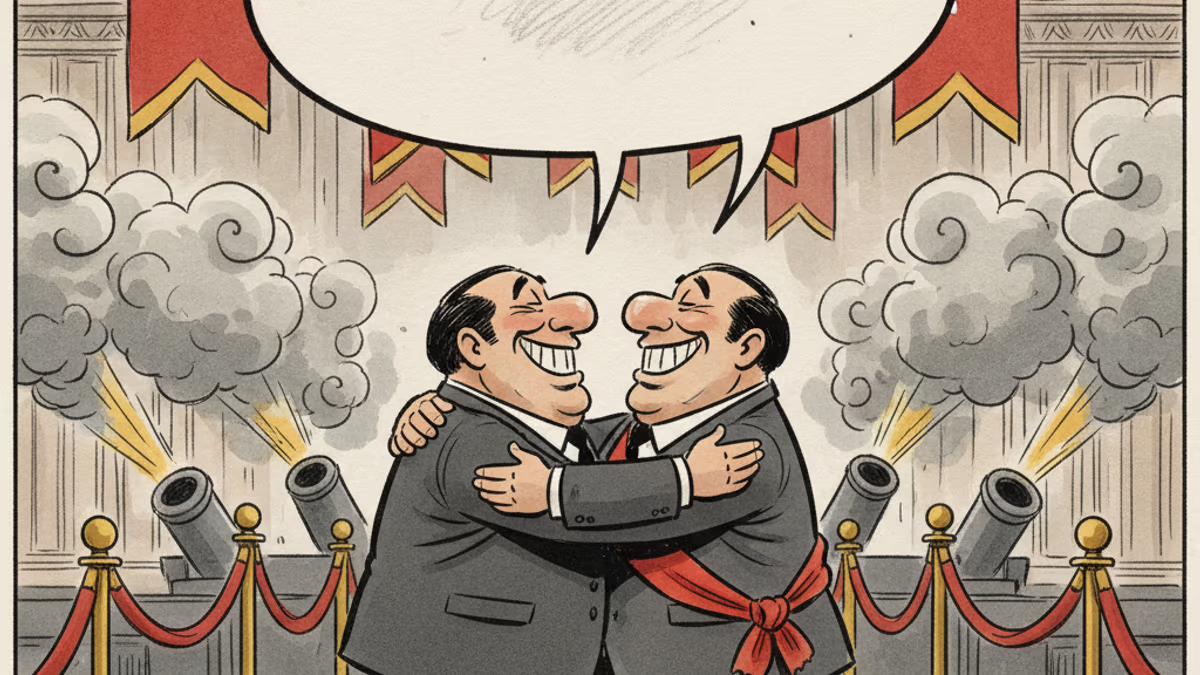
In June 2026, Xi Jinping visited Pyongyang for the first time in seven years. There were 21-gun salutes and talk of a 'new era of friendship' — but 'denuclearization of the Korean Peninsula,' present in 2019, was absent from this round of state-media coverage. A symbolic overreach, or a real upgrade?

Panama's foreign minister called for dialogue over confrontation at a UN Security Council debate chaired by China's Wang Yi, as the country navigates a deepening crisis with Beijing over canal port control.
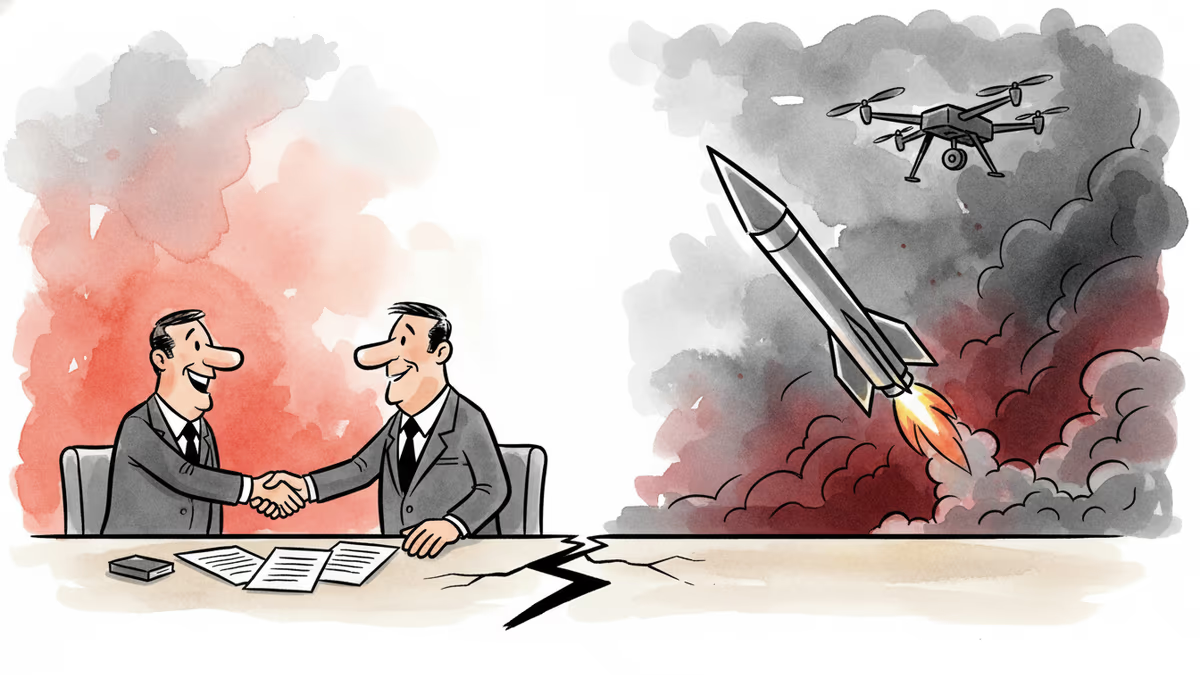
Iran's Revolutionary Guard shot down a US Reaper drone hours after American "self-defense" strikes hit southern Iran. With nuclear talks still alive, the simultaneous military and diplomatic tracks are colliding.

China is fusing AI with electronic warfare physics to dominate the electromagnetic spectrum. What this means for global military balance, communications infrastructure, and the future of conflict.
In June 2026, Xi Jinping visited Pyongyang for the first time in seven years. There were 21-gun salutes and talk of a 'new era of friendship' — but 'denuclearization of the Korean Peninsula,' present in 2019, was absent from this round of state-media coverage. A symbolic overreach, or a real upgrade?
Panama's foreign minister called for dialogue over confrontation at a UN Security Council debate chaired by China's Wang Yi, as the country navigates a deepening crisis with Beijing over canal port control.
Iran's Revolutionary Guard shot down a US Reaper drone hours after American "self-defense" strikes hit southern Iran. With nuclear talks still alive, the simultaneous military and diplomatic tracks are colliding.
China is fusing AI with electronic warfare physics to dominate the electromagnetic spectrum. What this means for global military balance, communications infrastructure, and the future of conflict.
Thoughts
Share your thoughts on this article
Sign in to join the conversation