
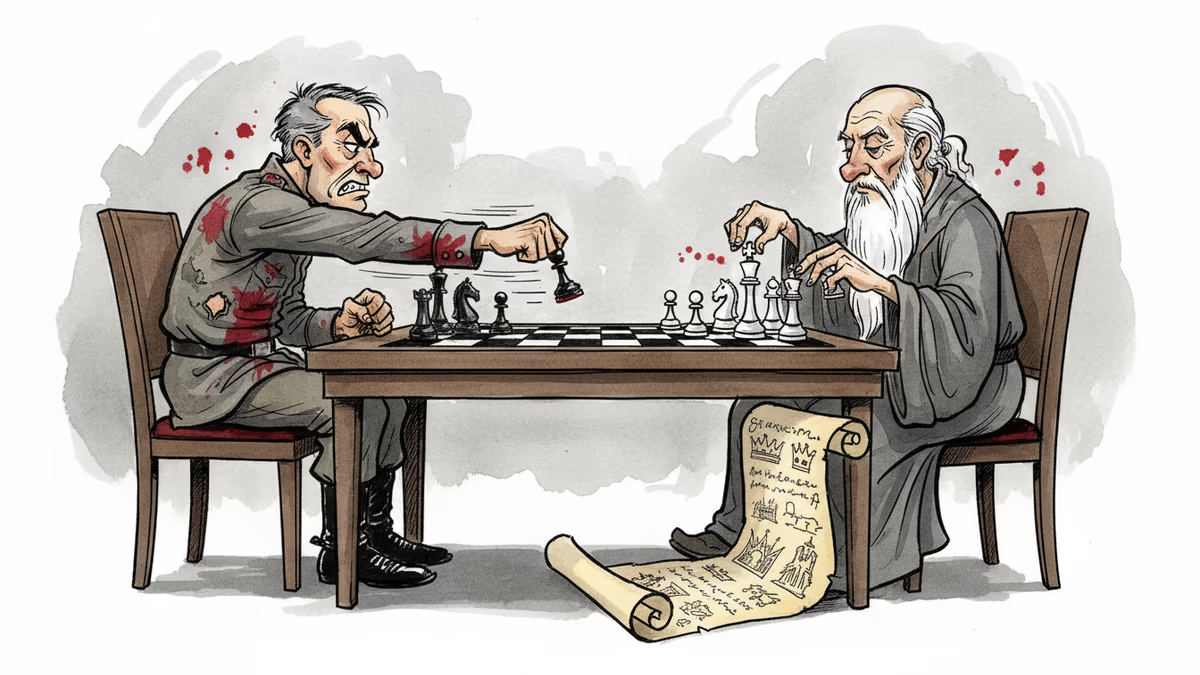
Trump Wants a Deal. Xi Is Playing a Different Game.
The U.S.-China summit may be the most consequential meeting between the two powers since Nixon met Mao. But the two leaders aren't just negotiating terms—they're operating on entirely different timelines.
Xi Jinping applied to join the Chinese Communist Party ten times before being accepted. Each rejection, by his own account, made him sharper. "The knife," he later said, "is sharpened by the stone." That man is now sitting across from Donald Trump.
The U.S.-China summit this week has been called, by people who have seen a few of these, potentially the most consequential meeting between the two powers since Richard Nixon sat down with Mao Zedong in 1972. Robert Hormats—who helped plan that 1972 summit as a senior economic adviser on the National Security Council under Henry Kissinger, and later served as Undersecretary of State under Obama—makes that comparison deliberately. The agenda this time spans semiconductors, rare earths, Iran, Taiwan, and the South China Sea simultaneously. That has never happened before.
But the real story isn't the agenda. It's the mismatch in how each side understands what a summit is for.
Two Leaders, Two Clocks
Trump wants a deal he can announce. Preferably before the next news cycle. His Commerce Secretary, Howard Lutnick, has already telegraphed the strategy: relax some technology restrictions, get China "addicted" to American semiconductors, and use that dependency as leverage. It's a transactional logic—give something now, extract something later.
Xi's logic runs on a different clock entirely. He has spent years studying the collapse of the Soviet Union—not as history, but as a cautionary manual. What he took from it: the USSR fell because of party fragmentation, over-reliance on too few trade partners, and fatal vulnerability to American economic pressure. Every major policy Xi has pursued since consolidating power—party discipline, supply chain self-sufficiency, diversified trade relationships, technological independence—traces back to that analysis.
Hormats, who first met Xi when he was still a provincial party secretary in Zhejiang, recalls being struck even then by his focus on keeping China from repeating Soviet mistakes. That was over two decades ago. The thinking hasn't changed. It's deepened.
This means Xi will engage on short-term economic arrangements—he has every reason to reduce tariff pressure and stabilize trade flows—but he will not let any agreement create structural dependency on the United States. If Lutnick's "addiction" framing has reached Beijing, and it almost certainly has, it has likely hardened Xi's resolve to retain leverage over rare earth exports regardless of what gets signed this week.

What's Actually on the Table
China's approach to summits is built on a principle that clashes directly with Trump's style: important agreements must be drafted months in advance by senior officials, leaving no room for post-meeting "mischaracterizations." The communiqué should exist before the leaders shake hands. The meeting itself is then reserved for deeper, personal exchange.
Trump's negotiating style—improvisational, deal-focused, resistant to pre-cooked outcomes—is precisely what Chinese officials find most difficult to calibrate. Hormats quotes Kissinger: "Everything ever said to me by any Chinese of any station during any visit was part of an intricate design." The implication is clear: China has already gamed out Trump's unpredictability and built responses to multiple scenarios. Washington may not have done the same.
Iran was not on the original summit agenda. It is now unavoidable. The U.S. is at war with Iran; China has close economic and political ties with Tehran; both countries share an interest in keeping the Strait of Hormuz open for energy flows. Xi will not abandon the relationship with Iran, nor will he pass up the economic opportunities created by the war's disruptions. But he also won't pick a public fight with Trump over it. Expect careful language and deliberate ambiguity.
Taiwan and the South China Sea are where the structural tensions become most dangerous. The Trump administration's National Security Strategy gestures toward a world of great-power spheres of influence—language that aligns, at least superficially, with Xi's calls for "a new type of great-power relations." But the National Defense Strategy simultaneously declares the Indo-Pacific the "key economic and political battleground" requiring robust U.S. deterrence. These two documents point in different directions. Xi will want to know which one reflects actual U.S. policy—and he will probe for the answer carefully, watching American responses in the South China and East China Seas in the months after the summit.
Hormats notes that Xi is acutely aware of the U.S.'s current vulnerabilities: a politically divided electorate, an unpopular war in Iran, strained alliances, and a stressed defense industrial base. That awareness may translate into more assertive Chinese military posturing in the region—not as provocation, but as a calibrated test of American will and capacity.
The Asymmetry That Matters Most
Neither side is negotiating in bad faith. Both have genuine interests in stabilizing the relationship—economically, at minimum. The danger isn't malice. It's misreading.
When the U.S. side assumes that technology access will create Chinese dependency, and the Chinese side is simultaneously accelerating domestic semiconductor development and rare earth processing capacity, the two parties may reach an agreement that each believes serves its own interests—only to discover, years later, that one side was right and the other was not.
Historically, American presidents have tended to measure summit success by what was announced in the room. Chinese leaders measure it by what position they occupy five years later. Nixon's 1972 summit is remembered in Washington as a diplomatic triumph. In Beijing, it is remembered as the moment China gained international legitimacy while conceding very little on Taiwan—a reading that has shaped Chinese negotiating strategy ever since.
This content is AI-generated based on source articles. While we strive for accuracy, errors may occur. We recommend verifying with the original source.
Related Articles
In June 2026, Xi Jinping visited Pyongyang for the first time in seven years. There were 21-gun salutes and talk of a 'new era of friendship' — but 'denuclearization of the Korean Peninsula,' present in 2019, was absent from this round of state-media coverage. A symbolic overreach, or a real upgrade?

Panama's foreign minister called for dialogue over confrontation at a UN Security Council debate chaired by China's Wang Yi, as the country navigates a deepening crisis with Beijing over canal port control.

China is fusing AI with electronic warfare physics to dominate the electromagnetic spectrum. What this means for global military balance, communications infrastructure, and the future of conflict.

Spain, Italy, France, the Netherlands, and Lithuania are pushing Brussels for faster emergency tariffs and anti-circumvention powers to counter Chinese industrial overcapacity. Here's what's at stake.
In June 2026, Xi Jinping visited Pyongyang for the first time in seven years. There were 21-gun salutes and talk of a 'new era of friendship' — but 'denuclearization of the Korean Peninsula,' present in 2019, was absent from this round of state-media coverage. A symbolic overreach, or a real upgrade?
Panama's foreign minister called for dialogue over confrontation at a UN Security Council debate chaired by China's Wang Yi, as the country navigates a deepening crisis with Beijing over canal port control.
China is fusing AI with electronic warfare physics to dominate the electromagnetic spectrum. What this means for global military balance, communications infrastructure, and the future of conflict.
Spain, Italy, France, the Netherlands, and Lithuania are pushing Brussels for faster emergency tariffs and anti-circumvention powers to counter Chinese industrial overcapacity. Here's what's at stake.
Thoughts
Share your thoughts on this article
Sign in to join the conversation