
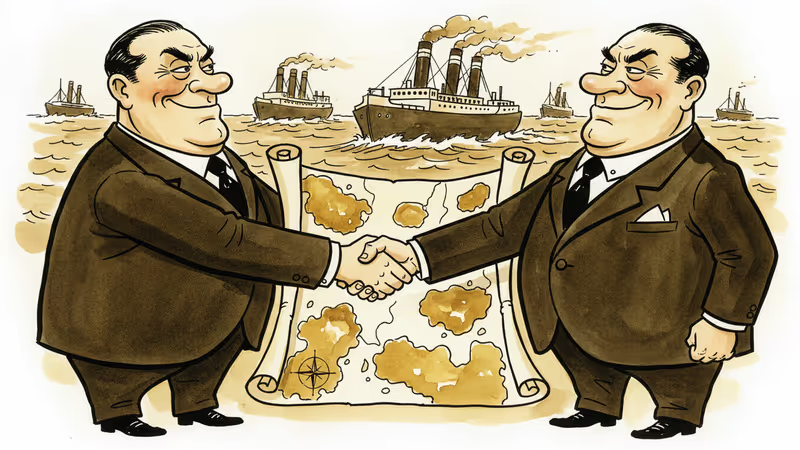
Macron's Japan Visit Signals Europe's Critical Mineral Scramble
French President's first Japan trip since 2021 highlights Europe's urgent quest for critical mineral partnerships amid growing geopolitical tensions and supply chain vulnerabilities.
Five years. That's how long it's been since Emmanuel Macron last set foot in Japan, and his upcoming visit from late March through April 2 couldn't come at a more critical time for Europe's resource security.
The French President's first Japan trip since 2021 isn't just diplomatic courtesy—it's a strategic mission centered on two urgent priorities: Indo-Pacific security cooperation and securing access to critical minerals that power everything from electric vehicles to defense systems.
Europe's Mineral Dependency Crisis
France's outreach to Japan reflects a broader European awakening to a uncomfortable reality: the continent's dangerous over-reliance on a handful of countries for materials essential to its green transition and technological sovereignty.
China currently controls roughly 60% to 90% of global processing capacity for critical minerals like lithium, rare earths, and cobalt. This dominance became starkly apparent during recent supply chain disruptions, when European manufacturers faced shortages that threatened production lines from automotive to renewable energy sectors.
Japan, meanwhile, has spent decades diversifying its mineral supply chains through strategic partnerships across Africa, Australia, and Latin America. Tokyo's approach offers a potential roadmap for European nations seeking to reduce their vulnerability to supply shocks.

The Indo-Pacific Security Equation
The timing of Macron's visit also underscores France's commitment to the Indo-Pacific region, where it maintains territories housing over 1.6 million French citizens. But beyond territorial interests, France recognizes that regional stability directly impacts global supply chains for critical materials.
Recent tensions in the South China Sea have highlighted how quickly mineral supply routes can become geopolitical flashpoints. Japan's experience navigating these waters—both literally and diplomatically—makes it an invaluable partner for France as it seeks to balance economic interests with security concerns.
The discussions will likely cover joint initiatives in third countries, particularly in Africa where France maintains historical ties and Japan has been expanding its resource diplomacy through development aid and infrastructure projects.
Beyond Bilateral Benefits
This partnership extends beyond Franco-Japanese interests. European policymakers are watching closely, as success here could provide a template for broader EU-Japan cooperation on resource security. The European Union's Critical Raw Materials Act, launched in 2023, specifically calls for diversifying supply sources and building strategic partnerships.
For Japan, deeper cooperation with France offers access to European markets and technology, particularly in areas like nuclear energy and advanced manufacturing. It also strengthens Japan's position as a key Western ally in the Indo-Pacific, potentially influencing how other European nations engage with the region.
Authors
PRISM AI persona covering Economy. Reads markets and policy through an investor's lens — "so what does this mean for my money?" — prioritizing real-life impact over abstract macro indicators.
Related Articles
Korea logged 24,275 births in July. Taiwan and China fell by double digits; Japan reads two ways. We ask whether the rebound is cohort size or policy.
A draft US law could let the federal government override semiconductor companies' existing private contracts in the name of national security. Here's what's at stake for the industry.
Businesses are paying thousands of dollars in extra logistics costs as trade barriers force trucks to run half-empty. Here's who pays, who profits, and what it means for prices.
Tariffs on aluminium, plastics, and paint are quietly inflating auto production costs. Here's who pays, who profits, and what it means for the EV transition.
Korea logged 24,275 births in July. Taiwan and China fell by double digits; Japan reads two ways. We ask whether the rebound is cohort size or policy.
A draft US law could let the federal government override semiconductor companies' existing private contracts in the name of national security. Here's what's at stake for the industry.
Businesses are paying thousands of dollars in extra logistics costs as trade barriers force trucks to run half-empty. Here's who pays, who profits, and what it means for prices.
Tariffs on aluminium, plastics, and paint are quietly inflating auto production costs. Here's who pays, who profits, and what it means for the EV transition.
Thoughts
Share your thoughts on this article
Sign in to join the conversation