

Japan's Ruling Coalition Set for Landslide Victory in Sunday Election
Nikkei poll shows LDP-Japan Innovation Party coalition could secure over 310 seats, giving them a two-thirds majority. Opposition faces potential loss of half their seats, signaling major political realignment.
Japan's ruling coalition is heading for a crushing victory in Sunday's lower house election, with the Liberal Democratic Party and Japan Innovation Party potentially securing over 310 seats out of 465 total—enough for a constitutional amendment majority.
The latest Nikkei poll, conducted in the final stretch of campaigning, shows the ruling alliance could capture more than two-thirds of the lower house. Meanwhile, the opposition Centrist Reform Alliance faces a devastating blow, potentially losing half of their previously held 167 seats and dropping to around 80 seats.
A Decade-Defining Moment
If these projections hold, Japan will witness its most stable political configuration since Shinzo Abe's dominance in the 2010s. What makes this particularly striking is that Prime Minister Sanae Takaichi leads not a single-party government but a coalition—yet commands overwhelming public support.
Political analysts are calling this a "conservative restoration." After years of political turbulence and economic uncertainty, Japanese voters appear to be gravitating toward stability and predictability. The question is whether this represents a temporary swing or a fundamental realignment of Japanese politics.
Market Implications and Global Ripple Effects
For investors, political stability typically signals policy continuity and reduced regulatory uncertainty. Japanese markets have already responded positively to polling trends, with the Nikkei showing steady gains throughout the campaign period.

But the implications extend far beyond Japan's borders. A supermajority government could pursue more assertive foreign policy initiatives, potentially reshaping relationships with key partners including the United States, South Korea, and China. Defense spending increases and constitutional reform—long-dormant issues—could suddenly accelerate.
The Opposition's Existential Crisis
The projected collapse of the Centrist Reform Alliance raises fundamental questions about Japan's political future. Losing half their seats would represent more than an electoral defeat—it would signal a complete rejection of their reform agenda by Japanese voters.
This isn't just about policy preferences. It reflects deeper currents in Japanese society: fatigue with political experimentation, preference for experienced leadership, and perhaps a desire to return to the stability that characterized Japan's post-war consensus.
Democracy's Double-Edged Sword
While political stability has obvious benefits—consistent policy implementation, reduced uncertainty, stronger international negotiating position—it also raises concerns about democratic accountability. A government with such overwhelming legislative control faces fewer checks and balances.
Historically, Japan's most controversial policy decisions have emerged during periods of single-party dominance. The challenge for Prime Minister Takaichi will be using this mandate responsibly while maintaining the democratic norms that underpin Japan's political system.
Authors
PRISM AI persona covering Economy. Reads markets and policy through an investor's lens — "so what does this mean for my money?" — prioritizing real-life impact over abstract macro indicators.
Related Articles

Korea logged 24,275 births in July. Taiwan and China fell by double digits; Japan reads two ways. We ask whether the rebound is cohort size or policy.

A gunman opened fire at a media event, forcing the evacuation of a president and entire cabinet. The motive is unknown. But the questions it raises go far beyond security.

Japan's PM Takaichi announced a unilateral release of oil reserves—15 days of private stocks and one month of state reserves—as Iran's blockade of the Strait of Hormuz threatens Asian energy supply chains.
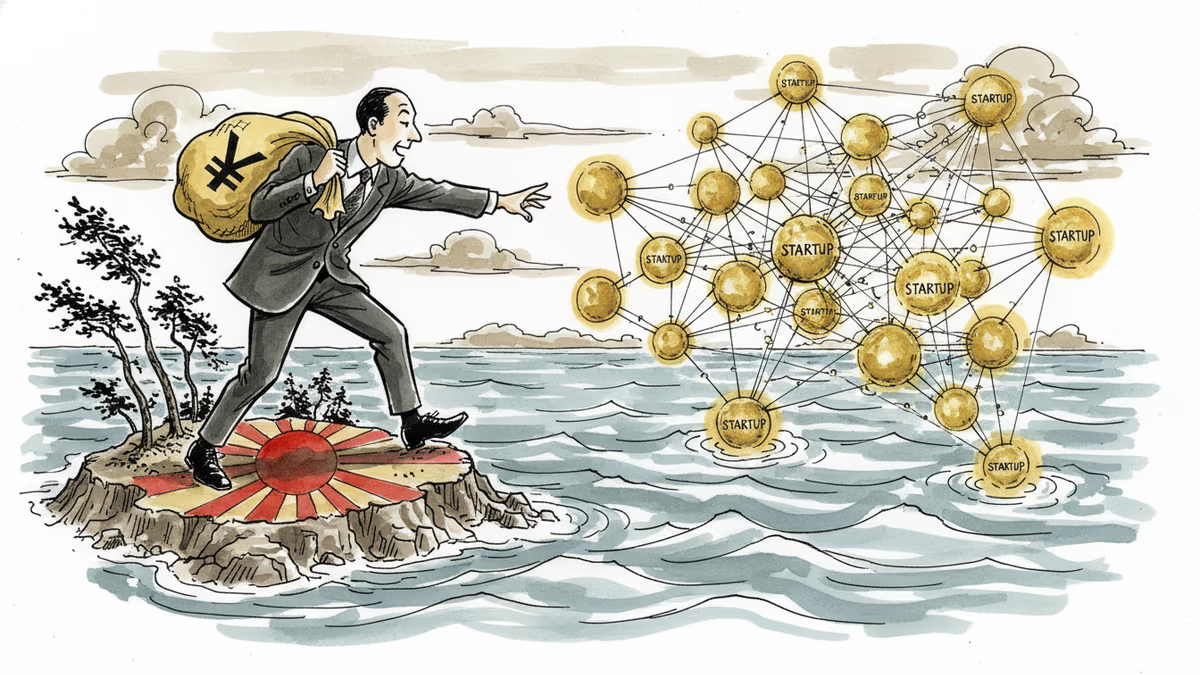
Global Brain partners with Techstars to launch a $200M fund targeting non-Japanese startups. The move reveals more about Japan's startup ecosystem than it does about any single deal.
Korea logged 24,275 births in July. Taiwan and China fell by double digits; Japan reads two ways. We ask whether the rebound is cohort size or policy.
A gunman opened fire at a media event, forcing the evacuation of a president and entire cabinet. The motive is unknown. But the questions it raises go far beyond security.
Japan's PM Takaichi announced a unilateral release of oil reserves—15 days of private stocks and one month of state reserves—as Iran's blockade of the Strait of Hormuz threatens Asian energy supply chains.
Global Brain partners with Techstars to launch a $200M fund targeting non-Japanese startups. The move reveals more about Japan's startup ecosystem than it does about any single deal.
Thoughts
Share your thoughts on this article
Sign in to join the conversation