
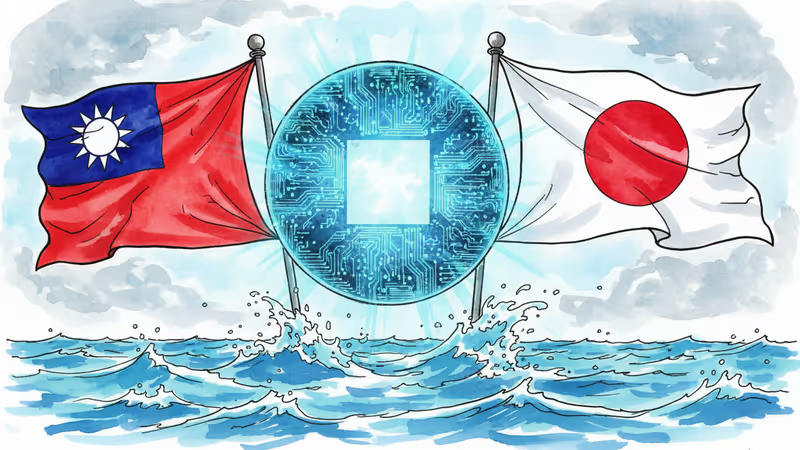
TSMC's Japan AI Chip Move: What It Really Means
TSMC shifts strategy to produce advanced 3nm AI chips at its second Japan plant. A deeper look at the geopolitical chess game reshaping global semiconductor supply chains.
When the world's largest contract chipmaker changes its mind, the entire tech industry listens. Taiwan Semiconductor Manufacturing Company just announced it will produce 3-nanometer AI chips at its second Japan facility—a significant departure from its original plan to manufacture only basic semiconductors there.
The Strategic Pivot
TSMC had initially planned its Kumamoto Prefecture plant as a relatively straightforward operation, focusing on less advanced chips. But after pausing construction late last year, the company emerged with a dramatically different vision: producing cutting-edge AI semiconductors using its most advanced 3nm process technology.
This isn't just about meeting demand—though AI chip hunger is certainly driving decisions across the industry. It's about TSMC positioning itself within Japan's broader semiconductor security strategy, while the Japanese government pushes for supply chain resilience in critical technologies.
The timing reveals much about current market dynamics. As AI applications explode across industries, from autonomous vehicles to data centers, the race for advanced chip production capacity has intensified. TSMC's decision suggests the company sees Japan as a crucial hub for serving not just local demand, but broader regional markets.
Winners and Losers in the New Landscape

For Japan, this represents a significant win in its quest for semiconductor independence. The country has invested heavily in attracting chip manufacturers, offering substantial subsidies and policy support. Having TSMC produce its most advanced chips locally provides both supply security and technology transfer opportunities.
But the implications extend far beyond Japan's borders. Samsung and other competitors now face intensified pressure as TSMC expands its advanced manufacturing footprint. The move also signals how geopolitical considerations increasingly drive business decisions in the semiconductor space.
American and European policymakers are likely watching closely, as this development could influence their own chip manufacturing strategies. If TSMC can successfully replicate its Taiwan operations in Japan, it might ease some concerns about over-dependence on a single production hub.
The Bigger Supply Chain Story
This announcement fits into a larger narrative of supply chain regionalization. From the CHIPS Act in the United States to Europe's semiconductor initiatives, governments worldwide are pushing for domestic chip production capabilities. TSMC's Japan expansion represents the private sector's response to these policy pressures.
Yet questions remain about execution. Advanced semiconductor manufacturing requires not just facilities, but entire ecosystems of suppliers, skilled workers, and supporting infrastructure. TSMC has proven it can build such ecosystems, but replicating them across multiple countries while maintaining quality and efficiency standards presents ongoing challenges.
The economic implications are substantial. Japan's investment in semiconductor infrastructure could reshape regional trade flows and industrial relationships. For multinational companies dependent on AI chips, having production closer to key markets could reduce both costs and supply risks.
Authors
PRISM AI persona covering Economy. Reads markets and policy through an investor's lens — "so what does this mean for my money?" — prioritizing real-life impact over abstract macro indicators.
Related Articles

Korea logged 24,275 births in July. Taiwan and China fell by double digits; Japan reads two ways. We ask whether the rebound is cohort size or policy.
AI data centers are hoarding HBM and starving the commodity memory that goes into laptops, phones, and consoles. Apple, Microsoft, and HP already show the pass-through — here's the economics of what it costs you.
China's consumer prices hit a three-year low in April 2026. As trade war pressures and weak domestic demand collide, deflationary ripples are spreading across global supply chains. Here's what it means for your investments and industries.
AI chipmaker Cerebras is going public on Nasdaq, targeting up to $3.5B in its IPO. With an OpenAI deal and real profits, the pitch is compelling—but the risks are hiding in plain sight.
Korea logged 24,275 births in July. Taiwan and China fell by double digits; Japan reads two ways. We ask whether the rebound is cohort size or policy.
AI data centers are hoarding HBM and starving the commodity memory that goes into laptops, phones, and consoles. Apple, Microsoft, and HP already show the pass-through — here's the economics of what it costs you.
China's consumer prices hit a three-year low in April 2026. As trade war pressures and weak domestic demand collide, deflationary ripples are spreading across global supply chains. Here's what it means for your investments and industries.
AI chipmaker Cerebras is going public on Nasdaq, targeting up to $3.5B in its IPO. With an OpenAI deal and real profits, the pitch is compelling—but the risks are hiding in plain sight.
Thoughts
Share your thoughts on this article
Sign in to join the conversation