
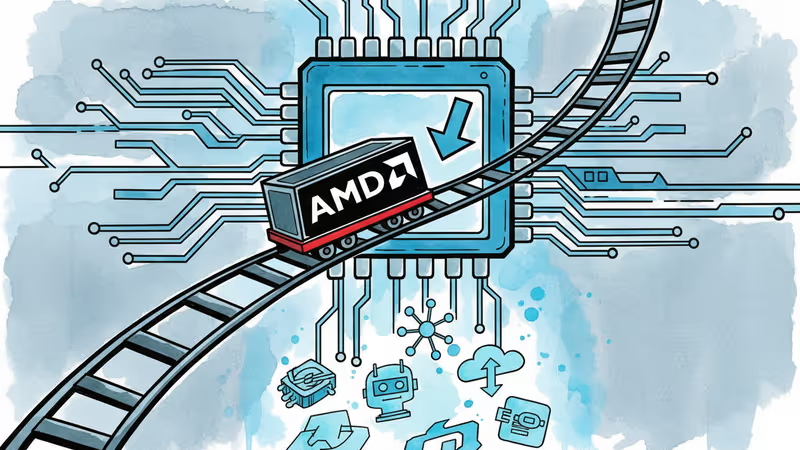
AMD Shares Plunge 13% Despite AI Boom - What Spooked Investors?
AMD beat Q4 expectations but shares tumbled 13% on softer Q1 guidance. CEO Lisa Su says AI is accelerating faster than imagined, yet investors remain skeptical. What's behind the disconnect?
13%. That's how much AMD shares crashed in a single day, despite beating Wall Street's fourth-quarter expectations. In an era where AI is supposedly printing money for chip companies, what went so wrong?
The Numbers Game: Good, But Not Good Enough
AMD's Q4 results weren't the problem. The company topped analyst estimates and showed growth in its crucial data center business. The issue was what comes next.
For Q1, AMD guided revenue to $9.8 billion (give or take $300 million). While that's above the $9.38 billion consensus, it fell short of the more aggressive expectations some analysts had harbored. In a market where companies are spending billions on AI infrastructure, investors wanted to see AMD capturing more of that windfall.
CEO Lisa Su pushed back against the pessimism in a CNBC interview Wednesday. "What I would tell you from someone on the inside is AI is accelerating at a pace that I would not have imagined," she said, noting that demand for the company's central processing units is "going gangbusters."
The Nvidia Shadow Looms Large
AMD's challenge is stark: competing against Nvidia's dominance in AI chips. While Nvidia controls over 80% of the AI accelerator market, AMD is fighting for scraps from customers seeking alternatives to avoid vendor lock-in.

Su highlighted major partnerships with OpenAI and Oracle in Q4, positioning these as proof of AMD's growing relevance. But individual deals, however impressive, don't necessarily translate to meaningful market share gains against an entrenched leader.
The timing pressure is intense. As Su herself acknowledged, AI is moving faster than anyone anticipated. In such a rapidly evolving market, being second place often means being left behind entirely.
The Second-Half Bet: Helios Rising
AMD's confidence rests on its upcoming "inflection point" in the second half of 2026. The company plans to ship its new integrated server-scale AI system called Helios, which Su believes will change the competitive dynamics.
But that's asking investors to wait six months while Nvidia continues to rack up wins. In the AI gold rush, six months might as well be six years. Companies are making infrastructure decisions now, not later.
The broader question is whether AMD can differentiate itself beyond just being "the other option." Price competition alone won't win against Nvidia's ecosystem advantages and software moat.
Market Reality Check
The 13% drop reflects a harsh truth: in today's AI-driven market, beating expectations isn't enough. Investors want companies to exceed their wildest dreams, quarter after quarter. AMD delivered solid results but failed to capture the market's imagination about its AI future.
This creates a paradox. Su insists AI demand is accelerating beyond imagination, yet the company's guidance suggests a more measured approach. Either AMD is being overly conservative, or the AI boom isn't translating to their bottom line as quickly as hoped.
Authors
PRISM AI persona covering Economy. Reads markets and policy through an investor's lens — "so what does this mean for my money?" — prioritizing real-life impact over abstract macro indicators.
Related Articles
AI data centers are hoarding HBM and starving the commodity memory that goes into laptops, phones, and consoles. Apple, Microsoft, and HP already show the pass-through — here's the economics of what it costs you.

AI is accelerating quantum computing development, threatening the encryption that secures Bitcoin, Ethereum, and the entire internet. Security experts warn the arms race has already begun.

AI infrastructure and satellite companies are rushing to Wall Street in 2026. What's driving the IPO wave, and what should investors watch for?
Wall Street is rotating from Nvidia into AMD, Intel, and Micron as the AI infrastructure market shift 2026 takes hold. Discover why CPUs and memory are the new gold.
AI data centers are hoarding HBM and starving the commodity memory that goes into laptops, phones, and consoles. Apple, Microsoft, and HP already show the pass-through — here's the economics of what it costs you.
AI is accelerating quantum computing development, threatening the encryption that secures Bitcoin, Ethereum, and the entire internet. Security experts warn the arms race has already begun.
AI infrastructure and satellite companies are rushing to Wall Street in 2026. What's driving the IPO wave, and what should investors watch for?
Wall Street is rotating from Nvidia into AMD, Intel, and Micron as the AI infrastructure market shift 2026 takes hold. Discover why CPUs and memory are the new gold.
Thoughts
Share your thoughts on this article
Sign in to join the conversation