
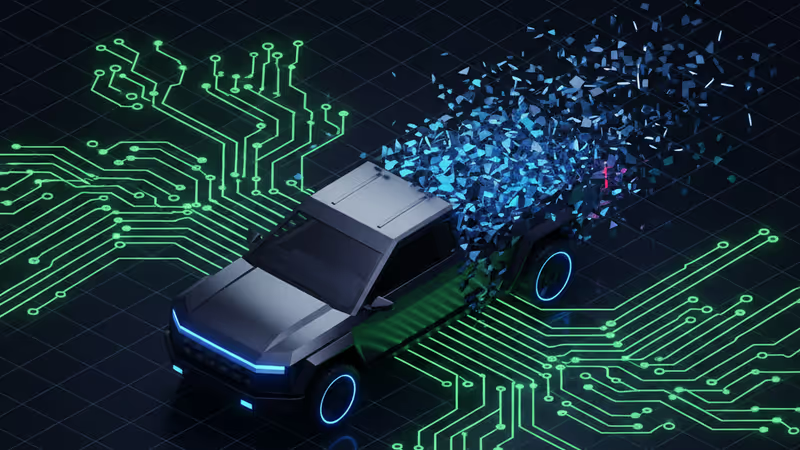
Ford Kills Its All-Electric Truck Dream—And Unlocks a Smarter Strategy
Ford is pivoting from all-in on EVs to a hybrid-focused future. Our analysis reveals why this retreat is a brilliant strategic move for investors and the industry.
The Big Picture
Ford just slammed the brakes on its all-in electric vehicle strategy, shelving plans for a large all-electric truck and repurposing an EV plant for gas-powered cars. On the surface, it’s a stunning retreat. In reality, it’s one of the most significant and pragmatic strategic pivots in the auto industry in a decade. Ford is publicly admitting the EV hype outpaced market reality, and in doing so, is de-risking its business, fortifying its most profitable segments, and accidentally creating a powerful new B2B energy company.
Why It Matters
This isn't just a product delay; it's a strategic earthquake that sends tremors across the entire automotive and energy landscape. For years, legacy automakers have been in an arms race to out-Tesla Tesla, promising an all-electric future. Ford’s move gives competitors like GM and Stellantis official cover to slow their own cash-burning EV rollouts. More importantly, it validates Toyota's long-held, and often criticized, belief in a hybrid-first transition. The second-order effect most are missing? By pivoting its excess battery capacity into a new stationary energy storage business, Ford is decoupling part of its future from the volatile consumer auto market and plugging directly into the booming infrastructure demands of AI and the energy grid.
The Analysis: Deconstructing the Pivot
The Hybrid's Revenge: A Solution for the Real World
Ford’s decision to make its next-generation F-150 an extended-range electric vehicle (EREV)—a plug-in hybrid using a gas engine as a generator—is a direct response to the core weakness of BEVs in the American heartland: towing. A pure-electric truck's range can be cut in half when pulling a heavy load, turning a simple trip into a logistical nightmare of frequent, slow charging stops. The EREV F-150, with a claimed 700-mile range, solves this problem overnight.

This isn't a new idea. GM’s Chevrolet Volt was a technologically brilliant EREV a decade ago but failed commercially. The difference now is context. The Volt was a small sedan marketed to early adopters. Ford is applying superior, modern battery tech to its most profitable product line—full-size trucks—to solve a problem its core customers actually have. It's a pragmatic move that protects Ford's dominance in the truck market while still pushing electrification forward in a way that makes sense for users, not just regulators.
An Accidental Energy Giant
The most underrated part of this announcement is the creation of a new business line for battery energy storage. With its EV plans scaled back, Ford is left with massive investments in battery manufacturing capacity. Instead of writing it off as a loss, it's pivoting to sell these batteries to utilities and data centers. This is a brilliant strategic maneuver born from a forecasting error.
Consider the tailwinds:
- AI & Data Centers: The explosion in AI is causing a commensurate explosion in energy demand from data centers, straining local power grids. These facilities require stable, uninterrupted power that large-scale batteries can provide.
- Grid Modernization: As renewable energy sources like solar and wind become more prevalent, the grid becomes less stable. Utility-scale batteries are essential for storing excess energy and discharging it during peak demand.
Ford is stumbling into a massive B2B infrastructure market that is less cyclical and brand-sensitive than consumer auto sales. This new division could, over time, become a critical and highly profitable part of Ford's business, offering a hedge against the brutal competition of the car market.
The Global Chessboard: Fighting a New War
While Ford adjusts its US strategy to match consumer pace, its European moves reveal a different battle. The partnership with Renault to co-develop small, affordable EVs is a direct defensive measure against the onslaught of low-cost, high-tech Chinese brands like BYD. This is an admission that Western automakers, with their high legacy costs, cannot compete with Chinese EV manufacturers on a dollar-for-dollar basis. Alliances and platform sharing are becoming tools for survival. This, combined with the California-based "skunkworks" team tasked with designing a truly low-cost EV platform, shows Ford is fighting a two-front war: a pragmatic, hybrid-focused one at home, and a desperate, cost-focused one abroad.
PRISM's Take
Ford’s strategic shift is not a failure; it’s a necessary and sober correction. The EV transition was never going to be a straight line, and Ford's leadership is demonstrating the courage to adapt to market signals rather than blindly follow a narrative. By embracing hybrids as a long-term solution for its most important customers and cleverly repurposing its battery investments, Ford is building a more resilient and diversified business. The all-electric future may still arrive, but Ford has decided to build a durable and profitable bridge to get there—and it may find the bridge itself is the more valuable asset.
Authors
Related Articles

Ford's new generative AI tool for commercial fleets turns vehicle data into plain-English recommendations. It's convenient—but who's really in control?
Despite EV success, electric sports cars struggle with consumer rejection, technical hurdles, and emotional disconnect from traditional performance enthusiasts

Exploring the used EV market at $15,000 budget point. BMW i3 and Chevrolet Bolt options compared with lower mileage, newer features, and better value propositions.
Ford set a record with 152 recalls last year. The latest 4.4 million vehicle recall exposes deeper issues plaguing the modern automotive industry.
Ford's new generative AI tool for commercial fleets turns vehicle data into plain-English recommendations. It's convenient—but who's really in control?
Despite EV success, electric sports cars struggle with consumer rejection, technical hurdles, and emotional disconnect from traditional performance enthusiasts
Exploring the used EV market at $15,000 budget point. BMW i3 and Chevrolet Bolt options compared with lower mileage, newer features, and better value propositions.
Ford set a record with 152 recalls last year. The latest 4.4 million vehicle recall exposes deeper issues plaguing the modern automotive industry.
Thoughts
Share your thoughts on this article
Sign in to join the conversation